
What Is Neutron Activation Analysis (NAA) ?
Neutron Activation is a method for quantifying the concentration of elements in materials. Samples are irradiated with neutrons, which causes elements to form unstable radioactive isotopes. As the elements decay, they release gamma rays that are measured to identify the material’s composition. This method is helpful in detecting small amounts of material, especially in fields such as semiconductors, nanotechnology, and advanced coatings, where precision is important. At Covalent, we focus on delivering accurate results while keeping the sample prep as simple and straightforward as possible.
Matrix-Independent Accuracy
Multi-Element Analysis
Ultra-Trace Detection
Why Use NAA?
Neutron Activation is ideal when ultra-trace, multi-element quantification is needed, especially for samples that are difficult to digest or analyze by other methods. Its minimal sample preparation, matrix-independent accuracy, and high sensitivity make it well-suited for semiconductors, advanced materials, geological studies, and any application requiring precise, reliable elemental analysis.
Neutron Activation is especially useful for samples—solid or liquid—that cannot be digested for ICP analysis, contain halides, or include elements like H, N, or O that are difficult to measure by standard methods. It also offers a more sensitive or cost-effective option when only a few elements need quantification, or when elements cannot be measured by ICP, such as noble or atmospheric gases.
High Sensitivity
Minimal Sample Prep
Versatile Applications
How NAA Works
Instrumental Neutron Activation Analysis (INAA) works by irradiating samples with neutrons in a nuclear reactor or with a neutron generator. Irradiation which causes certain stable nuclei to capture neutrons and become radioactive isotopes. As these unstable isotopes decay, they emit characteristic gamma rays that are measured to identify and quantify the elements present in the sample.
Equipment Used for NAA
Nuclear reactor or neutron generator and gamma ray detectors. High-speed pneumatic rabbit sample transfer is available for very short half-life nuclides, ex: 20F. Prompt gamma neutron activation for H, B, Gd and other elements. Fast neutron activation for N & O.
Key Differentiators
Neutron activation analysis requires minimal or no sample preparation and has limited sensitivity to the chemistry of the sample matrix, enabling robust quantification to trace levels in a wide variety of samples.
Strengths
- Neutron activation can give higher precision (more repeatable measurements) than most other methods.
- Isotope dilution and possible qNMR are better/comparable.
- Unlike SIMS and LA-ICP-MS, matched calibration standards are typically not needed.
- Liquids or solids can be easily measured.
Limitations
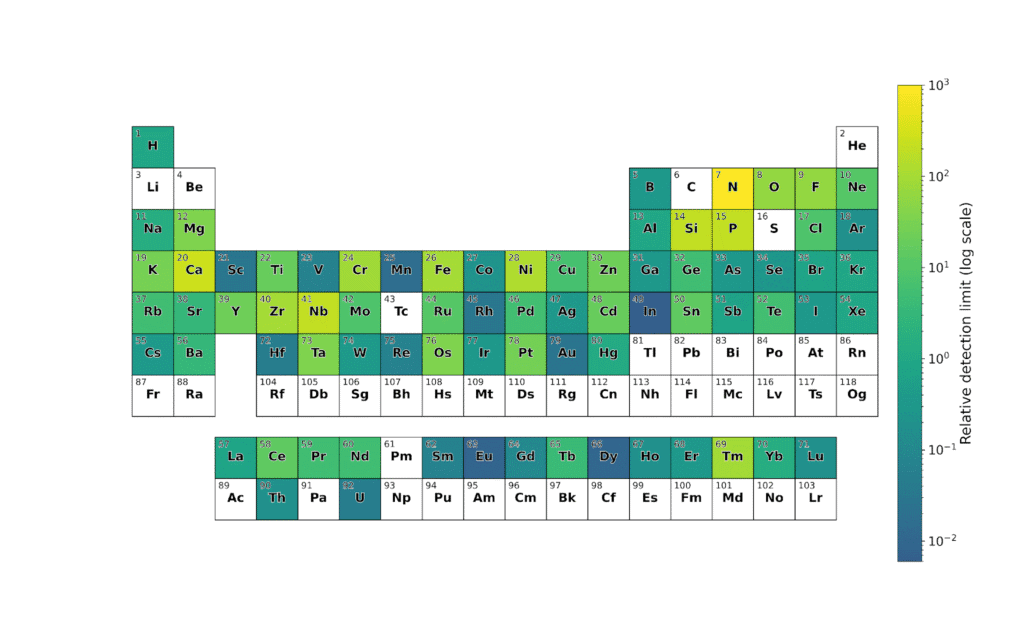
- High boron content can cause self-shielding; He, Li, Be, C, S, Pb not measurable.
- Samples may become radioactive and cannot always be returned.
- Short-lived isotopes (e.g., 20F) limit sensitivity; long-lived matrix elements may require extended decay times.
- Certain matrices (Na, Al, Mn) reduce accuracy; Si, C, Ca, N, H, O are preferred.
- Gas samples are difficult to measure; argon detection is challenging.
- Requires careful consideration of interferences and isotope half-lives.
Example Outputs
- Elemental composition reports showing relative concentrations of multiple elements in a single run.
- Gamma-ray spectra with characteristic peaks identifying specific elements in the sample.
- Detection limit tables indicating sensitivity from <1 ppb to percent-level concentrations.
- Isotope-specific data highlighting ultra-trace elements in complex matrices.
Sample Requirements
Little to no sample preparation is required, for larger solid samples they can be broken down to smaller pieces to fit in the sample container. Solids, powders and liquids can be analyzed. Please reach out to discuss if you need to analyze gas samples.
Nanoindentation Applications by Industry
Environmental Monitoring
Quantifying trace metals and pollutants in soil, water, and air particulates.
Semiconductor Manufacturing
Measuring ultra-trace metal contaminants in silicon wafers and process chemicals.
Geological Exploration
Determining elemental composition of rocks and minerals for mining and resource assessment.
Metallurgy & Materials Science
Determining trace elements in alloys and ceramic materials for development and quality control.
Pharmaceutical Production
Verifying elemental purity and detecting contaminants in raw materials and formulations.