
What Is Quality Control Testing?
Quality control (QC) testing measures a product or material against a defined specification to confirm it is fit for use. Where quality assurance (QA) sets up the processes that should produce a good product, QC checks the actual output: a lot of raw material, a batch of coated parts, or a finished component.
QC testing matters most once a product moves from development into production. Scaling up, adding suppliers, changing equipment or substituting a material can all shift a property that used to be stable. Regular testing catches those shifts before they turn into scrap, returns or field failures.

How Quality Control Testing Works
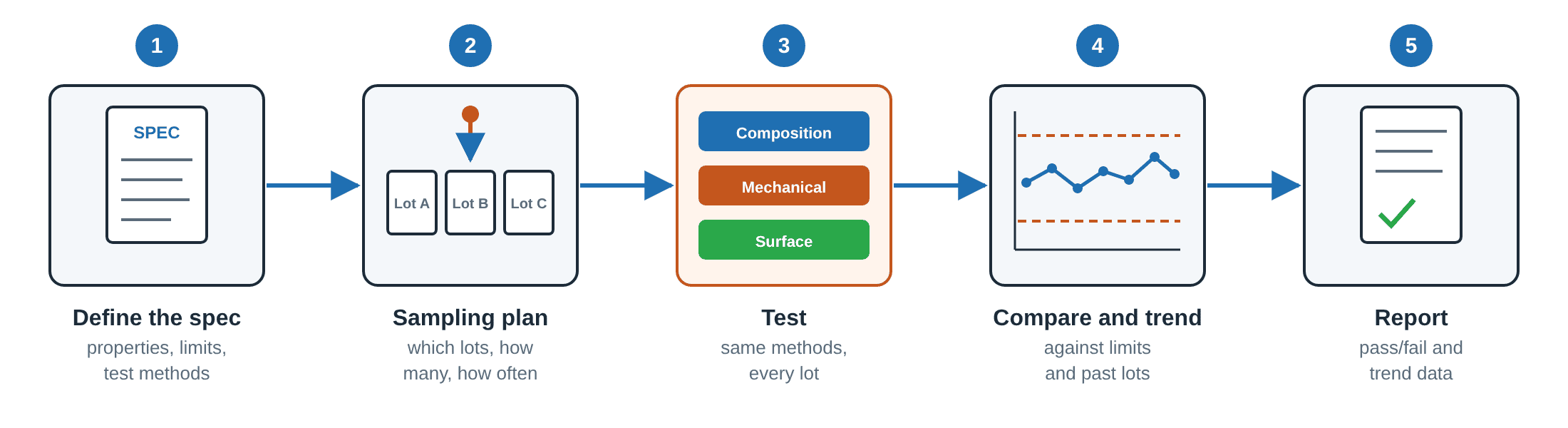
A QC program starts with the specification (1): the properties that matter, their limits, and the test method for each. We then agree on a sampling plan (2) that sets which lots are tested, how many samples come from each, and how often.
Each sample is tested with the same methods and settings every time (3), so results stay comparable. We compare every result with your limits and with previous lots (4), which shows drift before a lot fails outright. You receive a report (5) with pass/fail results and, for recurring programs, trend data across lots.
Why Quality Control Testing Is Important
QC testing is the last check before a product reaches your customer, and often the first sign that a process or supplier has changed. A good QC program:
- Catches composition and formulation changes early, before they reach production
- Reduces downtime, scrap and rework
- Keeps properties consistent across batches and suppliers, and gives you data to qualify new suppliers
- Shows compliance with customer, industry and regulatory requirements
- Builds a documented record for audits and certifications
When Do You Need Quality Control Testing?
QC testing usually runs at three points in production:
- Incoming inspection: verify raw materials and purchased parts before they enter production.
- In-process monitoring: check critical steps so drift is caught while it can still be corrected.
- Lot release: confirm finished parts or materials meet specification before shipping.
It is especially important when you scale from prototype to production, add or change suppliers, renew a certification, upgrade equipment, substitute a material, or investigate a yield or performance problem.
Common Types of Quality Control Testing
| QC test | What it checks | Typical techniques |
|---|---|---|
| Chemical composition | Purity, elemental composition, trace contaminants, polymer identity | ICP-OES, ICP-MS, XRF, FTIR, CHNS/O |
| Mechanical properties | Hardness, tensile strength, modulus, adhesion | Hardness testing, tensile testing, nanoindentation, scratch testing |
| Surface and dimension | Roughness, step height, thickness, flatness | LSCM, white light interferometry, profilometry, ellipsometry |
| Surface chemistry | Cleanliness, residues, coating chemistry | XPS, ToF-SIMS, water contact angle |
| Thermal properties | Melting point, Tg, cure, stability, filler content | DSC, TGA, TMA, DMA |
| Internal structure | Voids, cracks, delamination | Micro-CT, scanning acoustic microscopy, cross-sectioning with SEM |
| Particles and powders | Particle size, density, surface area | Laser diffraction, DLS, gas pycnometry, tap density, BET |
Factors That Set QC Testing Frequency
How often you test depends on:
- Production volume and lot size
- How critical the part is to safety or performance
- How tight the tolerance limits are
- How variable your suppliers have been
- Process stability and equipment calibration
- Customer or OEM quality requirements
- Regulatory and industry standards
- Past defect rates
- New materials or process changes
- The risk if a part fails in use
We can help you set a frequency that catches problems without slowing production, and adjust it as your data builds up.
Industries That Benefit From Quality Control Testing
Semiconductors and electronics
Wafer and film contamination, film thickness, solder joint integrity, Cp/Cpk data for high-volume processes
Medical devices
Surface cleanliness, coating thickness, polymer identity and lot-to-lot consistency
Batteries and energy storage
Electrode and separator composition, particle size, thermal stability by TGA and DSC
Aerospace and defense
Metal composition, hardness, tensile properties, coating verification
Polymers and plastics
Resin identity, molecular weight, filler content, hardness and dimensional checks
Coatings and optics
Thickness, adhesion, roughness and optical properties
Complementary Solutions
- Material Verification: confirm that a material is what the supplier says it is.
- Compositional Analysis: identify and quantify what a material contains.
- Contamination Analysis: find the source of particles, residues and stains.
- Metallurgical Analysis: check heat treatment, grain structure and metal quality.
- Performance Optimization: connect material properties with how a product performs.
Quality Control Testing Services at Covalent
Our Sunnyvale lab runs QC testing for one-time lot checks and for recurring programs. We document the method for each test so it is run the same way every time, and we flag results that are trending toward a limit, not only results that fail. When a lot fails, the same team can move straight to root cause using the full range of techniques in our lab. For methods we don’t run in-house, we can place work through Covalent Connect, our network of trusted partner labs.
Turnaround is typically 5–7 business days, with rush options available at an extra cost.
Frequently Asked Questions
What is the difference between quality control and quality assurance?
Quality assurance sets up the processes that should produce a good product. Quality control tests the actual product or material to confirm it meets specification.
What information do you need to set up QC testing?
Send the material composition, specification targets, tolerance limits and intended application, along with any standard or customer method you need to follow. The more detail you provide, the better we can match the tests to your requirements.
How much sample material is needed?
It depends on the test, but small samples are usually enough. We confirm the amount when we scope the project.
Can you run recurring QC testing on every lot?
Yes. We can set up a recurring program with fixed methods, a sampling plan and trend reporting across lots.
How long does QC testing take?
Turnaround is typically 5–7 business days, with rush options available at an extra cost.
How are results delivered?
You receive a report with the data, pass/fail results against your limits, and an explanation of any results that fall outside them. Our scientists can walk you through the findings and next steps.