
What Is Rheology?
Rheology or Rheometry is the scientific study of how materials deform and flow under applied forces. It captures the interplay of viscosity (resistance to flow), elasticity (reversible deformation), and viscoelasticity (time-dependent behavior) in materials.
Viscosity, one of the core parameters in rheology, is important for characterizing a material’s resistance to flow, which directly impacts processing methods such as pumping, mixing, spraying, and spreading in applications ranging from pharmaceuticals to coatings and food products. At Covalent, we have an Anton Paar MCR 302 rotational rheometer equipped with a peltier stage.
Advanced Testing Flexibility
Supports rotational, oscillatory, creep, stress relaxation, UV curing, and tribology studies.
Broad Material Compatibility
Handles liquids, gels, pastes, and soft solids with versatile measurement modes.
Precise Environmental Control
Offers -20°C to 200°C testing with evaporation blocker for volatile samples.
Why Use Rheology Testing?
Rheological testing is valued for its versatility and precision in characterizing material behavior. Rheology enables quantitative analysis of flow and deformation under real-world conditions.
Industries Served:
- Pharmaceuticals.
- Food and Beverage.
- Batteries and Energy Storage.
- Plastics and Polymers.
- Adhesives and Sealants.
- Biomedical and Cosmetics.
- Oil and Gas.
- Paints, Coatings, and Inks.
- Environmental Science.
Quantitative Flow and Deformation Analysis
Measures viscosity, elasticity, and viscoelasticity to simulate real-world material behavior.
Cross-Industry Applications
Widely used in pharmaceuticals, food, polymers, batteries, coatings, and biomedical fields.
Supports Product Development and QA
Provides data to optimize processing, stability, and performance of complex materials.
How Rheology Works
In a rheological test, the sample is placed between two geometries (e.g., cone-plate, parallel plate, or cup-and-bob), and a controlled shear stress or strain is applied. The instrument measures the resulting torque, displacement, and normal force to determine properties like viscosity, complex modulus, and damping behavior. This process helps simulate real-world conditions such as spreading, mixing, or flowing through a pipe.
Equipment Used for Rheology

Anton Paar MCR 302
- Features:
- Rotational rheometer with Peltier temperature control.
- Geometries Supported: Cone-plate, parallel plate, cup-and-bob.
- Optional setups: Tribology cell, UV cure.
- Air-bearing-supported EC motor.
- Available with flow, rotational, and oscillatory mode.
- Torque Range (Rotation): 0.5 nNm to 200 mNm.
- Torque Range (Oscillation): 7.5 nNm to 200 mNm.
- Variable Temperature Range: 20°C to 200°C.
Key Differentiators
In a rheometry test, a sample is subject to shearing with preset speed, frequency and temperature conditions –which can be either static or dynamic.
Strengths
- Broad applicability across liquids, gels, and soft solids.
- Precise temperature control from –20°C to 200°C.
Limitations
- Limited automation and throughput.
- High operator dependency for complex samples.
- Requires sufficient sample volume for reliable results.
Example Outputs
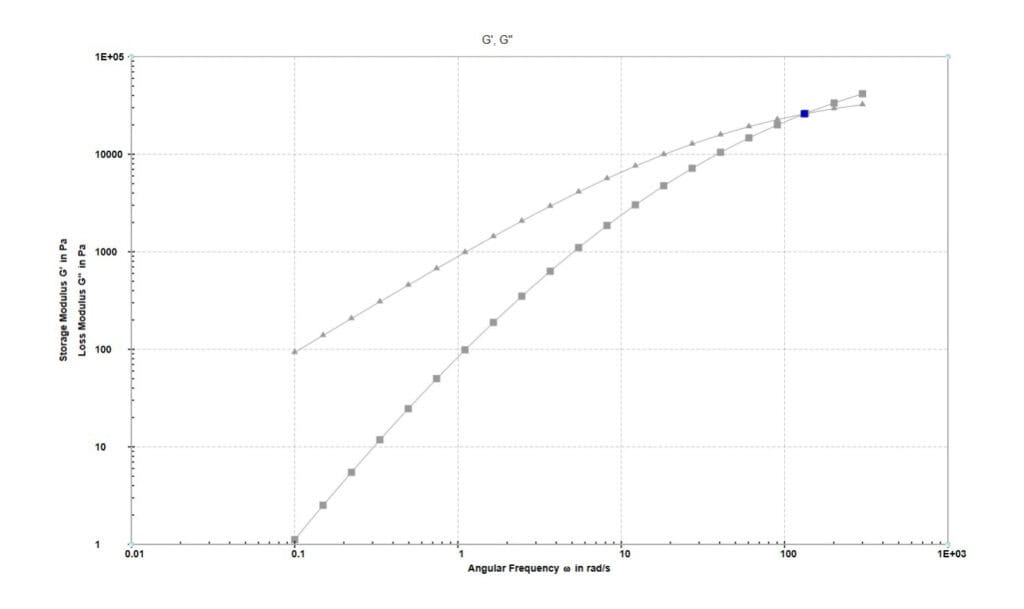
Frequency sweep of silicone oil showing viscoelastic crossover point between storage modulus (G′) and loss modulus (G″).
Sample Requirements
- Liquid/Fluid Samples: Typically, several mL preferred.
- Solid Samples: 25 mm or 50 mm diameter discs.
- Semisolid (gel, paste, ointment) or fluid phase (solution, slurry, liquid).
- Semisolid stiffness upper limit: up to a few decades of kPa.
- Fluid material viscosity lower limit: down to 1 mPa·s (1 cps).
Rheology Applications by Industry
Pharmaceuticals
Viscoelastic property analysis of gels and soft solids.
Food & Beverages
Thixotropy characterization.
Batteries & Energy Storage
DMA testing of polymer films and composites.
Plastics & Polymers
Curing studies of thermosets (e.g., epoxy resins).
Biomedical & Cosmetics
Tribological assessments.
Oil & Gas
Viscosity profiling of oils, greases, and emulsions.
Paints / Coatings / Ink
Determination of gel point.
Environmental Science
Flow curve development for slurries and dispersions.
Techniques That Complement Rheology
Rheology Testing Services at Covalent
Covalent offers rheology testing in-house at our Sunnyvale, CA lab, using an Anton Paar MCR 302 rotational rheometer with Peltier temperature control. Cone-plate, parallel-plate and cup-and-bob geometries let us test everything from thin oils and inks to thick pastes, gels and polymer melts. We run viscosity flow curves, frequency and amplitude sweeps and temperature ramps to measure shear-thinning, yield behavior, storage and loss modulus, and how materials change as they heat, cure or age. These results help you match a formulation to its process, compare lots and suppliers, and troubleshoot problems with dispensing, coating or printing.
Frequently Asked Questions
What types of samples can Covalent test with rheology?
We test liquids, gels, soft solids, and polymers, including pharmaceutical creams, electrode slurries, adhesives, and food emulsions..
Can you perform oscillatory and steady shear tests?
Yes, we can perform both oscillatory and steady shear tests.
What are your temperature capabilities?
We can test from –20°C to 200°C (Peltier).
How fast can I get results?
Turnaround time is typically 5 business days.