
What Is Laser Diffraction Particle Size Analysis (LD-PSA)?
Laser diffraction (LD, also called static light scattering (SLS)) is a technique used to analyze particle sizes. It works by passing laser light through a moving stream of dispersed particles and measuring the resulting diffraction pattern. Since the angle of diffraction is a function of the particle size, samples with populations of different particle sizes create unique combined diffraction patterns that can be analyzed to deduce the particle size distribution (PSD), which is representative of the entire sample.
Wide Dynamic Range
Fast and Repeatable Results
Process Compatibility
Why Use LD-PSA?
Laser diffraction is a versatile, efficient, and widely recognized method for particle size analysis (PSA) by various agencies, including but not limited to ISO, ASTM, and USP. It is applicable to wet or dry samples from various industries, can take measurements in just a few minutes with high repeatability, and has a wide dynamic range of particle sizes that can be measured. Results are easily interpretable and, in most cases, directly related to quality control/quality assurance (QA/QC) or process development targets.
Analytical Depth
Detection Limits
Material Compatibility
How Laser Diffraction-PSA Works
Laser diffraction works by passing laser light through a stream of particles that are dispersed as dry powder / granules or in a known liquid medium. The particles scatter (diffract) the laser light at angles related to their size, and the resulting diffraction pattern is measured by multiple detectors located at fixed angles. Mathematical models, including Fraunhofer or Mie theory if the optical properties of the particles are known, are applied to provide the 1-D particle size distribution of the sample.

Equipment Used for LD-PSA

Anton Paar PSA-1190
- Particle Size Measuring Range: 0.4 µm to 2500 µm.
- Repeatability: <1%.
- Particle Size Accuracy: <3%.
- Dry Jet Dispersion (DJD) technology to prevent agglomerate formation and improve accuracy for dry samples.
Key Differentiators
Laser diffraction provides fast, repeatable results across a wide range of particle sizes. This technique works with wet or dry samples, providing statistically relevant data in minutes.
Strengths
- Laser diffraction has an extensive dynamic range of particle sizes that can be measured.
- Results are fast and highly repeatable.
- Non-destructive way of characterizing and quantifying the phases within a material.
- Statistically relevant results that various standards agencies recognize.
- Samples can be measured wet or dry.
Limitations
- Particles are assumed to be spherical in mathematical data processing.
- Samples must be well-dispersed for analysis, either as non-agglomerating dry powders or in a suitable liquid medium.
- For proper measurements, an obscuration of ~5 to 30% is required; very opaque or completely transparent samples cannot be measured as is.
- Sample preparation methods can often resolve these issues.
- Slightly simplified models must be used if the optical properties of the particles themselves are not well-defined.
- Measurement results are representative of the entire sample but are indirect and cannot provide information on morphology or composition.
Example Output
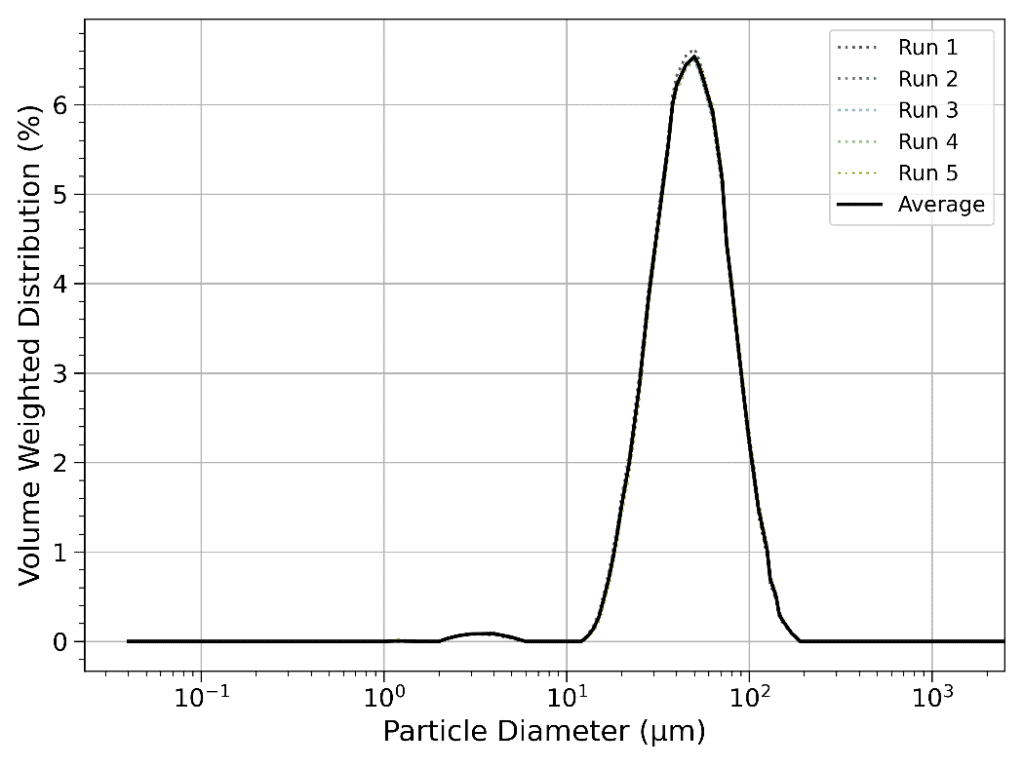
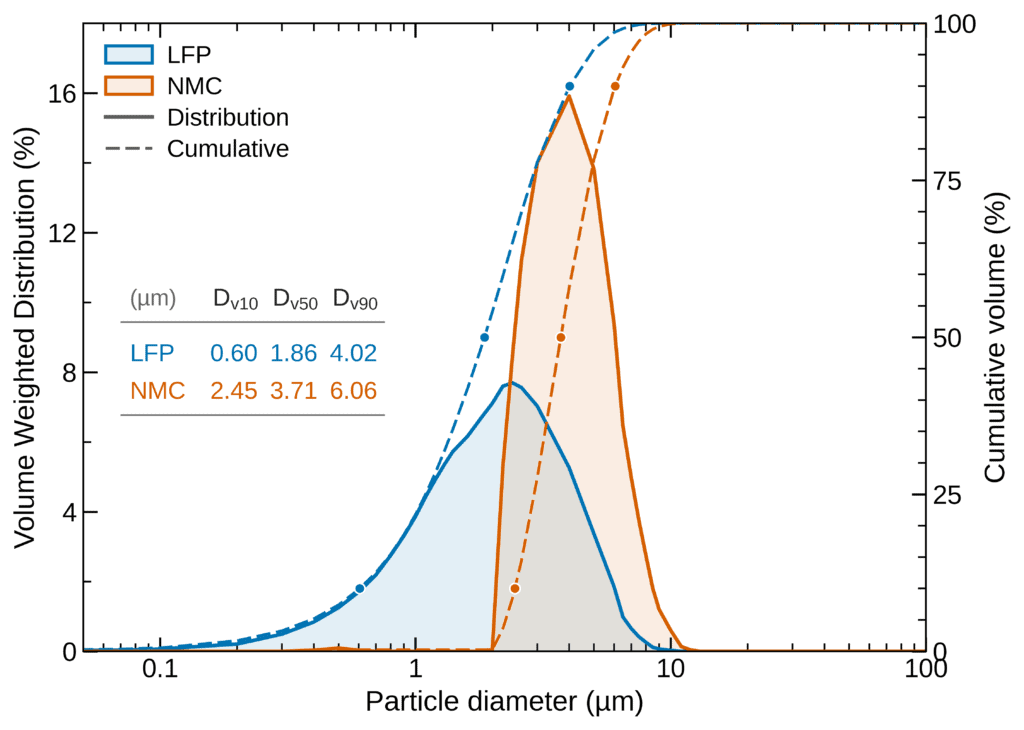
A comparison of the particle size distribution of two commercially sourced common battery cathode materials: Lithium Iron Phosphate (LFP), and Lithium Nickel Manganese Cobalt Oxide (NMC) which have tightly controlled particle size specifications due to the importance of particle size on various aspects of battery performance and longevity.
Sample Requirements
- Laser Diffraction requires samples to be in dispersed particulate form – this can be either as a dry powder, granules, or suspended in solution.
- Maximum Particle Diameter: 2500 µm.
- Minimum Particle Diameter (Dry): 0.1 µm.
- Minimum Particle Diameter (Wet): 0.04 µm.
Many common solvents are compatible with the instrument; optical properties must be known or measured prior to accurate results.
Laser Diffraction Particle Size Analysis Applications by Industry
Pharmaceuticals
Laser diffraction ensures drug particle size meets dissolution and bioavailability requirements. Critical for tablet formulations, inhalation powders, and suspension stability, where particle size directly impacts therapeutic efficacy and regulatory compliance.
Food & Beverage
Optimize texture, mouthfeel, and stability in food products by precisely controlling particle size. Essential for powdered ingredients, emulsions, and beverages where consistent particle distribution affects sensory properties and shelf life.
Cosmetics
Achieve desired coverage, spreadability, feel, and appearance in makeup and skincare products. Particle size analysis ensures optimal pigment distribution, smooth application, and enhanced product performance across foundations, lotions, and color cosmetics.
Battery Materials
Maximize electrode performance and battery life through controlled particle size distributions. Critical for battery manufacturing, where anode and cathode particle sizes affect charge capacity, cycling stability, and safety characteristics.
Mining & Mineralogy
Optimize mineral processing efficiency and product quality by characterizing particle size. Essential for flotation processes, grinding optimization, and ore beneficiation, where size distribution impacts recovery rates and final product specifications.
Soil & Agriculture
Analyze soil texture and fertilizer particle sizes to optimize nutrient delivery and crop yields. Critical for understanding soil composition, drainage properties, and ensuring the effective distribution of agricultural amendments and pesticides.
Chemical Processes
Enhance catalyst activity, improve coating uniformity, and optimize PGM dispersion by precisely controlling particle size. Essential for maximizing reaction efficiency, achieving consistent product quality, and meeting performance specifications across industrial applications.
Techniques That Complement LD-PSA
DLS is a complementary technique to particle size analysis (PSA) and operates on similar principles. While there is some overlap in size range, which is useful for verifying micron-sized particles, DLS is much better suited for measuring sub-micron and even nanometer-sized particle sizes in liquid dispersions.
Surface area, pore size distribution, and metal dispersion measurements are often relevant to materials being measured for particle size as well. Chemisorption measurements can also approximate crystallite sizes of active metals on catalyst support particles.
SEM provides direct high-resolution images of surface morphology, particle shape and size, and agglomeration, all of which can provide insight or validation to laser diffraction PSA results.
XRD can estimate crystal sizes and provide information on particle composition and crystal phase.
Why Choose Covalent for Your LD-PSA Needs?
Covalent offers comprehensive testing services that deliver rapid turnaround times that span the entire spectrum of particle sizes and material types.