
What Is Dynamic Mechanical Analysis (DMA)?
DMA measures the displacement of the material under an applied force (periodic or constant).
Viscoelastic properties such as storage modulus, loss modulus, and tan delta are calculated by measuring the phase lag between the input applied periodic force and the resulting periodic displacement.
Examples of periodic/sinusoidal force include:
- Viscoelastic material properties can be determined by DMA, such as storage and loss modulus, and tan delta.
- Fatigue tests can be performed under continuous cyclic loading.
- Under a controlled temperature range, the glass transition can be determined.
- Oscillatory shear rheology.
- Time-Temperature Superposition (TTS).
Examples of constant/quasi-static force include:
- Compression-set of elastomers under continual force.
- Creep/recovery.
- Stress vs. strain of soft materials to determine Young’s modulus, ultimate tensile strength, etc.
Versatile Testing
High Sensitivity
Thermal Insight
Why Use DMA?
Dynamic Mechanical Analysis (DMA) is used to measure the bulk mechanical properties of viscoelastic solids, providing precise insights into their behavior under stress. It accommodates solid and gel-phase materials and operates over a typical displacement range from microns to millimeters, with forces ranging from 0.005 N to 50 N. This makes DMA an ideal technique for characterizing the viscoelastic performance of polymers, gels, and other soft materials across various testing conditions.
Polymer Analysis
Advanced Testing
Complementary Methods
How Dynamic Mechanical Analysis Works
DMA works by applying an oscillatory force or stress to the sample and measuring the sample displacement or strain. Forces can be applied in tension/torsion, compression, and 3-point bend. The phase angle between the stress and strain oscillatory waves is calculated, which allows extrapolation of the storage and loss modulus.
| Mode | Length (mm) | Width (mm) | Thickness (mm) | Temperature range (°C) | Stiffness range (MPa) |
|---|---|---|---|---|---|
| Tension/Torsion | 5 to 35 | 5 to 15 | 0.01-5 | -100-350 | 0.1-10000 |
| Compression | 1 to 40 | 1 to 40 | 0.5-5 | -100-220 | 0.0001-100 |
| 3-pt Bend | 45 to 50 | 10 to 12 | stiff = 0.2-0.3 soft = 1-2 | -100-350 | 100 to 1000000 |
Force range: 0.005 N to 50 N.
Equipment Used for DMA

Anton Paar MCR 702 Multidrive (linear and rotation)
- Platform: Combined DMA/rheometer supporting tension, bending, compression, torsion, and rheology modes.
- Linear Drive: Force 0.5 mN–40 N; displacement 10 nm–9.4 mm; frequency 0.001–100 Hz.
- Rotational Drive: Torque 0.5 nNm–230 mNm; angular frequency ~10⁻⁷–628 rad/s; normal force 0.005–50 N.
- Temperature Range: −160 °C to +600 °C (linear) / up to +1000 °C (rotational, accessory-dependent).
- Thermal Control: Max heating rate 35 K/min; max cooling rate 30 K/min.
Key Differentiators
Strengths
- Measures bulk viscoelastic properties such as storage and loss modulus.
- More sensitive measurement of glass transition temperature compared to DSC.
Limitations
- Not ideal for quasi-static tensile tests; the Instron with the 50N load cell is preferred.
- Failure to properly grip or mount the sample during long measurement times can be problematic.
- Coefficient of thermal expansion (CTE) is not well-suited for our tool.
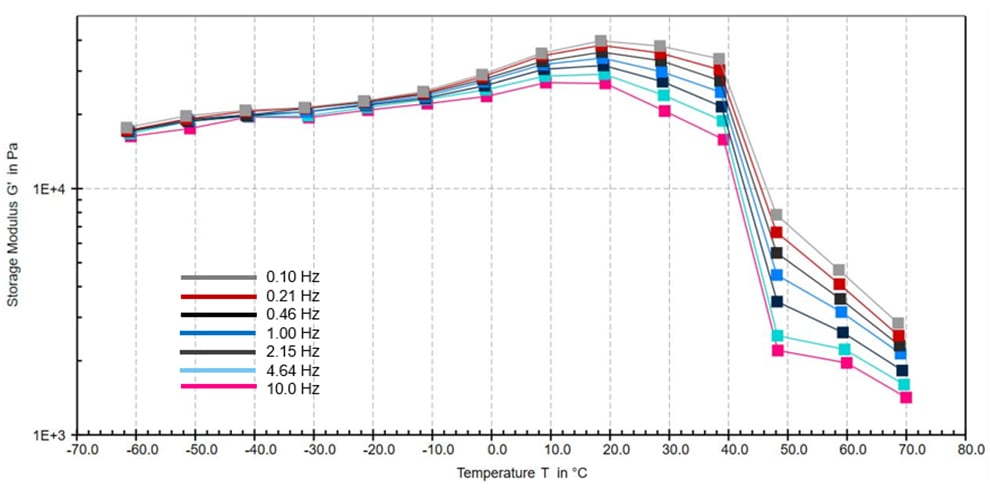
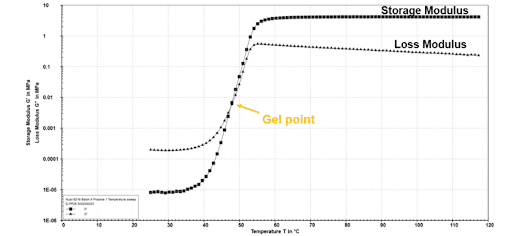
Example Outputs
Sample Requirements
DMA requires a solid form of samples of polymers, gels, and soft metals.
DMA by Industry
Polymers / Plastics / Elastomers
Used to measure glass transition temperature, stiffness, and damping to understand flexibility and performance across temperatures.
Composites & High-Performance Materials
Used to evaluate viscoelastic behavior and service temperature limits for fiber-reinforced and advanced materials.
Adhesives / Coatings / Films
Used to assess cured strength, flexibility, thermal stability, and high‑temperature viscoelastic behavior of adhesives, coatings, thin films, and semiconductor packaging materials (e.g. adhesives, epoxies, thermal interface materials, gels) to characterize flow behavior under load and at operating temperatures above their glass transition temperature (50 °C – 200 °C).
R&D & Quality Control
Used to compare formulations, validate processing, and ensure consistent mechanical and thermal performance.
Biomedical & Soft Materials
Used to characterize the viscoelastic properties and deformation behavior of soft tissues, gels, and biopolymers.
Techniques That Complement DMA
A universal testing machine like Covalent’s Instron can be used for standardized ASTM tensile tests, such as ASTM D638. This is a complementary technique to DMA for measuring Young’s tensile properties of plastics. Instron can achieve much higher forces compared to DMA (as high as 5kN).
Why Choose Covalent for Your DMA Needs?
At Covalent, we provide major advantages to utilizing DMA with our unique partnership agreement with Anton Paar to support customer projects, modules, and more. We can also schedule tests the same-day with advanced notice at the standard price.