
What Is Fourier Transform Infrared Spectroscopy (FTIR)?
Every material tells a story, and in materials science, and Fourier Transform Infrared Spectroscopy (FTIR) is how we read it. FTIR spectroscopy is a precise, non-destructive technique that analyzes how a material interacts with infrared (IR) light to reveal its molecular structure.
All materials are composed of chemical bonds, each with unique vibrational characteristics. When exposed to IR radiation, these bonds absorb specific wavelengths that correspond to their vibrational frequencies. These interactions result in unique FTIR spectra: graphs that act like a fingerprint of the sample, mapping chemical composition, structures, and bonds in detail.
Covalent’s FTIR capability supports both traditional chemical analysis and precision FTIR-optical measurements. For chemistry-focused projects, FTIR identifies molecular bonds, contaminants, polymer composition, oxidation, degradation, and formulation changes. For optics-based applications, Covalent measures how much infrared light passes through a material as a function of wavelength or wavenumber, helping customers evaluate accurate transmission, reflection, absorbance, and overall and IR optical performance.
Non‑Destructive Analysis
Rapid Insights
Broad Material Coverage
Accurate IR optical spectra measurements
Why Use FTIR?
Covalent’s FTIR analysis supports both chemical identification and optical transmission characterization. Our FTIR workflows are used for molecular fingerprinting, contamination analysis, polymer and coating evaluation, and high-accuracy infrared optical transmission measurements.
- Bulk chemical identification.
- Failure analysis in polymers and coatings.
- Surface contamination analysis.
- Oxidation, cross-linking, or degradation studies.
- Incoming material inspection.
- IR transmission/reflection measurement for films, windows, filters, coatings, and optical components.
- Comparing optical performance across lots, process conditions, or environmental exposures.
Analytical Depth
Material Compatibility
How FTIR Works
A typical FTIR analysis begins by directing IR light onto the sample through a device called an interferometer. This device is the core of a Fourier Transform Infrared Spectrometer (also known as a Fourier Transform IR Spectrometer or FTIR Spectrometer), which splits and modulates the light to produce an interferogram.
This signal captures how the sample responds to a broad range of infrared wavelengths and is then mathematically processed (the Fourier Transform) into an FTIR spectrum, more precisely, a set of FTIR spectra that depict absorbance or transmittance at different wavenumbers.
The resulting peaks (typically ranging from 4000 to 400 cm⁻¹) signify the sample’s chemical bonds and molecular structure.
Depending on the sample, different sampling modes are selected:
- Transmission Mode: IR light passes through the sample to the detector.
- Reflectance Mode: Light bounces off a reflective surface and back to the detector.
- ATR-FTIR Spectroscopy: Measures shallow penetration depths into the sample using diamond or germanium ATR crystals.
What FTIR-Optical Measurements Can Tell You
FTIR-optical measurements help determine whether a material performs as intended in an infrared optical system. Instead of focusing only on material peak identification, Covalent can quantify how a sample changes the transmitted IR intensity across the measured spectral range.
Typical outputs include:
- Transmission Intensity spectrum: How much IR light passes through the sample at each wavelength or wavenumber.
- Absorbance spectrum: Where the material absorbs IR light and how strongly.
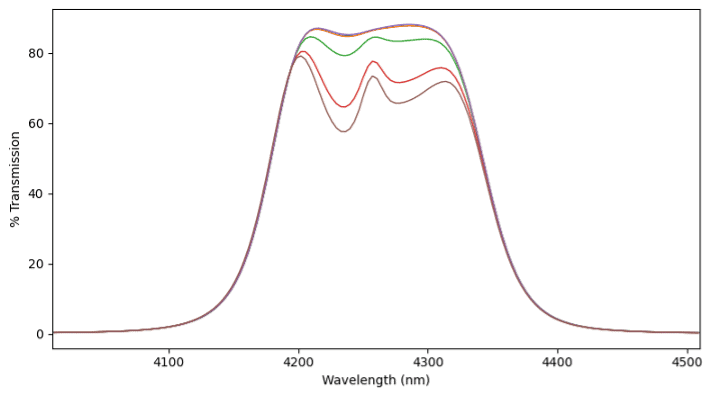
- Bandpass/blocking behavior: Whether a filter or coating transmits and blocks in the intended regions.
- Material comparison: Whether different lots, vendors, cure recipes, coating thicknesses, or processing conditions change IR optical performance.
- Accurate Optical Property Determination: Transmission intensity spectra obtained form FTIR optical measurements can be integrated with infrared spectroscopic ellipsometry (SE) measurements to perform optical modeling to determine accurate refractive index and absorption coefficient in IR range.
Equipment Used for FTIR
The Fourier Transform Infrared Spectroscopy lab at Covalent is equipped with industry-grade systems, carefully deployed to deliver high-resolution insights across a dynamic spectral range, at both macro and micro scales. For intensity-sensitive measurements, Covalent uses a modified optical configuration.

ThermoFisher Scientific Nicolet iS50 FT-IR Spectrometer
- Spectral range: 7800 to 350 cm⁻¹ with resolution < 0.09 cm⁻¹.
- Resolution: < 0.09 cm⁻¹.
- Wavenumber accuracy: < 0.005 cm⁻¹.
- Multi-detector configuration to support advanced analytical modes.
Integrated Accessories:
- Diamond ATR (standard and high-pressure) for hard samples, Ge ATR for carbon-filled or opaque materials.
- Variable angle ATR and transmission model for precision thin film analysis.
- Reflectance mode for metallic surface coatings and contaminants on reflective surfaces.
- Suppression of unwanted IR radiation from internal and temperature-controlled DLaTGS detectors for improved detector stability.

ThermoFisher Scientific Nicolet Continuum IR Microscope
- 15x and 32x objectives.
- Detector options: Narrow-band MCT-A High performance (4000 to 750 cm⁻¹) and Narrow-band MCT-A (50um element, 4000 to 700 cm⁻¹).
- Sampling modes: Transmission, reflection, Ge ATR, and diamond cell transmission.
- ATR objectives: Dedicated with interchangeable Diamond, Ge, ZnSe, and Si crystals; integrated pressure sensor for robust sampling.
- Grazing angle objective: NA 0.99 for sensitive thin-film and surface analysis.
- Detector configuration: Dual detector bay supporting MCT-A, MCT-B, and InGaAs detectors for broad spectral coverage.
Key Differentiators
Our advanced FTIR systems combine analytical depth, broad material compatibility, and versatile sampling modes. Whether analyzing polymers, coatings, or trace contaminants, these capabilities ensure rapid, high-resolution insights tailored to solve real-world materials challenges with confidence.
- Analytical Depth: Transmission and reflection depth of analysis is the total thickness. Diamond ATR is ~2 µm depth, and Germanium ATR is ~0.66 µm to nm level depths, ideal for FTIR ATR spectroscopy.
- Material Compatibility: Suited for organic compounds, films, surface residues, coatings, and polymers analyzed using a Fourier Transform Infrared Spectrometer.
- Sampling Modes: ATR (ATR FTIR spectroscopy), specular reflectance, absorbance reflectance, and transmission.
- Spectral Range: Ranging from 4000 to 450 cm⁻¹ (Mid‑IR) and 7000 to 4000 cm⁻¹ (Near‑IR).
- Resolution: <0.09 cm⁻¹ with wavenumber accuracy better than 0.005 cm⁻¹.
- Wavenumber Accuracy: ±0.005 cm⁻¹.
- Microscopy Support: Spot identification and spatial mapping with 15× and 35× magnification.
- Modified optical configuration: Aperture controls help suppress unwanted internal IR contributions that can limit intensity accuracy.
- Temperature-controlled DLaTGS detection: Detector stabilization supports more repeatable IR intensity measurements.
- Enhanced accuracy in optical properties determination: When integrated with SE and optical modeling, accurate optical properties are determined.
What Is the Difference Between IR and FTIR?
Infrared spectroscopy (IR) refers to a general class of spectroscopy using infrared light. Fourier Transform Infrared Spectroscopy specifically involves an interferometer and a Fourier Transform to produce high‑resolution spectra.
In fact, nearly all modern IR spectrometers are Fourier Transform Infrared Spectrometers.
What Is the Difference Between FTIR and Raman Spectroscopy?
Both FTIR and Raman spectroscopy reveal molecular insights. FTIR spectroscopy is more effective for polar bonds like O‑H, C=O, and N‑H, whereas Raman is ideal for non‑polar bonds like C–C, C=C, and S–S.
Strengths
FTIR is designed for efficient and reliable compound identification, ideal for complex organic materials, polymers, and coatings. It offers:
- Access to rich spectral libraries for confident compound classification.
- Chemical mapping capabilities for analyzing small sample regions.
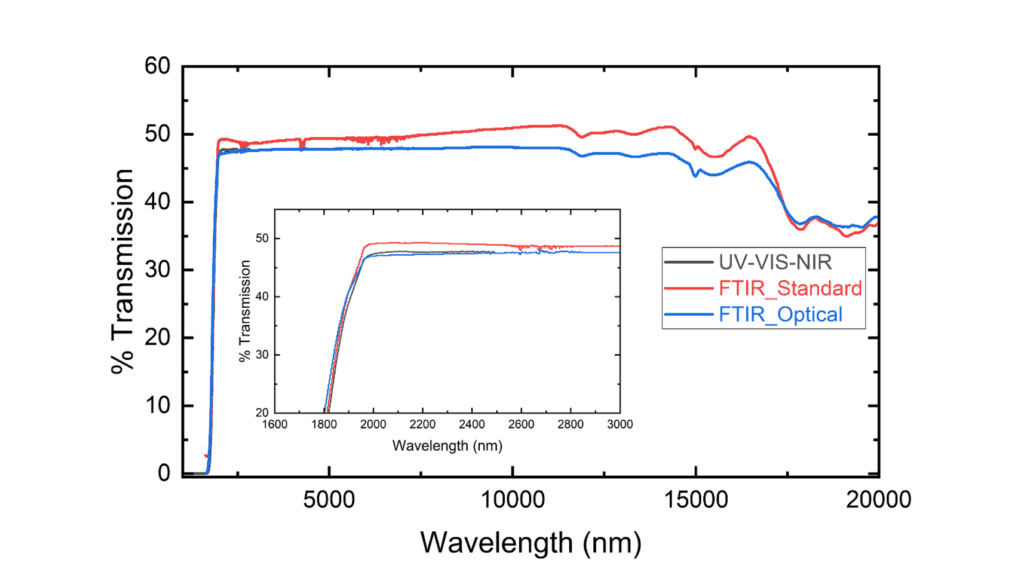
- Modified FTIR-optical configuration enables accurate optical transmission measurements with precision often comparable to spectrophotometer-based measurements.
Limitations
FTIR is versatile and can be applied to any identification, but it is limited to certain diagnostic powers, which depend on contextual interpretation and, mainly, sample selection.
- A reference or standard sample is often required for spectral comparison.
- Many inorganic compounds like carbonates reveal overlapping peaks, resulting in blurry spectral specificity.
- Reflection and transmission modes demand thin samples for the IR light to penetrate or reach a reflective surface.
- Opaque or strongly IR-absorbing materials typically fall outside the usable range for these modes.
- The microscopes at Covalent are limited to a stage height of approximately 20 mm, restricting analysis of some larger samples.
- For rough or hazy samples, integrating sphere measurements are needed because specular FTIR transmission alone cannot fully capture scattered light or total transmitted intensity.
Why Standard FTIR Is Not Always Enough for Optical Intensity Measurements?
FTIR is well suited for identifying chemical peaks and molecular fingerprints, but optical measurements often require greater confidence in the actual IR transmission intensity. For these measurements, factors such as thermal background, stray radiation, aperture effects, and detector drift, and beam-path mismatch can affect accuracy if the measured intensity.
Therefore, Covalent has modified its FTIR configuration to improve intensity-based transmission measurements. The setup uses beam-defining apertures to reduce unwanted IR radiation and a temperature-controlled DLaTGS detector to improve measurement stability that enables repeatable, high-confidence IR transmission data.
Example Outputs
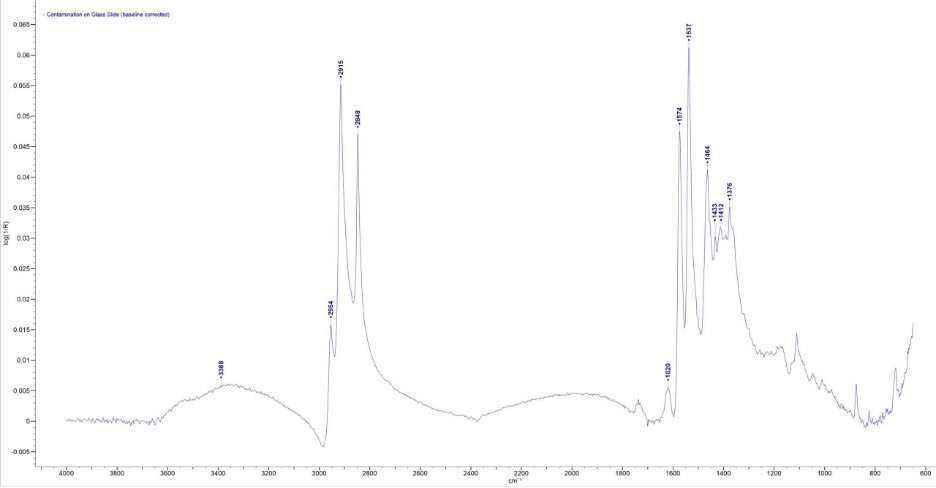
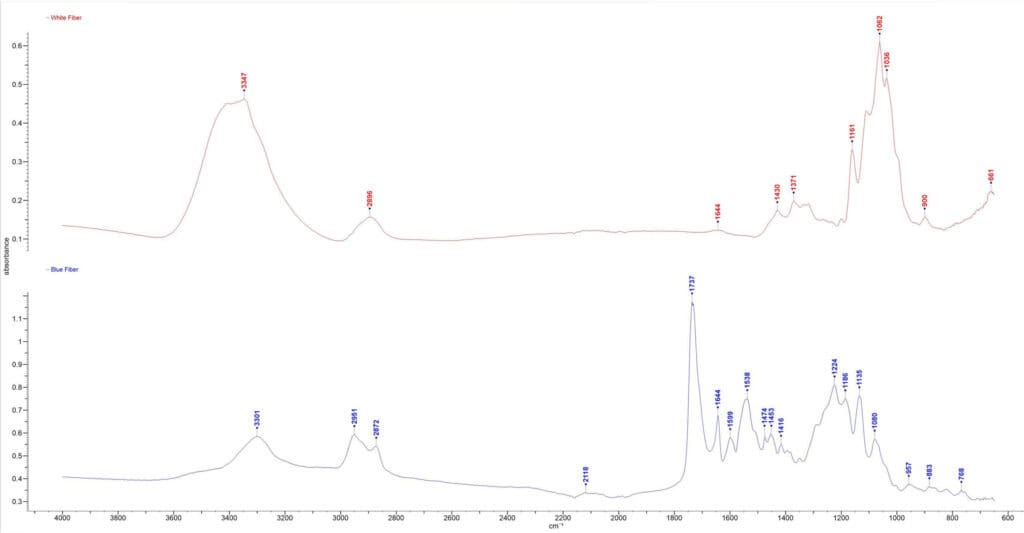
The graph (spectrum) from an IR spectrometer displays transmittance or absorbance intensities across the different inverse wavelengths, which is the key to accurately identifying molecular bonds and chemical structures.
- Covalent’s spectra library enables fast classification and spectra matches.
- Peak positions and intensities reveal qualitative analysis of compound concentration.
- Surface-level insights can be analyzed for coatings, residues, or layered materials using the ATR mode.
Our FTIR reporting helps answer all chemical-level questions, from solving a failure to validating a formulation to tracking material degradation.
Sample Requirements
Each technique, transmission, reflection, or ATR, has its own sample requirements to achieve a clean, accurate spectrum:
- For transmission mode, the optimal film thickness should ideally be under 10 µm.
- Flat surfaces are ideal for obtaining the highest data accuracy and quality in both transmission and reflection modes.
- Covalent’s FTIR system, with a vertical stage clearance of up to 20 mm, accommodates sample sizes between ~150 µm and 10 µm.
- All physical forms, solids and liquids, are accepted, provided they are compatible with infrared exposure.
- For FTIR optical measurements, samples should be large enough to fully cover the measurement aperture (~1 cm diameter). Uniform thickness across the measured area is preferred.
FTIR Applications by Industry
Electronics & Semiconductor
FTIR analysis detects unknown residues on PCBs and other electronic components, helping ensure product reliability. It verifies polymer coatings and encapsulants, and enables comparison of raw materials across production cycles to maintain consistency and quality. FTIR measures how coatings, deposited films, surface treatments, or contamination layers change IR transmission. Compare coated and uncoated references to isolate the optical effect of the layer.
Energy & Batteries
The technique identifies chemical degradation in electrodes caused by electrolyte exposure, helping optimize battery performance. It also detects cross-linking or oxidation in battery polymers and validates material formulations for reliable energy storage components.
Industrial Manufacturing & Materials Science
FTIR reveals thin contamination films on metal tooling, pins, and plates, supporting process quality control. It confirms polymer compositions, evaluates coatings and films, and analyzes surface residues for failure investigations.
Consumer Goods & Polymers
FTIR verifies raw material authenticity using molecular fingerprinting and helps investigate degradation or aging in polymers and coatings. It also detects contaminants in packaging materials, films, or fibers, ensuring product safety and consistency. It also measures how coatings, deposited films, surface treatments, or contamination layers change IR transmission. Compare coated and uncoated references to isolate the optical effect of the layer.
Research & Development
FTIR provides rapid, non-destructive molecular fingerprinting of solids and liquids. It characterizes functional groups and chemical bonds in novel materials, and integrates seamlessly with Raman, SEM-EDS, XPS, and GC-MS for comprehensive material analysis. In addition, FTIR optical helps accurately characterize the optical properties of new materials when integrated with spectroscopic ellipsometry.
Optics and Photonics
FTIR optical evaluates transmission intensity, absorption bands, passband behavior, blocking performance, and cutoff regions in optical windows, lenses, filters, and protective covers. Characterize IR transmission through wafers, substrates, dielectric layers, and device materials and help determine IR optical properties.
Techniques That Complement FTIR
FTIR is an initial screening method that opens the door for advanced structural and trace-level analysis. Usually, it is paired with various complementary techniques that expand analytical reach into inorganic, elemental, and trace-level domains.
Why Choose Covalent for Your FTIR Needs?
Covalent’s Fourier Transform Infrared Spectroscopy (FTIR) lab is well-reputed for speed, precision, and cost-effectiveness. Our lab is equipped with advanced benchtop and microscope-based FTIR systems, designed to handle diverse sample types and deliver high-resolution data with minimal preparation.
We empower our clients with enterprise-grade insight, thanks to our scientists' multidisciplinary expertise in materials science, polymer chemistry, and surface engineering.
Every test is given personalized and undivided attention, from technique selection to spectral interpretation, to ensure high-value outcomes.
Frequently Asked Questions
When is it appropriate to use transmittance vs. absorbance?
What can FTIR analysis be used for?
What is the importance of the wavenumber in FTIR analysis?
What information can be obtained from an FTIR spectrum?
Are there different types of FTIR techniques?
Can FTIR be used for quantitative analysis?
How is FTIR-optical measurement different from standard FTIR chemical analysis?
What are the differences among FTIR, Micro-FTIR, and Nano-FTIR?
FTIR measures bulk samples using transmission, reflection, or ATR. Micro‑FTIR works with a microscope to narrow the area below 150 µm. Nano‑FTIR couples Atomic Force Microscopy (AFM) with FTIR to map chemical features at the nanoscale.