
What Is Tap Density?
For powdered, granulated, or flaked solids, the tap density is the ratio of the mass of a sample to its volume after mechanical tapping over a certain number of cycles. A powder’s tapped density provides a quantitative metric for its compressibility and maximum packing efficiency.
Its mass must first be measured using a high-sensitivity analytical balance to measure tap density on a sample. Once the mass is known, the sample can be loaded into a calibrated graduated cylinder mounted on the analyzer (sometimes called a “tap volumeter”). The initial bulk density is calculated using the reported volume after the powder settles. Then, the cylinder is mechanically tapped several times to redistribute the particulates until no further volume change is detected. To maximize volume accuracy, the cylinder is automatically rotated to promote a flat powder interface. These combined values help calculate the Carr compressibility index and the Hausner ratio to obtain a metric on flowability:
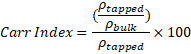
Where  is the Hausner ratio.
Flowability Metrics
Density Measurement
Automated Tapping
Why Use Tap Density?
Tap density analysis is a non-destructive method that precisely measures powder compressibility, packing efficiency, and granular behavior. It offers higher accuracy than bulk density, especially for fine or irregular particles, and delivers reproducible, comparable results. This efficient technique gives valuable insights into powders and particulate solids, with samples limited to solid particulates.
Compressibility Insights
Quality Control Support
Efficient and Non-Destructive
How Tap Density Works
Tap Density Testing measures how powders, granules, or flakes pack under mechanical tapping. The process begins by weighing a known mass of the sample using a precision analytical balance. The powder is then placed in a calibrated graduated cylinder mounted on a tapped density analyzer (or “tap volumeter”). The instrument repeatedly taps and rotates the cylinder to redistribute particles and minimize void spaces. Measurements are taken at intervals until the volume stabilizes, indicating maximum packing efficiency.
These values determine bulk density and tapped density, enabling Hausner ratio calculation and Carr compressibility index estimation—two key metrics used in powder flowability testing.
Equipment Used for Tap Density

Anton Paar Dual AutoTap Tapped Density Analyzer
This is an industry-standard system designed for precise and repeatable tapped density measurement of powders, flakes, and granules.
Instrument Specifications:
- Cylinder Sizes: 10 mL, 25 mL, 50 mL, 100 mL, 250 mL (standard), 500 mL, and 1000 mL.
- Nominal Tapping Rate: 260 taps per minute (supports up to 300 taps per minute).
- Tapping (Drop) Height: 3 mm.
- Maximum Tap Count per Trial: 999,999.
Key Differentiators
Operating ModeDual-station configuration for simultaneous sample analysis.
| Property | Tap Density |
|---|---|
| Cylinder Sizes | 10 mL, 25 mL, 50 mL, 100 mL, 250 mL (standard), 500 mL, 1000 mL |
| Nominal Tapping Rate | 260 taps per minute; (supports up to 300 taps per minute) |
| Tapping (Drop) Height | 3 mm |
| Maximum Tap Count per Trial | Up to 999,999 taps |
| Precision & Reproducibility | Automated mechanical tapping and rotation ensure consistent, repeatable measurements |
| Data Outputs | Bulk density, tapped density, Hausner ratio, Carr compressibility index |
| Sample Compatibility | Suitable for powdered, granulated, or flaked solids (non-liquid and non-gaseous samples) |
| Analysis Insights | Reveals powder compressibility, packing efficiency, and flowability characteristics |
Strengths
- Inexpensive and straightforward, leading to sample turnover efficiency.
- Results are easily reproducible and comparable.
- Provides insight into how powders and particulate solids behave under handling or vibration.
- Indirect insights into flowability through a combination of bulk and tapped densities to derive the Hausner ratio and the Carr compressibility index.
Limitations
- Only suitable for particulate solid materials.
- This technique does not reveal particle size, shape, or textural information.
- This technique provides no direct compositional information.
Example Outputs
| Taps | Volume (cm³) | Density (g/cm³) |
|---|---|---|
| 0 | V₀ = 96 | 1.41 |
| 2000 | Vf = 67.5 | 2.01 |
An example Tap Density measurement output for 136.07 g of commercial cement measured using the Anton Paar Autotap. The calculated Carr compressibility index is 29.7.
Sample Requirements
Samples must be solid particulates – powders, flakes, granules, etc.
Tap Density Applications by Industry
Food & Beverage
Assess powder (e.g., coffee grains) flow and compaction, which relates to processing, packaging, storage/stability, and shipping.
Pharmaceuticals
Evaluating the flowability and compressibility of both active ingredients and excipients aids in the formulation and design of tablet or capsule form factors.
Batteries & Energy
Assess electrode materials’ packing density, directly affecting uniformity, energy density, and loading.
Additive Manufacturing of Metals & Ceramics
Optimization of powder packing for pressing, sintering, and printing, where the precursor physical properties often directly translate to the performance and properties of the end product (i.e., density, strength, durability).
Pigments & Chemicals
Monitoring bulk powders, intermediates, and end products to ensure consistency and reproducibility in blending and dispersion, among other downstream uses.
Techniques That Complement Tap Density
Why Choose Covalent for Your Tap Density Needs?
Covalent provides high-quality results and fast turnaround at affordable and competitive prices with aggressive volume discounts. We can also prepare samples in various ways, including grinding, ball milling, extraction, filtering, and drying. We have a wide array of complementary techniques available to support full project needs rather than just one transactional measurement, which we can do on a routine basis if needed.