
What Is Gas Pycnometry?
Gas Pycnometry (or just pycnometry) is a high-resolution analytical technique used to measure the true volume and density (also called pycnometric or skeletal volume/density) of solids and semisolids, using the principles of gas displacement. These measurements are performed with a gas pycnometer, which can use various inert gases, although helium is the most common; hence, you may also hear of helium pycnometers or helium gas pycnometers.
Quality Control
True Density Measurement
Porosity Insight
Why Use Gas Pycnometry?
Gas pycnometers provide a fast, non-destructive, and repeatable way to deliver high-resolution volume and density measurements for various materials, regardless of shape or form.
A benefit of the gas displacement technique is that it allows for very sensitive measurements, with a density resolution of 0.0001 g/cm³. Identifying the true density of a material provides valuable information on its pores and voids, which is useful when comparing with the bulk densities of porous materials.
As a result, gas pycnometry is a rapid and cost-effective quality control technique across multiple industries.
Versatile Across Materials
Powder and Solid Flexibility
Non-Destructive Testing
How Gas Pycnometry Works
Gas pycnometry works on the principles of Archimedes’ Fluid Displacement and Boyle’s Gas Expansion to analyze the true volume and density of solid and semisolid materials.
The first step measures the sample’s mass using a sensitive analytical balance. The sample of known mass is then placed in a sample chamber of predetermined volume, which is then sealed and pressurized typically to a target 18 psi, using inert gas such as Helium or Nitrogen. Once the gas fills the space around the sample, including any accessible pores, the pressure stabilizes. A valve connecting the sample chamber to a calibrated internal reference chamber is then opened, allowing gas to flow between the sample and reference chambers, resulting in a pressure differential proportional to the sample volume.
For some samples, such as fine powders, this process is reversed to prevent the displacement of fine particles.
The pressure readings before and after this equilibration process are then used in the following equation to determine the true volume of the sample:
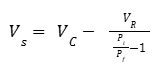
In the above equation, VS is the true volume of the sample, VC is the volume of the sample chamber, VR is the volume of the reference chamber, and Pi and Pf are the initial and final pressures, respectively.
The integrated software then calculates the true density from simply the ratio of the sample mass to the averaged true volume from a series of repeated pycnometry measurements. Specific gravity can also be easily obtained by a simple ratio of the true density to the density of water at the regulated analysis temperature.
Equipment Used for Gas Pycnometry

Anton Paar Ultrapyc 5000 Micro Gas Pycnometer
At Covalent, we use the market-leading Anton Paar Ultrapyc 5000 Micro gas pycnometer, optimized for measuring small sample quantities.
Cell Options:
- Micro (4.5 cm³): Accuracy 0.10% | Repeatability 0.05%.
- Meso 1.8 cm³): Accuracy 0.30% | Repeatability 0.15%.
- Nano (0.25 cm³): Accuracy 1.00% | Repeatability 0.50%.
Additional Features:
- Preparation modes: Flow, Pulse, or Vacuum.
- Pressure resolution 0.001 psi.
- Transducer accuracy: Better than 0.1 %.
- Temperature control: 3 – 50°C with stability better than ± 0.05°C.
Key Differentiators
- True volume, true density, specific gravity, and porosity measurement for solids and semisolids.
- Accuracy of 0.10–1.00%, depending on the cell used.
- Repeatability of 0.05–0.50, depending on the cell used.
- PowderProtect mode for accurate measurement of fine powders.
- Temperature-controlled from 3–50℃, with stability better than ± 0.05°C.
Strengths
- Unmatched accuracy, reproducibility, and reliability for volumetric measurements.
- Fast repeated measurements in as little as 10 minutes per sample.
- Flexible analysis modes for a wide variety of sample types.
- Non-destructive.
- Ideal for hydrophobic or liquid-sensitive materials (no liquid-immersion needed).
- Tailored to measure the gas-accessible solid material, better representing the true material properties.
- Works well with very small sample amounts, so high-quality can still be obtained for quality assurance/quality control, even if you are sample-constrained.
Limitations
- Sensitive to closed porosity.
- Closed pores or voids are inaccessible to the analysis gas, meaning that the massless volume of these pores/voids will contribute to the measured true volume and impact the resulting density.
- Unsuited for measuring the density of liquids or suspensions.
- Does not identify or measure the size of any pores present.
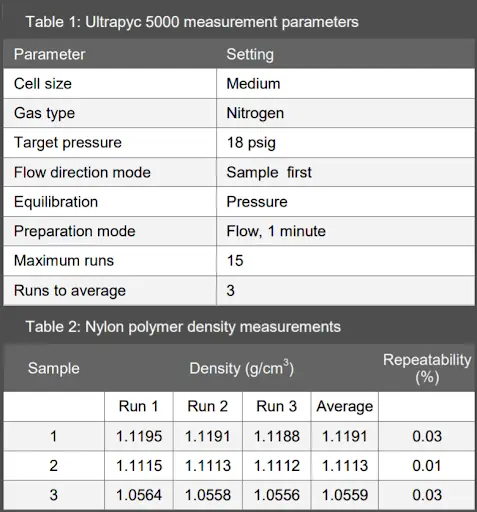
Example Outputs
Sample Requirements
- Samples must be solid or semisolid (Aerogels, pastes, gels, films, etc.).
- Sample size must be within 0.125cm3 up to 4.5cm3 (Larger samples can be prepared to meet these size requirements; measurements are most successful when samples occupy 50-75% of analysis cell volume).
- Samples must be non-volatile (mass and structure need to stay unchanged via gas adsorption or desorption; the test procedure can be adapted to volatile samples, if necessary).
Gas Pycnometry Applications by Industry
Curing Studies
Track volume contraction and density increase of epoxy resins before and after UV curing to better understand curing efficiency.
Quality and Batch Control
Verify consistent densities across batches, lots, or sub-regions of uniform materials to ensure specifications and performance compliance.
Porosity Studies
Compare bulk and true densities to calculate porosity percentage, gaining insight into the extent of internal voids or closed pores.
Process Comparison and Validation
Differentiate material properties by comparing the density and porosity of hot-melt extruded plastics and injection-molded plastics, correlating to performance outcomes.
Environmental Applications
Analyze soil and mineral specific gravity or determine microplastic densities to support environmental assessments and regulatory testing.
Metals / Ceramics / Refractory Materials
Assess sintering quality, density, and porosity of precursors, intermediates, and final products to optimize material processing.
Pharmaceuticals
Aid quality control by measuring true density to ensure packability, flowability, and controlled dissolution of drug formulations.
Battery / Energy / Catalysts
Provide critical data on electrode design, membrane porosity, catalyst characterization, crystallinity, and overall component quality in energy storage and conversion systems.
Techniques That Complement Gas Pycnometry
Why Choose Covalent for Your Gas Pycnometry Needs?
At Covalent, we bring together technical expertise and world-class technology to obtain high-quality data and consistent results.
Our turnaround time for gas pycnometry projects is usually 1–3 days. We can also deliver a complete picture of your material’s density, porosity, composition, and performance with complementary analytical techniques.