
What is Powder Testing?
Powder testing measures the physical, chemical and surface properties of fine particles. Powders are solids, but a bulk powder can flow, pack, cake and segregate in ways that depend on particle size, shape, surface area and moisture. Two lots with the same chemistry can behave very differently in a hopper, a press or a 3D printer.
Powder characterization connects those particle properties to how the powder behaves in your process. It takes several techniques, because no single measurement captures size, shape, density, surface and chemistry together.

Why Invest in Powder Testing?
When a powder is part of your product or process, testing helps with:
- Performance: confirm that the powder flows, compacts and stays stable as expected.
- Processing and handling: reduce clogging, caking and segregation in storage and production.
- Quality control: catch contamination, variability or degradation between lots.
- Material selection: choose powders and formulations that meet product requirements.
- Production consistency: confirm that batches match each other at production scale.
When Should Powder Testing Be Performed?
- R&D: to engineer particles and optimize formulations.
- Supplier qualification and incoming inspection: to confirm that a new supplier or lot meets your specification.
- Production: to monitor consistency and prevent delays caused by variable material.
- Powder reuse in additive manufacturing: to check whether recycled powder is still within specification.
- Failure analysis: when you see clumping, segregation, poor flow, porosity in printed parts, or field failures traced to the powder.
What Properties Are Measured in Powder Testing?
We disperse, image, compact, heat and chemically analyze powders to measure the properties that control their behavior:
- Particle size distribution
- Particle shape and surface morphology
- Tap density, bulk density and true (skeletal) density
- Specific surface area and porosity
- Chemical composition, trace impurities and crystal phase
- Moisture content and thermal stability
Types of Powder Testing
| Test | What it tells you | Techniques |
|---|---|---|
| Particle size analysis | Size distribution (D10, D50, D90), which affects flow, packing and reactivity | Laser diffraction particle size analysis, dynamic light scattering for nanoparticles |
| Particle shape and morphology | Sphericity, satellites, agglomerates and surface defects | SEM imaging |
| Density and packing | How tightly a powder packs and how much internal porosity particles hold | Tap density, gas pycnometry |
| Surface area and porosity | Specific surface area and pore size, which affect reactivity, sintering and dissolution | Gas adsorption (BET surface area) |
| Flowability | How easily a powder flows, spreads or doses | Powder rheometry |
| Chemical composition and purity | Major elements, trace impurities and contamination | ICP-OES, ICP-MS, SEM-EDS |
| Light elements (C, H, N, S, O) | Carbon, oxygen and other light-element content | CHNS/O elemental analysis |
| Crystal phase | Phase identity and phase purity | XRD |
| Thermal behavior and moisture | Mass loss, moisture, decomposition and phase transitions on heating | TGA and DSC |
| Surface charge | Dispersion stability of powders in liquids | Zeta potential |
| Magnetic properties | Response of magnetic powders to an applied field | Vibrating sample magnetometry (VSM) |
| Internal porosity | Hollow particles and trapped gas pores | Micro-CT |
How Powder Testing Works
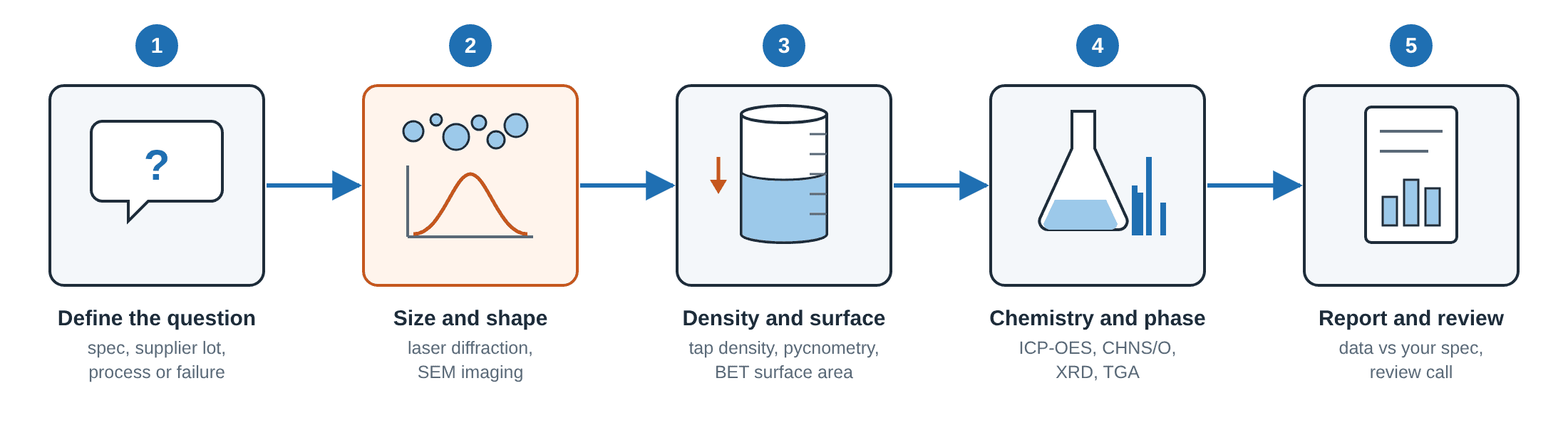
A project starts by defining the question (1): a specification to check, a supplier lot to compare, a process problem or a failure. Size and shape come first (2), with laser diffraction for the size distribution and SEM to see sphericity, satellites and agglomerates. Next we measure density and surface (3) with tap density, gas pycnometry and BET surface area. Chemistry and phase follow (4), with ICP-OES, CHNS/O, XRD and TGA as the question requires. Finally, you get a report that compares every result with your specification, plus a call with the scientist who ran the work (5).
How Are Results Tracked and Reported?
We support your project from the first email: choosing the methods, advising on how to ship samples, and agreeing the scope. You can also join some measurements live, in the lab or remotely. Our reports include:
- High-resolution images, spectra, tables and figures
- Calibrated, quantified measurements
- Results compared against your specification when you provide one
- Interpretation aligned to your goals
- The equipment and methods used
- Raw data on request
Key Differentiators
Strengths
- Measures the properties that make powders behave partly like solids and partly like liquids
- Combines size, shape, density, surface area and chemistry on the same lot
- Works on metals, ceramics, polymers, pharmaceuticals, battery materials and composites
- Scales from small R&D samples to routine lot release in quality control programs
Limitations
- Some tests consume or alter the sample, so plan enough material for every test
- Moisture and humidity change powder behavior, so samples must be stored and shipped sealed
- Results from different techniques need expert interpretation to agree with each other. Our scientists do this as part of every report.
Industries That Use Powder Testing
Metal Powders & Additive Manufacturing
Qualify virgin and recycled metal powders for 3D printing, metal injection molding and press-and-sinter: particle size, sphericity, density, flow and contamination.
Energy & Batteries
Characterize cathode and anode powders and conductive additives: particle size, surface area, tap density and composition.
Pharmaceuticals & Biotech
Support tablet formulation, controlled-release and inhalable products with particle size, surface area and moisture data.
Catalysts & Chemicals
Optimize surface area and porosity for reactivity and adsorption.
Ceramics & Advanced Materials
Control particle size and purity of ceramic powders, such as alumina, before forming and sintering.
Food & Agriculture
Check the consistency of flavorings, supplements, fertilizers and stabilizers.
Related Techniques for Powder Testing
Quantifies powder flowability, cohesion, and shear properties under controlled stresses. Predicts handling, dosing, and processing performance for manufacturing and additive workflows.
Measures particle size distributions rapidly and reproducibly for suspensions or powders. Supports QC, formulation tuning, and process control across wide size ranges.
High-resolution imaging of powder morphology, size, and surface features. Identifies agglomeration, shape, and defects to support quality control and process optimization.
Determines surface area, pore size distribution, and porosity. Optimizes adsorption, catalytic activity, permeability, and packing for powders and porous materials.
Measures mass change and heat flow versus temperature. Identifies composition, thermal stability, phase transitions, and reactions to guide processing and formulation.
Powder Testing Services at Covalent
Our Sunnyvale lab measures particle size, shape, density, surface area, chemistry and phase on the same powder lot. That means one team can explain why two lots that pass the same chemical specification still flow or sinter differently. We test virgin and recycled metal powders for additive manufacturing, battery cathode and anode powders, ceramics and pharmaceutical powders. You can join measurements live, and our scientists interpret the combined results against your specification. For techniques we don’t run in-house, we can place work through Covalent Connect, our network of trusted partner labs.
Turnaround is typically 5–7 business days, with rush options available at an extra cost.
Frequently Asked Questions
What is the typical turnaround time for powder testing, such as particle size analysis?
Turnaround is typically 5–7 business days, with rush options available at an extra cost. Larger projects with several techniques may take longer, and we confirm timing when we scope the work.
Can you test recycled or reused metal powder for additive manufacturing?
Yes. We compare reused powder with virgin powder or your specification. Typical checks are particle size distribution, sphericity and satellites by SEM, density, and contamination or oxygen pickup.
Why measure both particle size and particle shape? What does each tell me?
They describe different things, and each affects behavior independently. Particle size controls surface area, dissolution rate, packing density, and how a powder spreads or compacts. Particle shape (roundness, aspect ratio, satellites and angularity) controls flow, cohesion, packing efficiency, and how particles interact mechanically.
Beyond the report, do you offer consulting on how our powder will affect the final product?
Yes. Our scientists explain the data, answer your questions, and help connect powder properties to processing and product performance.
What tests do you recommend for metal powders?
Usually particle size distribution by laser diffraction, shape and satellites by SEM, tap and true density, and chemistry by ICP-OES. We add XRD for phase, and micro-CT for hollow particles or trapped porosity, when the application needs them.
How much powder do you need?
It depends on the tests. Most single techniques need a few grams. Plan for more if you need several tests on the same lot or repeat measurements.