
What We Offer
- R&D support for new packaging films, coatings and materials
- Packaging material identification and multilayer film analysis
- Foreign matter and physical contaminant identification
- Heavy metal and trace element analysis
- Coating and surface analysis of packaging and processing equipment
- Molecular and structural analysis of ingredients and agricultural materials
We don't run pesticide residue, allergen, nutritional, mycotoxin or microbiological testing.
Why Teams Choose Covalent
Speed
Elemental, molecular, microscopy and surface analysis are under one roof in Sunnyvale, so a foreign matter complaint is handled by one team.
Quality
ICP-MS measures heavy metals at trace levels, and SEM-EDS, FTIR and Raman identify particles from their chemistry.
Detailed reporting
Detailed reports with follow-up interpretation, giving your quality team evidence to share with suppliers and customers.
Why Materials Analysis Matters in Food Packaging and Agriculture
Foreign matter, packaging failures and trace metals are common causes of customer complaints, rejected shipments and recalls. Materials analysis shows what a contaminant or packaging layer actually is, measures heavy metals against your limits, and gives you clear evidence to share with suppliers and customers.
Common Challenges We Solve
| Challenge | What we measure | Techniques |
|---|---|---|
| Foreign matter in product | Identity of plastic, metal, glass or other particles | SEM-EDS, FTIR, Raman |
| Packaging material and structure | Layer count, thickness and polymer in each layer | Cross-sections, FTIR, DSC |
| Heavy metals | Arsenic, lead, cadmium and other trace elements in soil, water and materials | ICP-MS, ICP-OES |
| Coatings and surfaces | Can coatings, liners and equipment surface residues | XPS, ToF-SIMS, FTIR |
| Ingredient composition | Molecular structure and authenticity | NMR, FTIR |
How We Work With You
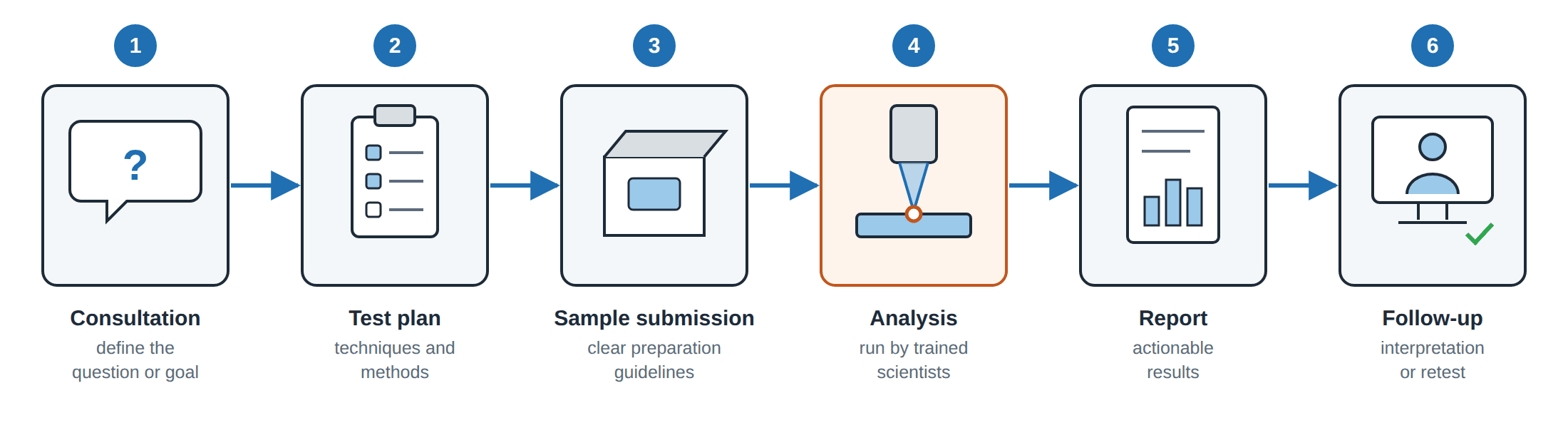
- Consultation: we define the question or goal.
- Test plan: we choose the techniques and methods.
- Sample submission: clear preparation guidelines.
- Analysis: run by trained scientists.
- Report: results in an actionable format.
- Follow-up: an optional interpretation session or retest.
Techniques for Food Packaging and Agricultural Analysis
| Area | Techniques | What you learn |
|---|---|---|
| Elemental | ICP-MS, ICP-OES, XRF | Heavy metals and trace elements |
| Molecular | FTIR, Raman, NMR, GC-MS | Polymer, ingredient and residue identity |
| Microscopy | SEM-EDS, optical microscopy | Particle size, shape and composition |
| Surface | XPS, ToF-SIMS | Coatings and thin residues |
| Thermal | DSC, TGA | Packaging polymer identity and stability |
From R&D to Production
- Packaging R&D: identify and compare candidate films and coatings.
- Incoming materials: verify packaging and raw materials from suppliers.
- Complaint investigation: identify foreign matter reported by customers.
- Supply chain checks: measure heavy metals in soils, water and agricultural inputs.
Enterprise Metrology Solutions for Food Packaging and Agricultural
Food producers and packaging suppliers work with Covalent's scientists on packaging development, supplier verification, heavy metal monitoring and foreign matter complaints, with consistent methods your quality team can trend over time.
Experts on your team
A technical lead and scientists who join your quality reviews and know your packaging, suppliers and earlier complaints.
Methods development
New methods for new packaging films, coatings and sample types, including recycled and compostable materials.
Lab on demand
Extra capacity for supplier verification, heavy metal monitoring or a foreign matter complaint, without adding instruments or staff.
One partner, secure data
Packaging, foreign matter and elemental analysis in one lab, plus Covalent Connect partner labs, under ISO/IEC 17025 and SOC 2, with results in a secure portal.
Food Packaging & Agricultural Testing Services at Covalent
We bring a broad range of analytical techniques under one roof in Sunnyvale, with scientists who deliver detailed reports and follow-up interpretation. For techniques we don't run in-house, we can place work through Covalent Connect, our network of trusted partner labs.
Turnaround is typically 5–7 business days, with rush options available at an extra cost.
Frequently Asked Questions
Can you identify a foreign object found in food?
Do you test for pesticides, allergens or microbes?
We don't run those tests in-house; we focus on materials and elemental analysis. Ask us about partner labs in Covalent Connect for the rest of your testing needs.
Can you measure heavy metals?
Can you identify the layers in a multilayer packaging film?
Yes. Cross-sections show the layer count and thickness, and FTIR and DSC identify the polymer in each layer.
Can you analyze can coatings and liners?
Yes. XPS, ToF-SIMS and FTIR characterize coatings, liners and thin residues on packaging and processing equipment.