
What We Offer
- R&D support and process development for EV, battery and lightweight materials
- Battery materials analysis: cathodes, anodes, separators and electrolytes
- Coating and layer analysis: thickness, uniformity and composition
- Adhesive and bond analysis: interface chemistry and bond-line defects
- Contamination detection on sensitive assemblies
- Raw material purity and supplier verification
- Catalyst characterization
- Failure analysis of returned and failed parts
Why Teams Choose Covalent
Speed
Contamination, coatings, adhesives, catalysts and battery materials are analyzed in one lab, so a field return doesn't move between vendors.
Quality
Calibrated instruments, sample protocols that keep parts intact, and direct contact with the scientist running your samples.
Detailed reporting
Engineer-friendly reports you can share with OEMs as evidence, with an optional review of results and next steps.
Why Materials Analysis Matters in Automotive
Safety, performance and regulation meet at the material level. Materials analysis helps you reduce failures, validate designs, qualify lightweight and recycled materials, and give OEMs the evidence they ask for.
Common Challenges We Solve
| Challenge | What we measure | Techniques |
|---|---|---|
| EV battery quality and stability | Particle size, composition, degradation | Laser diffraction, ICP-OES, SEM-EDS, XPS |
| Coating and paint performance | Thickness, adhesion, layer structure | Cross-sections, FIB-SEM, XPS, nano scratch |
| Adhesive bonds | Interface chemistry, voids, cure | XPS, FTIR, SAM, DSC |
| Contamination | Films, particles and residues that cause corrosion or shorts | FTIR, SEM-EDS, ToF-SIMS |
| Corrosion after exposure testing | Corrosion products and attack depth | SEM-EDS, XPS, XRD, cross-sections |
| Electronics and sensors | Solder joints, voids and micro-scale defects | 2D X-ray, micro-CT, SAM, cross-sections |
| Catalysts | Composition, active sites, surface area, crystal phase | XPS, TEM, gas adsorption (BET), XRD |
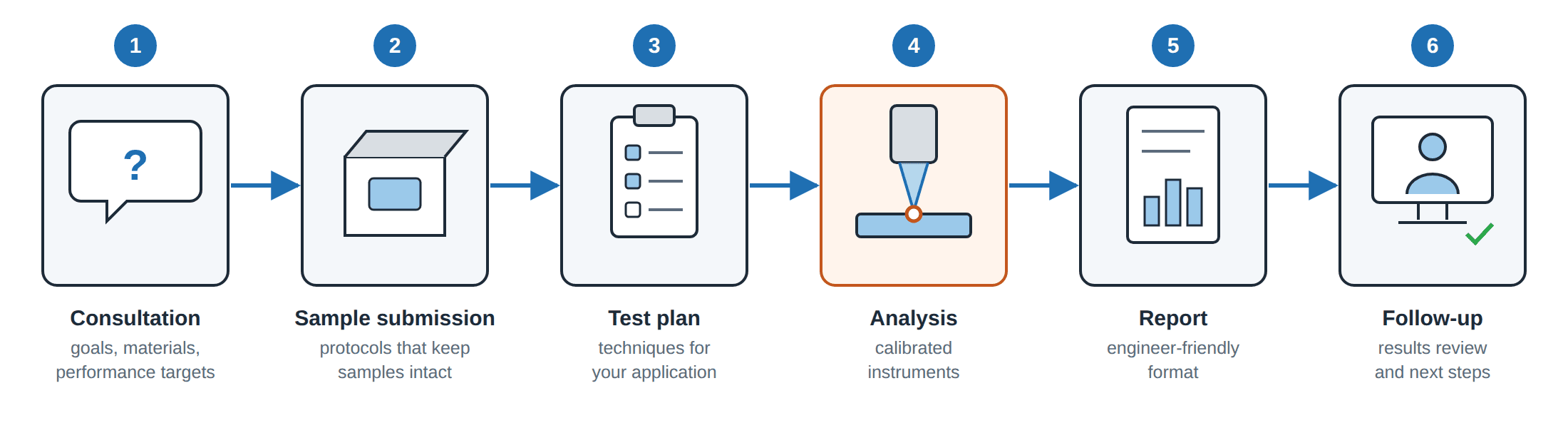
How We Work With You
- Consultation: Define test goals, materials and performance targets.
- Sample submission: Protocols that keep samples intact.
- Test plan: Techniques chosen for your application.
- Analysis: Run on calibrated instruments by experienced scientists.
- Report: Results in an engineer-friendly format.
- Follow-up: Optional review of results and next steps.
Techniques for Automotive Analysis
| Area | Techniques | What you learn |
|---|---|---|
| Microscopy | SEM, FIB-SEM, optical microscopy | Fracture surfaces, failure sites and fine structure |
| Structure | XRD | Crystallinity, residual stress and phases in metals, ceramics and battery materials |
| Surface chemistry | XPS, ToF-SIMS, dynamic SIMS | Coatings, contaminants and dopants |
| Organic analysis | FTIR, GC-MS | Residues, oils and polymer identity |
| Nondestructive inspection | Micro-CT, 2D X-ray, SAM | Voids, cracks and delamination |
| Thermal and mechanical | DSC, TGA, DMA, tensile, hardness | Cure, thermal stability and mechanical properties |
From R&D to Production
- R&D and prototype validation: evaluate new materials and designs, including lightweight composites and high-strength alloys.
- Pre-production QA/QC: validate materials and parts before they reach the line.
- Process development and scale-up: keep suppliers and production consistent during ramp-up and transitions.
- Post-test analysis: examine parts after durability or corrosion testing run elsewhere.
- Field failures and returns: find the root cause with multi-technique analysis, including cross-sections and SEM.
Enterprise Metrology Solutions for Automotive
OEMs and Tier 1 and Tier 2 suppliers work with Covalent's scientists through vehicle programs: material and supplier selection in development, checks during ramp and root-cause analysis on field returns. The same team stays with the program from prototype to production.
Experts on your team
A technical lead who joins your program reviews and knows your vehicle platforms, suppliers and earlier field returns.
Methods development
New methods for new battery chemistries, lightweight materials, coatings and adhesives as your programs change.
Lab on demand
Extra capacity during launches, ramp-up and field issues, without adding instruments or staff.
One partner, secure data
Battery, coating, contamination and failure analysis in one lab, plus Covalent Connect partner labs, under ISO/IEC 17025 and SOC 2, with results in a secure portal.
Automotive Testing Services at Covalent
We combine a wide range of analytical techniques under one roof, from contamination detection to catalyst characterization. Our scientists support OEMs and Tier 1 suppliers with fast, actionable data, and you work directly with the person running your samples. For techniques we don't run in-house, we can place work through Covalent Connect, our network of trusted partner labs.
Turnaround is typically 5–7 business days, with rush options available at an extra cost.
Frequently Asked Questions
Do you test EV battery materials?
Do you run salt spray or vibration testing?
We don't run those tests in-house. Ask us about arranging them through Covalent Connect, our network of trusted partner labs. We analyze parts before and after to show what changed and why, so you have one point of contact.
Can you find what's contaminating a part?
Can you investigate a failed field return?
What is Enterprise Metrology Solutions?
An ongoing partnership where Covalent's scientists work as an extension of your team: a dedicated technical lead, regular reviews, method development and on-demand lab capacity. It starts with an assessment of your current metrology needs. See Enterprise Metrology Solutions.
Can you analyze coating and paint failures?
Yes. Cross-sections, FIB-SEM and XPS measure thickness, layer structure and interface chemistry, and nano scratch testing measures adhesion.
Do you characterize catalysts?
Yes. XPS, TEM, gas adsorption (BET) and XRD measure composition, active sites, surface area and crystal phase.