
What We Offer
- Patent support: characterize inventions and prior art, and test for infringement
- Comparative analysis of disputed and accused products
- Material identity and authenticity, including counterfeit detection
- Failure and damage analysis for product liability, warranty and insurance claims
- Chain-of-custody sample handling and confidentiality agreements
- Supervised testing sessions in our lab for high-sensitivity matters
- Clear, structured reports for legal and regulatory documentation
Why Teams Choose Covalent
Speed
Multi-technique analysis runs in one lab, and rush options are available for matters with filing or court deadlines.
Quality
Precise, repeatable protocols in a lab accredited to ISO/IEC 17025 across 60+ methods, with full traceability of data and samples.
Detailed reporting
Clear, structured reports written for non-scientists, with expert consultation for interpretation or technical review.
Why Materials Analysis Matters in Legal and IP Cases
In patent and IP disputes, the question often comes down to what a material is made of and how it is built. Reliable analysis confirms the composition or structure of a product, shows whether two materials are the same or different, and turns complex technical findings into facts that hold up to scrutiny.
Common Challenges
| Challenge | How we handle it |
|---|---|
| Confirming uniqueness to support or refute patent claims | Multi-technique composition and structure analysis mapped to the claim language |
| Verifying formulations in trade secret or authenticity disputes | Side-by-side comparison of disputed and reference samples |
| Limited or degraded samples | Nondestructive methods first, then targeted destructive analysis |
| Confidentiality and chain of custody | Documented custody from intake to report, NDAs and supervised sessions |
| Explaining results to non-scientists | Plain-language reports and expert interpretation |
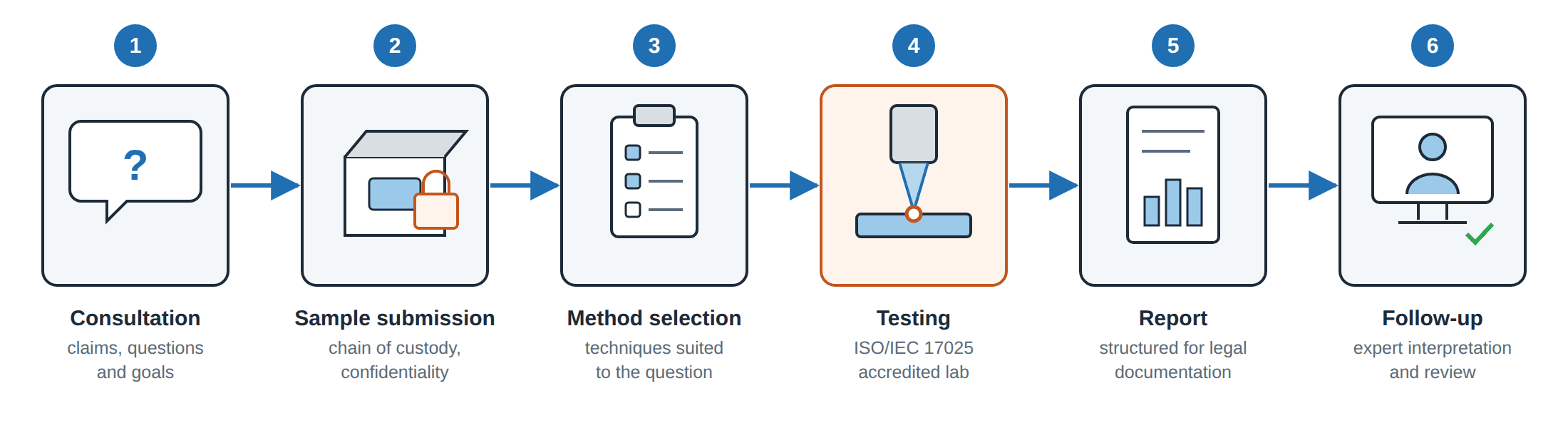
How We Work With You
- Consultation: define the claims, questions or goals to test.
- Sample submission: under strict chain-of-custody protocols and confidentiality agreements.
- Method selection: the analytical techniques best suited to the question.
- Testing: by our scientists on calibrated instruments in our ISO/IEC 17025 accredited lab.
- Report: results in a clear, structured format suitable for legal documentation.
- Follow-up: expert consultation for interpretation, retesting or technical review.
Support at Every Stage of a Matter
- Preliminary assessment: understand unknown or disputed materials early, before strategy is set.
- Comparative analysis: determine whether materials are similar or different in patent or infringement cases.
- Verification: confirm material identity and authenticity for patent filings or regulatory documentation.
- Failure and damage analysis: find the cause of degradation, contamination or failure in a disputed product.
- Reporting and expert support: defensible data reports and expert interpretation.
Techniques for Legal and IP Analysis
We choose techniques for the question, often combining several:
| Question | Techniques |
|---|---|
| What is it made of? | XPS, ToF-SIMS, ICP-OES, ICP-MS, FTIR, Raman, NMR, GC-MS |
| How is it built? | SEM, FIB-SEM, TEM, micro-CT, cross-sections, XRD |
| How does it behave? | DSC, TGA, DMA, tensile testing, nanoindentation |
| Why did it fail? | Full failure analysis workflow, nondestructive first |
Enterprise Metrology Solutions for Legal and IP
Law firms and in-house IP teams work with Covalent's scientists across matters, not just single cases: patent portfolio support, recurring counterfeit checks and product liability investigations, with documented methods and chain of custody throughout.
Experts on your team
A technical lead and scientists who work with your attorneys and testifying experts across matters and know your products, patents and prior analyses.
Methods development
Methods built around the claim language or the question in dispute, documented so they can be repeated and reviewed.
Lab on demand
Capacity for several matters at once, from portfolio support to recurring counterfeit checks, without hiring your own lab.
One partner, secure data
Chain of custody, NDAs and supervised sessions in an ISO/IEC 17025 accredited lab, plus Covalent Connect partner labs, with results in a secure portal.
Legal & IP Analysis Services at Covalent
Covalent's results are built to meet technical and legal scrutiny. We follow precise, repeatable measurement protocols, keep full traceability of data and samples, and maintain strict confidentiality. Our lab is accredited to ISO/IEC 17025 across 60+ methods, holds a SOC 2 examination and is ITAR registered. For techniques we don't run in-house, we can place work through Covalent Connect, our network of trusted partner labs.
Turnaround is typically 5–7 business days, with rush options available at an extra cost.
Frequently Asked Questions
What legal and IP matters use materials analysis?
Which techniques are used to support IP cases?
How do you make results defensible?
Can we observe the testing?
How quickly can urgent matters be handled?
Rush options are available at an extra cost. Tell us your filing or court deadline when you request a quote, and we'll plan the work around it.
Can you work with limited or degraded samples?
Yes. We start with nondestructive methods, then use targeted destructive analysis only where it answers the question.
Can you detect counterfeit materials?
Yes. We compare a suspect sample with a reference sample using composition and structure analysis to confirm identity and authenticity.