
What We Offer
- R&D support for new materials, and process development for molding, coating and finishing
- Material identification: polymers, fabrics, metals and composites
- Contamination, residue and foreign particle analysis
- Heavy metal screening of materials and components
- Coating, paint and laminate analysis
- Discoloration and degradation investigations
- Failure analysis and supplier comparison
Why Teams Choose Covalent
Speed
Spectroscopy, thermal analysis, microscopy and elemental screening run in one lab, so a complaint investigation doesn't wait on several vendors.
Quality
We compare affected parts with known-good ones, so findings separate material, process and use problems.
Detailed reporting
Clear reports you can share with suppliers and retailers, and interpretation sessions when you need them.
Why Materials Analysis Matters for Consumer Products
A cheaper resin from a new supplier, a coating that doesn't cure, or a residue left in molding can turn into returns and bad reviews. Materials analysis catches those changes early and gives you evidence to share with suppliers and retailers.
Common Challenges We Solve
| Challenge | What we measure | Techniques |
|---|---|---|
| Appearance and durability | Discoloration, surface wear, scratch resistance | FTIR, XPS, optical microscopy, nano scratch |
| Material identity and substitution | Polymer type, fillers, additives | FTIR, Raman, DSC, TGA, GC-MS |
| Restricted substances | Lead, cadmium and other heavy metals | XRF, ICP-OES, ICP-MS |
| Contamination | Particles, films and residues | SEM-EDS, FTIR, ToF-SIMS |
| Coatings and adhesion | Thickness, layer structure, delamination | Cross-sections, SEM, XPS |
| Mechanical failure | Cracks, brittle fracture, warping | Fractography, tensile testing, DMA |
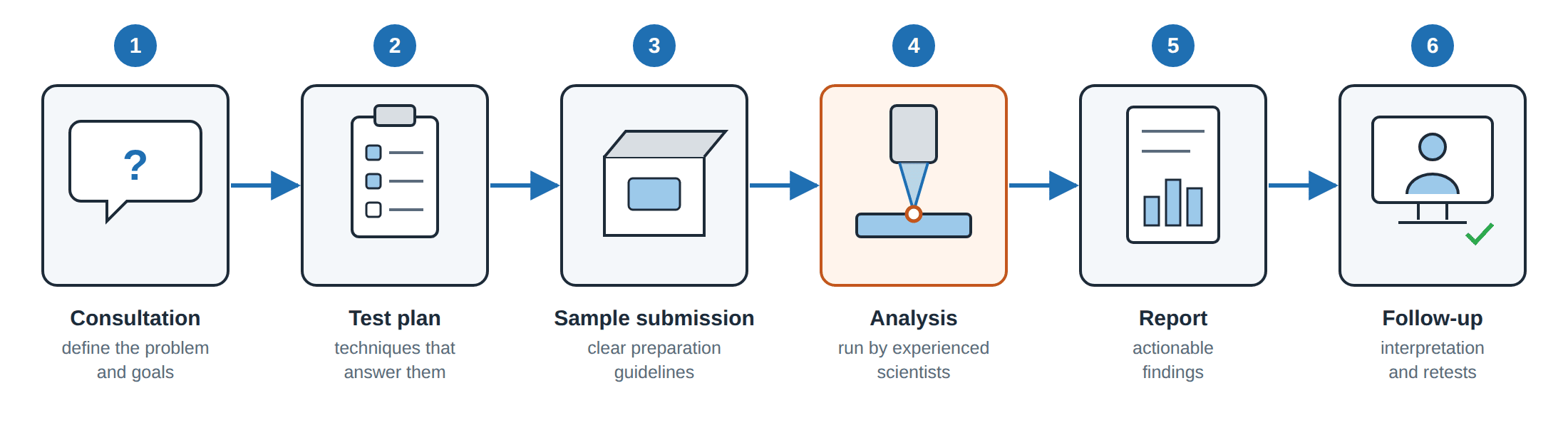
How We Work With You
- Consultation: we define the problem and set clear goals.
- Test plan: our scientists choose the techniques that answer them.
- Sample submission: clear preparation guidelines.
- Analysis: run by experienced scientists.
- Report: findings in an actionable format.
- Follow-up: interpretation sessions and retests if needed.
Techniques for Consumer Product Analysis
| Area | Techniques | What you learn |
|---|---|---|
| Composition and trace analysis | FTIR, Raman, XRF, GC-MS | Polymer and fabric identity, residues, restricted substances |
| Thermal | DSC, TGA | Melting point, crystallinity, filler content and degradation |
| Mechanical | Tensile testing, DMA, hardness | Strength, stiffness and how properties change with temperature |
| Microscopy | Optical microscopy, SEM-EDS | Fracture surfaces, wear and particles |
| Surface | XPS, water contact angle, white light interferometry | Coating chemistry, wettability and roughness |
From R&D to Production
- R&D and material selection: compare candidate materials and suppliers.
- Process development: check how changes to molding, coating or finishing affect the part.
- Prototype validation: check that early builds use the intended materials and coatings.
- Production quality control: confirm lot-to-lot consistency and catch supplier substitutions.
- Post-stress analysis: examine products after weathering or durability tests run elsewhere.
- Complaint and failure investigation: find why a product failed and whether it's material, process or use.
Enterprise Metrology Solutions for Consumer Product
Brands and manufacturers work with Covalent's scientists from material selection and prototype validation through supplier changes and complaint investigations. A team that knows your known-good materials catches a supplier change quickly.
Experts on your team
A technical lead and scientists who know your products, materials and suppliers, and who join your quality and product reviews.
Methods development
New methods for new materials, recycled content, coatings and finishes, including comparisons with your known-good parts.
Lab on demand
Extra capacity during a launch, a supplier change or a wave of complaints, without adding instruments or staff.
One partner, secure data
Material ID, contamination and failure analysis in one lab, plus Covalent Connect partner labs, under ISO/IEC 17025 and SOC 2, with results in a secure portal.
Consumer Product Testing Services at Covalent
Our Sunnyvale lab offers a wide range of analytical techniques under one roof, and your project is handled by experienced scientists who give you both the data and recommendations. For techniques we don't run in-house, we can place work through Covalent Connect, our network of trusted partner labs.
Turnaround is typically 5–7 business days, with rush options available at an extra cost.
Frequently Asked Questions
Can you tell whether a supplier changed our plastic?
Why is our product turning yellow?
Do you run drop, weathering or safety certification tests?
Can you screen for heavy metals?
Can you identify a residue or particle on our product?
Yes. SEM-EDS, FTIR and ToF-SIMS identify particles, films and residues.
Can you find out why a plastic part cracked?
Yes. Fractography shows where and how the crack started, and FTIR, DSC and tensile testing show whether the material, the process or the use caused it.