
What Is Gas Adsorption Porosimetry?
Porosimetry is a broad term for a set of analytical techniques and data processing methods that are used to characterize porous materials. Physical adsorption, or Physisorption, involves gas molecules weakly attaching or adsorbing to a surface through weak Van der Waal’s forces. The BET surface area analysis method is a specific data processing method for a subset of physisorption data. Chemical adsorption, or Chemisorption, involves gases forming stronger chemical bonds with the surface, while vaporsorption looks at how vapors are absorbed.
Gas adsorption porosimetry is primarily used to determine the specific surface area, pore size distribution, and pore volume of solid porous or, in some cases, relatively non-porous materials. If a reactive gas is used as in chemisorption, then additional parameters such as active metal surface area, metal dispersion, oxygen storage capacity, and average crystallite size can also be determined.
Other details:
- Detects pore sizes from 0.35 to 500 nm with high reproducibility.
- Ideal for catalysts, refractory materials, battery materials, and pharmaceuticals.
- Precise temperature and pressure control ensure reliable data.
- Supports N₂, Ar, Kr, CO₂, H₂, and other gases for tailored analysis.
High Sensitivity
Molecular-Level Insight
Analytical Depth
Why Use Gas Adsorption Porosimetry?
- Gas adsorption porosimetry is the ideal technique for analyzing solid materials with pores in the nanoscale range, such as powders, granules, and flakes.
- Useful to obtain benchmark quality metrics under carefully controlled and reproducible conditions.
- One of the most sensitive techniques capable of measuring specific surface area and pore size distribution on a size and precision scale relevant to the material’s chemical interactions.
- Provides insights and useful metrics into catalyst activity, storage and transport properties, and gas adsorption capacity.
Surface and Pore Characterization
Active Sites and Reactivity Assessment
Functional Performance
How Gas Adsorption Porosimetry Works
Gas adsorption porosimetry works by first ‘cleaning’ the sample surface of any adsorbed moisture or gases through a process of heating under vacuum or inert gas flow. For analysis, samples are held at a specific temperature with cryogenic fluids, circulating coolers, or electric furnaces. Controlled doses of ultrapure gas are input into the sample cell, and the amount of adsorbed gas at increasing relative pressures is recorded. This data forms an isotherm, which is analyzed to determine relevant parameters using various physical and mathematical models.
Equipment Used for Gas Adsorption Porosimetry
We use the Anton Paar Nova 800 for our high-throughput BET and general physisorption measurements, and the Quantachrome (now Anton Paar) Autosorb iQ series 7 for low surface area Kr physisorption and chemisorption or vaporsorption measurements. Certain custom experiments can be performed through dedicated and specialized equipment offered through our Connect partner network.

Anton Paar Nova 800
- Relative Pressure Range: 1E-7 to 0.999.
- Pressure Resolution: 1.2 x 1E-4 Torr.
- Pressure Accuracy: ±0.1% of full scale.
- Surface Area Range: 0.01 m²/g to no known upper limit.
- Pore Volume Limit (STP): 1.2 x 1E-8 cm3 .
- Detectable Pore Size Range: 0.35 nm to 500 nm.
- Reproducibility: <2%.
- Compatible Adsorbates: N₂, Ar, Kr, CO₂, H2, O2 and others.

Anton Paar Autosorb iQ 7
- Relative Pressure Range: 1E-8 to 0.999.
- Pressure Accuracy: < ± 0.15 % of reading.
- Surface Area Range: 0.01 m²/g to 1000+ m²/g.
- Detectable Pore Size Range: 0.35 nm to 500 nm.
- Ultimate Vacuum Pressure: 5 x 10⁻¹⁰ mbar.
- Compatible Adsorbates: N₂, Ar, CO₂, Kr, O₂, H₂, CH4, and more.
- Maximum Furnace Temperature: 1100 ℃.
Key Differentiators
At Covalent, we don’t just measure porosity – we help you understand it. Our Gas Adsorption Porosimetry services include full sample prep, testing, and analysis, supported by a range of complementary methods to reveal how structure, composition, and surface properties impact your material’s performance.
Strengths
- Efficient characterization of solid sample surface area, porosity, pore size distribution, active metal area, dispersion, and crystallite size.
- Accurate and reproducible surface areas down to 0.01 m²/g and pore sizes ranging from 0.35 to 500 nm.
- Automated in operando sample preparation.
Limitations
- Not optimized for large pore sizes (> 0.5 μm).
- Minimal insight into chemical composition, elemental distribution, or crystalline phases.
- Assumptions are made on pore structures to simplify the modeling algorithms.
Example Outputs
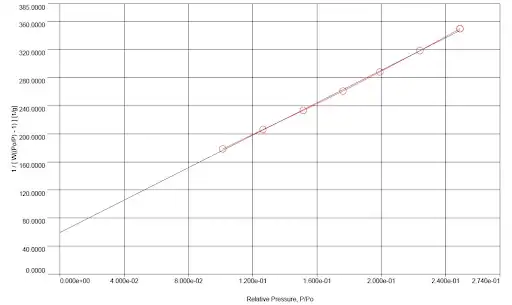
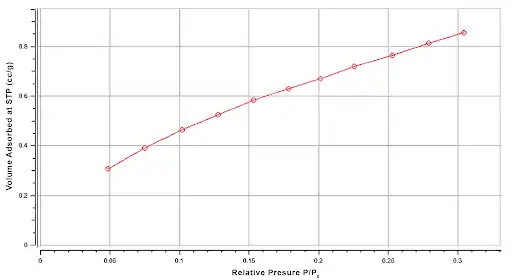
Sample Requirements
- A sample’s physical form must be solid.
- Samples with low volatility and vapor pressure are preferred to prevent interference with data collection and instrument performance.
- Our in-house instruments can measure pore sizes from 0.35 nm to 500 nm.
Gas Adsorption Porosimetry Applications by Industry
Battery Materials
Porosimetry testing is crucial in battery material characterization, including precursors and anode / cathode mixtures of LFP, NMC, graphite, carbon black, and other materials.
Catalysis & Energy
Evaluates catalysts and supports to maximize surface area, dispersion, and pore accessibility.
Pharmaceutical
Assesses drug delivery systems and excipients to optimize dissolution, stability, and bioavailability.
Air Purification & Carbon Capture
Measures adsorbents and MOFs to improve adsorption efficiency and capacity.
Techniques That Complement Gas Adsorption Porosimetry
Why Choose Covalent for Your Porosimetry Testing Needs?
Covalent provides sample preparation and access to various Porosimetry methods for different applications. We offer techniques to analyze material composition and other physical or chemical properties influencing performance and quality. We excel at high-throughput physisorption measurements and maintain partnerships with dedicated catalysis facilities for advanced Porosimetry measurements. We work with various gases and analysis conditions while following multiple standard methods.