
What Is Differential Scanning Calorimetry?
Differential Scanning Calorimetry (DSC) analysis, also referred to as calorimetry or thermal analysis, is a technique that measures how a material’s heat capacity changes in response to heat. It is capable of identifying thermal changes, including glass transition (Tg), melting, crystallization, and curing. It does so by monitoring how much heat the sample absorbs or releases compared to a baseline reference.
At Covalent, we use the TA Instruments Discovery DSC 2500, a high-performance system with modulated DSC capability, which offers rapid response times as well as excellent baseline stability, so you will be able to detect even the most subtle transitions.
Wide Operating Range
Heat Flow Measurement
Thermal Event Detection
Why Use Differential Scanning Calorimetry?
DSC testing excels at providing precise, direct measurement of thermal transitions, often with just 5–10 mg of sample. It is the perfect tool needed for understanding polymer behavior, purity changes, or thermal stability in product development and quality control.
For best results, we suggest using DSC instead of TGA when you need heat flow data related to phase transitions rather than mass loss.
Common Applications of DSC Services:
- Measuring glass transition temperature (Tg) of polymers.
- Determining melting and crystallization temperatures.
- Assessing curing behavior and degree of cure in adhesives, composites.
- Quantifying the enthalpy of transitions, whether it’s fusion or crystallization.
- Evaluating compatibility or miscibility in polymer blends.
- Estimating thermal history and purity of materials.
Precise Thermal Profiling
Versatile Material Compatibility
Informed Product Development
How DSC Measurement Works
Differential Scanning Calorimetry Services are used across multiple industries, providing critical insights into material behavior. It excels at process optimization and cure analysis when dealing with polymers and composites. In energy and battery, DSC acts as a separator for stability and thermal events in electrolyte films. DSC testing also plays a crucial role in food and packaging, as it provides the glass transition and melting behavior of food-grade polymers.
In a DSC analysis test, a small sample and a reference are heated at the same controlled rate. By comparing their heat flow, the instrument detects thermal events such as glass transition (Tg), melting, crystallization, and curing. Allowing for standard and modulated DSC (MDSC), Covalent’s cutting-edge system offers enhanced resolution of overlapping transitions and improved sensitivity to weak events.
Equipment Used for DSC

TA Instruments Discovery DSC 2500
- Temperature Range: -90 to 550°C.
- Temperature Accuracy: ± 0.025°C.
- Nitrogen Air Atmosphere.
Key Differentiators
DSC is highly sensitive to heat flow and works with a variety of materials.
- Analytical Output: DSC measures the heat flow in terms of temperature and time, as well as calculates the enthalpy change (J/g) and specific heat capacity.
- Detection Limits: With high heat flow sensitivity, it can detect up to ~0.1 µW.
- Material Compatibility: DSC is able to work with a variety of materials, including polymers, powders, adhesives, thin films, and organics.
- Temperature Range: It is capable of measuring temperature spanning from -90° through 550°C.
- Atmospheres: It works well in environments with Nitrogen (inert) and air.
- Heating and Cooling Rates: 0.01 to 100°C per minute, whether it’s ramped or isothermal.
- Covalent Capabilities: It works with Modulated DSC (MDSC), and can run isothermal tests, which will hold the temperature steady, or dynamic ramp tests, which gradually change the temperature of the sample.
Strengths
- Identifies thermal events with excellent precision and reproducibility.
- Integrates with TGA and complementary spectroscopic techniques for full thermal and chemical characterization.
- Modulated heating separates reversible (Tg) and non-reversible (curing, crystallization) transitions.
- Highly effective for complex or overlapping transitions, making it suitable for advanced material systems.
Limitations
- Cannot detect mass changes; use TGA for volatile loss, decomposition, or outgassing.
- Extremely slow heating rates (<0.5 °C/min) may reduce accuracy.
- Subtle or multiphase thermal events may require additional techniques for clarification.
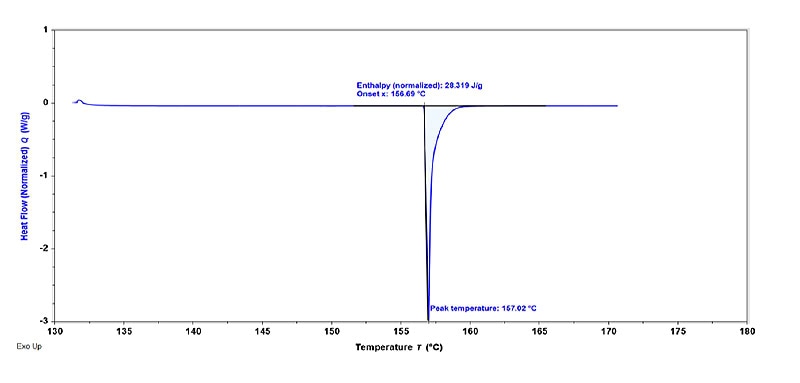
Example Outputs
Sample Requirements
For best results, we advise that your sample fit the following guidelines:
- Physical Form: Films, powders, pellets, adhesives, and organics.
- Sample Size: Typically 5–10 mg given that it must fit in a DSC pan, which is ~40 µL in volume.
- Sample Prep: The sample should be dry and thermally stable at test conditions. Low volatility is preferred.
- Pan: A standard pan is optimal, although hermetic or vented aluminum pans are available depending on the sample needs.
DSC Applications by Industry
Polymers & Materials
Measure glass transition and thermal compatibility in polymer blends.
Plastics & Packaging
Characterize crystallinity in semicrystalline plastics like PET and PEEK.
Pharmaceuticals
Benchmark thermal stability of formulations for quality control and R&D.
Medical
Techniques That Complement DSC
What makes DSC services stand out is that it complements these methods by isolating thermal transitions and enthalpic behavior. It often reveals information not accessible by other techniques.
Why Choose Covalent for Your DSC Needs?
At Covalent, our advanced modulated DSC systems can accurately measure enthalpy, detect the smallest thermal transitions, and provide highly accurate measurements of heat flow and capacity. Paired with TGA, FTIR, and GC-MS, our multi-dimensional approach delivers comprehensive thermal and chemical insights and provides an in-depth analysis, helping you fully understand and optimize complex materials.