
What Is Nano-Scratch?
At a constant normal load, nano-scratch tests the coefficient of friction and scratch hardness, which are important for characterizing a material’s resistance to scratch and wear.
A coating scratch test can characterize interfacial adhesion at a progressive, linear, normal load, determining how well a coating adheres to a substrate.
Mechanical and Surface Properties
Precision Measurement
Real-World Simulation
Why Use Nano-Scratch?
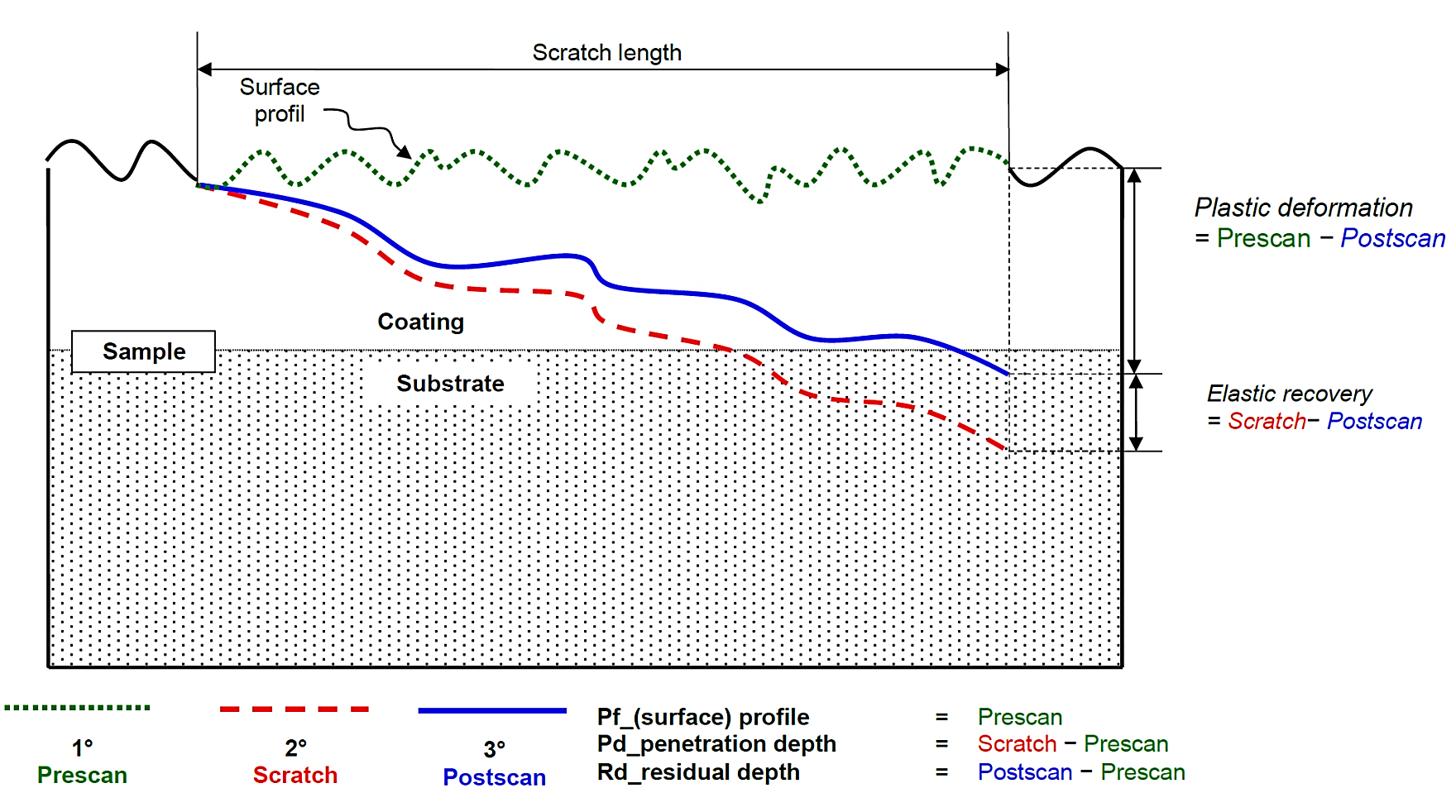
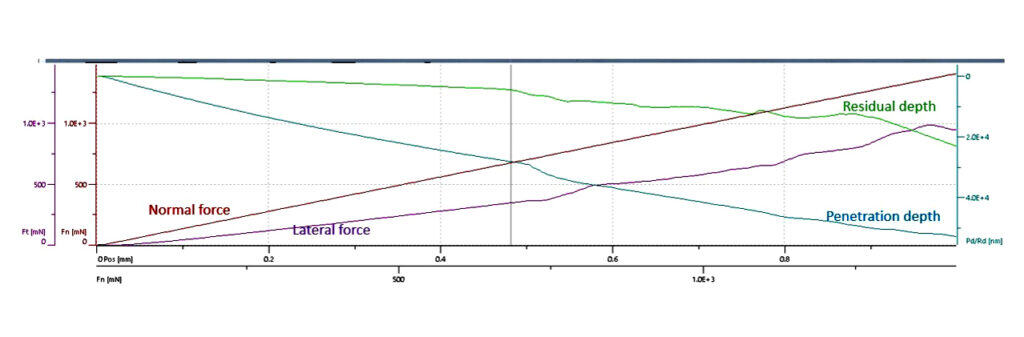
Nano-Scratch measurement output is the lateral force and the indenter displacement. Our nano-scratch tester operates in a 3-pass mode. As seen in the image below, in the 1st pass, the topographic line profile of the surface can be probed using very low force. In the 2nd pass, the nano-scratch testing function is applied. Finally, the 3rd pass measures the scratch profile’s topography to determine the coating material’s permanent plastic deformation and elastic recovery.
Material Compatibility
Depth Resolution
Lateral resolution
How Nano Scratch Testing Works
Our coating scratch test stands out in its resolution in force and displacement. It allows you to measure the coefficient of friction, scratch hardness, and interfacial adhesion of thin coatings. These measurements are important for characterizing the mechanical properties used in optical components, smartphone glass, and wafer coatings. Coating scratch tests provide well-controlled studies that can simulate real-world handling of materials. They offer more profound insights into designing new scratch-resistant coating materials.
Equipment Used for Nano-Scratch
At Covalent, we have an Anton Paar STeP (Standard Testing Platform) 600. The platform has 3 testing heads: UNHT3 (Ultra Nanoindentation Tester), MCT3 (Micro-combi Tester, used for micro-indentation and micro-scratch), and NST3 (nano-scratch tester). The NST3 has 2 types of cantilevers. One dedicated to high-resolution testing and one for high-load testing.

Anton Paar UNHT3 Ultra Nanoindentation Tester
- Multiple Nanomechanical Testing Heads:
- UNHT3: Ultra Nanoindentation Tester
Normal Load Range: 10 μN to 100 mN. - NST3: Nano-scratch Tester
Normal Load Range: 10 mN to 1 N.
- UNHT3: Ultra Nanoindentation Tester
- Depth Range: 10 nm to 100 μm.
- Acoustic enclosure with anti-vibration table.
- Heated stage.
- Integrated optical video microscopes for synchronized panoramic imaging during force measurement.
- Long-term thermal stability for elevated-temperature analysis.
Key Differentiators
Simulates real-world mechanical wear at the nanoscale to measure adhesion, friction, and scratch resistance of thin coatings.
Strengths
- High force and displacement resolution.
- Mimics every everyday handling of materials.
- Measures the coefficient of friction, scratch hardness, and interfacial adhesion of thin coatings.
Limitations
- Does not work with concave surfaces.
- Cannot provide accuracy of 5 microns or less.
- Soft materials are unsuitable for internal instrumentation.
- High surface roughness induces variations in results.
Example Outputs
Sample Requirements
Samples must be solid materials and ideally flat. Otherwise, some mechanical preparation may be required for more reliable testing.
Nano Scratch Test Applications by Industry
Battery Materials
Adhesion strength of laminate electrodes on current collectors.
Semiconductor
Adhesion strength of passivation layers.
MEMS
Gliding friction of anti-stiction coatings.
Consumer Electronics
Scratch durability of hard plastic coatings, scratch resistance of DLC coatings, and scratch hardness of chemically tempered glass.
Lubricants
Shear strength of tribo-films.
Techniques That Complement Nano Scartch Test
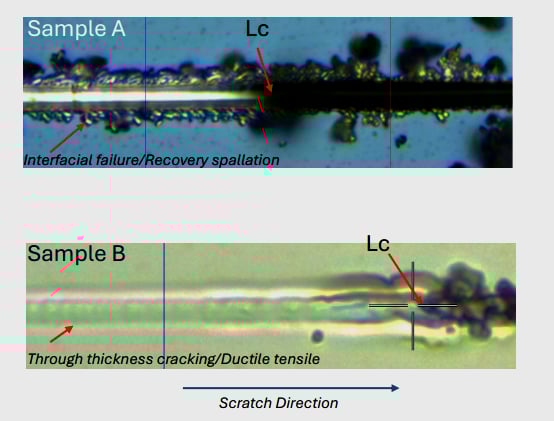
We recommend using optical microscopy or SEM (Scanning Electron Microscopy) to visualize the scratch.
Why Choose Covalent for Your Nano-Scratch Needs?
Covalent provides top-of-the-line micro scratch testers equipped with an optical microscope that captures panoramic images of each scratch and then correlates failure modes imaged optically with the lateral force scratch output. Typically, we test five scratches and report the average scratch hardness or critical load for interfacial coating adhesion.