
What is TDTR?
Time-Domain Thermoreflectance (TDTR) uses a pulsed pump laser to heat a thin metal transducer on the sample surface, and a delayed probe laser to monitor the resulting surface temperature decay through small changes in reflectivity. By fitting the measured response with a multilayer thermal model, TDTR can quantify thermal conductivity and interface conductance across length-scales between tens of nanometers to microns.
Thermal Conductivity of Thin Films
Transients
Interfaces
Why Use TDTR?
TDTR is used when high-resolution thermal property data is needed from small areas, multilayer structures, or buried interfaces. It is well suited for semiconductor materials, multilayer stacks, bonded structures, and R&D programs where composition, porosity, grain structure, or interface quality may affect thermal performance.
Complementary to bulk methods
Localized measurement capability
Multilayer and interface analysis
How TDTR Works
After depositing a thin metal transducer, the sample is heated with an ultrafast pump laser and monitored with a delayed probe laser. The measured signal is compared with a multilayer thermal model using the sample stack, layer thicknesses, spot size, and modulation conditions. Standard TDTR is typically most sensitive to near-surface through-plane transport; specialized beam-offset, variable-spot-size, or related TDTR configurations are used when directional in-plane heat transport is the objective.

Equipment Used for TDTR
A TDTR system typically includes picosecond pulsed laser source, optical delay stage, pump and probe optics, focusing objectives, and a photodetector connected to lock‑in amplification electronics. The sample is coated with a thin metal transducer layer such as aluminum or gold to facilitate laser heating and temperature detection.

Key Differentiators
This technique measures thermal conductivity, thermal diffusivity, and thermal boundary conductance with high sensitivity, capable of detecting thermal conductivity changes in nanometer-scale thin films. It is compatible with thin films, multilayers, semiconductors, polymers, and coatings, and typically probes depths ranging from hundreds of nanometers to several microns depending on modulation frequency. Samples should have flat, reflective (specular) surfaces and be approximately 1 cm × 1 cm in size.
Strengths
- Optimized for thin films and multilayers: Provides accurate thermal measurements in layered structures where bulk methods are limited.
- High sensitivity to nanoscale transport: Resolves thermal behavior in nanoscale layers and interfaces.
- Interfacial thermal characterization: Enables direct measurement of thermal boundary conductance.
- Non-contact optical technique: Eliminates the need for physical probes, reducing measurement-induced artifacts.
- Adjustable measurement depth: Modulation conditions can be tuned to probe different depths within layered structures.
Limitations
Requires metal transducer coating: Samples must be coated with a thin metal layer (typically applied by the lab) to enable measurement.
Surface quality requirements: Samples must have smooth, optically reflective (specular) surfaces for accurate signal detection.
Model-dependent analysis: Extraction of thermal properties requires fitting to a multilayer thermal model.
Limited penetration depth: Typically sensitive to depths from hundreds of nanometers to several microns, depending on modulation conditions.
Example Outputs
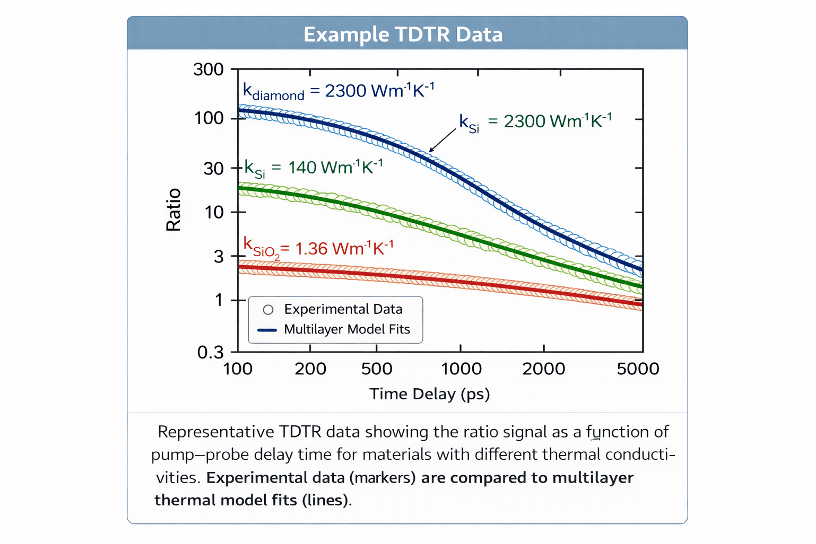
Representative TDTR data showing the ratio signal as a function of pump-probe delay time for materials with different thermal conductivities. Experimental data (markers) are compared to multilayer thermal model fits (lines). Materials with higher thermal conductivity (e.g., diamond) exhibit faster signal decay, while lower conductivity materials (e.g., SiO2) show slower decay. Agreement between measured data and model fits enables accurate extraction of thermal properties.
TDTR Applications by Industry
Semiconductor
Evaluation of heat dissipation and thermal behavior in microelectronic structures.
Thermal barrier coatings
Characterization of thermal conductivity in ceramic coatings and protective layers.
Energy materials
Analysis of heat transport in thermoelectric and energy-related materials.
Polymers and composites
Evaluation of heat conduction in functional polymer systems and composite materials.
Thin films and nanomaterials
Characterization of thermal properties in nanoscale films and advanced materials such as graphene and 2D systems.