
What Is Pendant Drop Surface Tension Measurement?
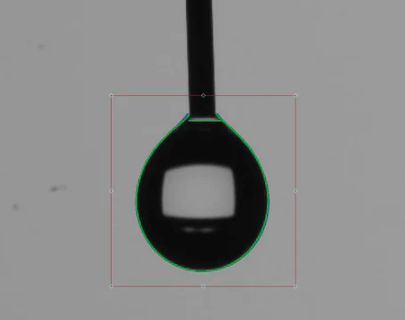
Pendant drop surface tension measurement is a technique used to determine the surface or interfacial tension of a liquid by analyzing the shape of a droplet suspended from the end of a syringe or capillary. The shape of the droplet, influenced by the balance between gravity and surface tension, is captured and fitted to the Young–Laplace equation to calculate the surface tension.
Non‑Destructive Testing
High Precision Results
Rapid and Accessible
Why Use Pendant Drop Surface Tension Measurement?
Pendant drop surface tension measurement is widely applied in research and industry to evaluate fluid behavior, surfactant efficiency, and interfacial interactions in formulations and coatings.
Surfactant Performance
Formulation Optimization
Quality Control and R&D
How Pendant Drop Surface Tension Measurement Works
A pendant drop measurement works by suspending a backlit droplet from the tip of a needle or capillary and capturing its shape using a high-resolution camera. Automated image analysis software is used to extract the droplet’s and mathematically fit it using the Young–Laplace equation, which relates the shape of the drop to the surface or interfacial tension based on the balance between gravity and surface forces.
Equipment Used for Pendant Drop Surface Tension Measurement

Ossila Contact Angle Goniometer
- Angle range: 5° to 180°.
- Maximum measurement speed: 33 ms (30 fps).
- Maximum camera resolution: 1920 × 1080.
- Typical droplet volume: Microliter scale.
Key Differentiators
Strengths
- Rapid, inexpensive and sensitive assessment of surface tension.
Limitations
- Highly volatile liquids can be difficult to measure.
Example Output
Sample Requirements
Sample prep is straightforward, which makes this a fast and efficient testing option. To get the best results, liquid samples need to be clean, bubble and particle free. Covalent provides clear instructions to help you provide a clear sample, if materials need special handling, our team is ready to step in with expert support and custom solutions.
What we accept:
- Liquid sample.
- Hazardous liquids can be handled by moving the instrument into a fume hood.
- While typically the droplet is suspended in air, the drop can also be suspended in another liquid contained in a cuvette to measure the interfacial energy between 2 liquids.
Pendant Drop Method Applications by Industry
Coatings/Paints/Inks
Measuring surface tension of formulations to optimize wetting, leveling, and substrate adhesion.
Pharmaceuticals & Biotech
Quantifying protein or surfactant effects on air–liquid and oil–water interfaces in drug formulations.
Cosmetics & Personal Care
Determining interfacial tension to design stable emulsions in creams, lotions, and shampoos.
Food & Beverage
Optimizing emulsifier concentration for stable emulsions and foams.
Chemical Manufacturing
Characterizing solvent mixtures and surfactants to control blending and separation behavior.
Semiconductor & Electronics Cleaning
Measuring surface tension of cleaning and rinsing solutions to control wetting and residue removal.
Polymer & Material Science
Determining interfacial tension between polymers and liquids for coating, adhesion, or composite design.
Environmental & Wastewater Analysis
Assessing surfactant contamination by monitoring changes in surface tension of aqueous samples.