
What is X-ray Absorption Spectroscopy (XAS)?
XAS measures the absorption of X-rays as they interact with a sample and provides insights into its chemical composition and bonding. This includes valuable structural and chemical information about the absorbing atom’s local environment, such as coordination number, bond distances, and oxidation state.
Advanced Structural Insights
Bulk & Flexible Analysis
Element-Specific Precision
Why use XAS?
X-ray absorption spectroscopy is element-specific, enabling analysis of specific elements within a sample, even in complex mixtures. XAS provides valuable structural and chemical information about the absorbing atom’s local environment, such as coordination number, bond distances, and oxidation state.
XAS requires easy sample preparation and is bulk sensitive, not limited to sample surfaces. You can perform XAS in situ and operando measurements, for example, during battery cycling.
Other Details: does not require long-range structural order.
Track Materials in Action
Supports Challenging Samples
Complementary Power
How XAS Works
XAS works by directing X-rays at a sample and measuring how much is absorbed as the X-ray energy varies across a specific element's absorption edge. When the X-ray energy matches the binding energy of core-level electrons, those electrons are ejected, causing an increase in absorption. The spectrum then provides information about the element's oxidation state, electronic structure, and local atomic environment.
XAS vs XPS: Which Do You Need?
XAS and XPS both reveal chemical state, but they look at different parts of your sample. XPS analyzes only the top 7–10 nm of a surface, while XAS measures the bulk of the material. Choose XAS when you need oxidation state and local structure throughout the material, and XPS when the question is about the surface.
XAS works by directing X-rays at a sample and measuring how much is absorbed as the X-ray energy varies across a specific element's absorption edge. When the X-ray energy matches the binding energy of core-level electrons, those electrons are ejected, causing an increase in absorption. The spectrum then provides information about the element's oxidation state, electronic structure, and local atomic environment.
| XAS | XPS | |
|---|---|---|
| Information depth | Bulk of the sample | Top 7–10 nm of the surface |
| What it measures | Oxidation state, coordination number, bond distances | Elemental composition and chemical states |
| Elements | Ti through Ag and Te through U | All elements except H and He |
| Detection limit | A few tenths of a percent | About 0.01–0.5 atomic % |
| Sample types | Powders, films, solids, and liquids, including air-sensitive samples | Vacuum-stable solids, films, and powders |
| Best for | Battery cathodes, catalysts, and in-situ or operando studies | Contamination, oxidation, thin films, and surface treatments |
Many projects use both. XPS shows what is happening at the surface, and XAS confirms whether the same chemistry runs through the bulk. For example, it can show whether a cathode’s surface oxidation reflects the whole material.
Equipment Used for XAS

easyXAFS300+
Measurement service makes your X-ray absorption analysis easier and faster.
- Energy range: 4.5–25+ keV, supporting tender and hard X-ray applications in catalysis, batteries, mineralogy, ore processing, and more.
- High-performance spectrometers: Provide synchrotron-level resolution in minutes for routine, high-throughput measurements.
Key Differentiators
XAS provides element-specific precision, flexible analysis in bulk, and reveals advanced structural insights.
Strengths
- Provides quantitative determination of chemical/oxidation state, coordination number, and bonding distances for specific elements in samples.
- XAS provides chemical state information, unlike purely elemental analysis techniques.
- Covalent provides expertise in the interpretation and analysis of data for XAS.
Limitations
- Very low concentrations of samples or materials are not well-suited to XAS.
- Sensitivity is limited to a few tenths of a percent; very low concentrations cannot be measured.
- XPS provides elemental and chemical analysis of the near-surface region of a sample (~5-8nm), while XAS provides bulk information.
Example Outputs
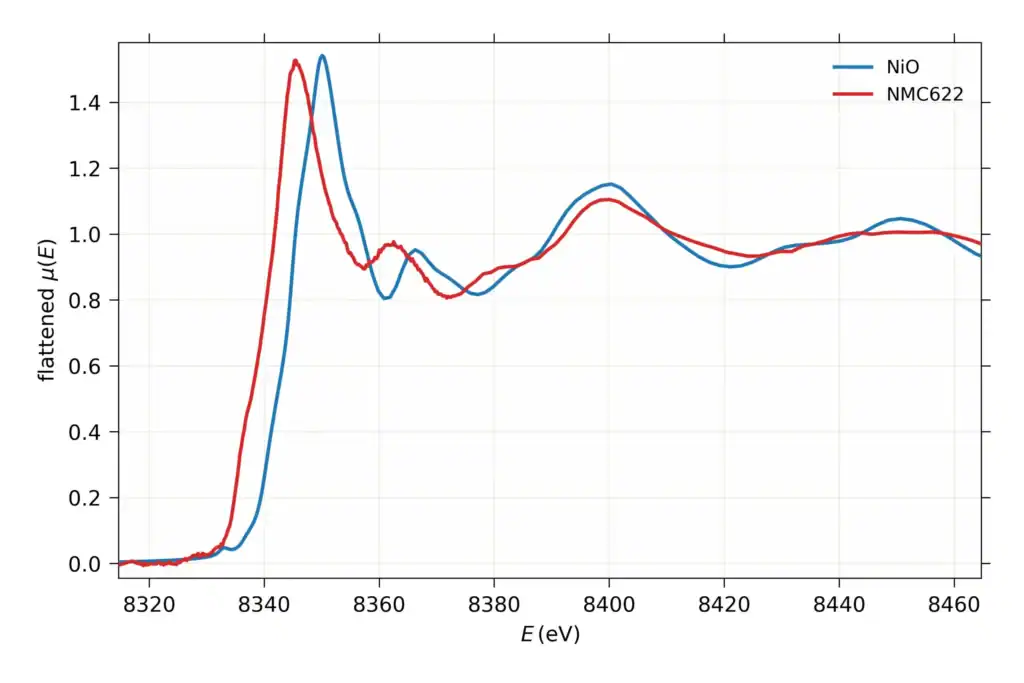
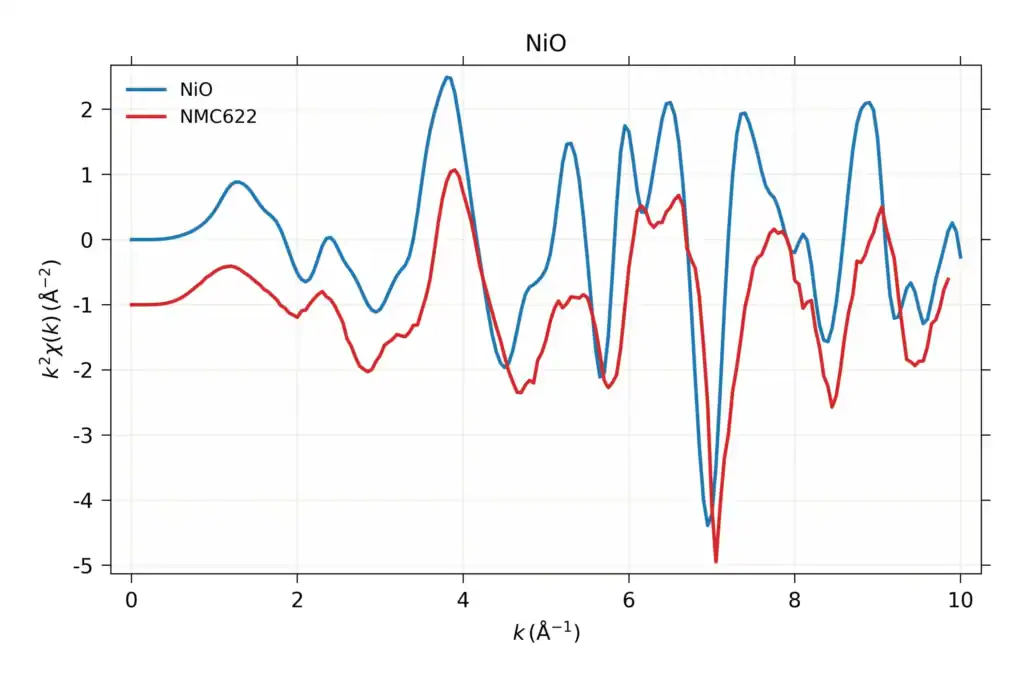
Image of X-ray near-edge spectra of Nickel oxide and Nickel-Manganese-Cobalt lithium-ion battery cathode material.
Sample Requirements
Solids and liquids are possible to measure. Fine powders and thin films are optimal for transmission measurement. Samples should be uniform or ground to a fine powder and diluted in a matrix.
XAS Applications by Industry
Catalysis Research
XAS is used to study the oxidation states and local coordination environments of catalytic active sites, helping researchers understand reaction mechanisms and optimize catalyst performance.
Battery & Energy Materials
XAS helps track changes in the electronic structure and local bonding environments of electrode materials during charging and discharging, providing insights into degradation and performance.
Techniques That Complement XAS
Why Choose Covalent for Your XAS Needs?
Covalent provides advanced XAS analysis for high-resolution characterization of solid and liquid samples, including air- and moisture-sensitive materials. Through XANES and EXAFS measurements, we reveal oxidation states, coordination environments, and bond distances, even for elements at low concentrations. Our experts translate complex spectra into meaningful insights for applications such as catalysis, battery development, and environmental research.
Frequently Asked Questions
What is X-ray Absorption Spectroscopy (XAS) used for?
What is the difference between XAS and XPS?
XPS measures elemental composition and chemical states in the top 7–10 nm of a surface. XAS measures oxidation state, coordination, and bond distances through the bulk of the material, and works on liquids and air-sensitive samples. Use XPS for surface questions and XAS for bulk chemistry; together they show whether surface and bulk behave the same way.