
What Is Zeta Potential?
The electric double layer consists of two main parts: the Stern layer and the diffuse layer. The Stern layer is a tightly bound layer of counter-ions, while the diffuse layer is a more mobile cloud of weakly bound ions. The slipping plane lies between these layers, typically just into the diffuse layer. It reflects where ions outside that plane move freely with the liquid, while those inside remain bound to the solid surface. The zeta potential reflects the net surface charge under flow or motion of the liquid medium.
Since the zeta potential depends on how surface groups ionize and how counter-ions arrange themselves, it is highly sensitive to pH and ionic strength. It can be a strong indicator of colloidal stability, ion-surface interaction behavior, or the functionality of solid materials. For particles in liquid dispersion, zeta potential can be determined by electrophoretic light scattering, and for macroscopic solids, by streaming potential measurements.
Other details:
- Works with powders, colloids, and solids.
- Measurements are completed in minutes for fast results.
- Reliable zeta potential determination under real-world conditions.
Performance Insights
Versatility
Efficient Measurement
Why Use Zeta Potential?
- Important for characterizing a material’s surface and its surface charge under real-world conditions to optimize performance.
- Measures important parameters for determining colloidal stability and aggregation behavior.
- Provides insight into surface functionalization and interaction with dissolved species.
- Can be performed quickly for liquid dispersions or a variety of solid materials, often in a non-destructive manner.
Zeta Potential and Surface Charge
Particle Size and Dispersion
Automation and Compatibility
How Zeta Potential Measurement Works
For liquid, colloidal dispersions, Electrophoretic light scattering (ELS) is used to measure the zeta potential of the particles. An electric field is applied, and the particle movement in response to this applied field is analyzed as particles will move at speeds proportional to their surface charge which causes a measurable doppler shift in the incident laser light. This electrophoretic mobility is used in the Henry equation with additional known parameters of the sample to calculate the zeta potential.
For macroscopic solid surfaces, the streaming potential method is used. This involves flowing an electrolyte solution at various pressures over a geometrically defined area of the sample surface. During this flow, ions from the EDL are sheared off, resulting in a buildup of charge downstream which comprises the streaming current. These parameters along with properties of the electrolyte and geometric factors are used in the Helmholtz-Smoluchowski equations to calculate the zeta potential of the solid surface.
Equipment Used for Zeta Potential

Anton Paar SurPASS 3
For solid, granular, and powder samples:
- Streaming Potential Voltage: ± 2000 mV.
- Streaming Current: ± 2 mA.
- Cell Resistance: 5 Ω to 20 MΩ.
- Conductivity: 0.1 to 2×10^5 mS/m.
- pH Scan Range: 1 to 14.
- Temperature Range: 5 °C to 40 °C.

Anton Paar Litesizer 500
- Dynamic light scattering particle size and zeta potential measurements.
- Zeta potential and molecular mass measurements via ELS and Static Light Scattering (SLS).
- Refractive index measurements.
- Measurement angles: 15° (forward scatter), 90° (side scatter), 175° (backscatter).
- Particle size range: ~0.3 nm – 10.0 μm.
- Zeta potential measuring range: ≥ ±1000 mV.
- Maximum sample conductivity: 200 mS/cm.
- Accuracy and repeatability: better than ±10% and ±3%, respectively.
- Laser light source: 658 ± 3 nm, 40 mW.
- Temperature control range: 0–90°C (±0.3°C accuracy).
Key Differentiators
Directly measures particle surface charge to predict stability, dispersion behavior, and performance characteristics.
Strengths
- Rapid and straightforward data collection.
- Insights for long-term dispersion.
- Non-destructive.
- High sensitivity.
Limitations
- No capability for layered detection.
- Requires exact dimensions and capillary channel cross-section for solid samples.
- Zeta potential is only present when a material contacts a liquid.
Example Outputs
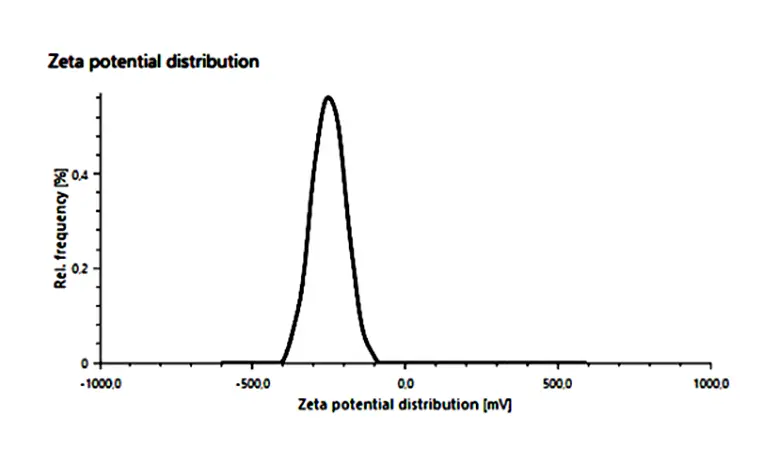
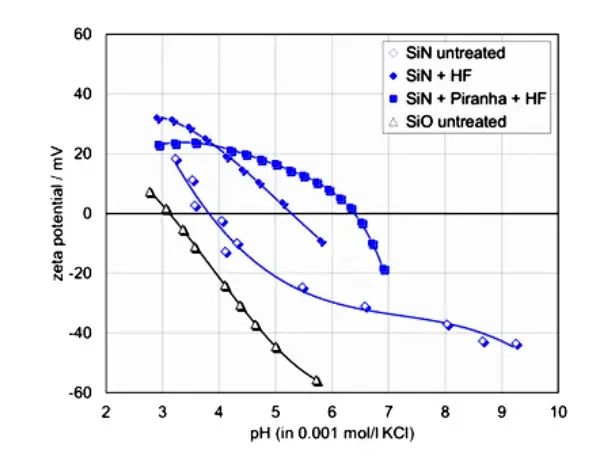
Zeta potential distribution of carbon-black dispersed in toluene (left) and surface zeta potential of SiN wafers after cleaning by hydrofluoric acid, displayed as a function of pH (right).
Sample Requirements
Various simple geometries of solid samples are compatible. Please contact us to inquire if your sample is measurable. Irregular sample geometries are not well-suited for this measurement. Solid samples need a minimum particle size (powders) of 25 μm. Available sample cells are cylindrical, adjustable-gap, and clamping. Liquid dispersed samples require a volume of 2 mL, a maximum sample concentration of 70 % w/v, and a particle size range of 3.8 nm to 100 μm.
Zeta Potential Applications by Industry
Pharmaceuticals & Medicine
Zeta potential helps characterize colloidal drug formulations and predict particle interactions for stability and efficacy.
Cosmetics & Personal Care
Used to evaluate emulsions, creams, and suspensions to ensure long-term dispersion and product consistency.
Paints and Coatings
Assesses particle interactions and stability in pigments and coatings for uniform application and performance, as well as hydrophobicity and other properties of coated solid surfaces.
Water Treatment
Monitors suspended particles and predicts flocculation or aggregation for optimized treatment processes.
Food & Beverages
Analyzes colloidal suspensions to improve the texture, stability, and shelf life of liquid and semi-solid products.
Advanced Materials
Used to assess the surface functionality, stability, uniformity, and as a proxy to composition for precursor materials in refractory, battery, and semiconductor materials.
Techniques That Complement Zeta Potential
Why Choose Covalent for Your Zeta Potential Needs?
At Covalent, we pride ourselves on fast turnaround times, cost-effective solutions, and years of expertise. In our Zeta potential analysis lab, we handle both liquid and solid samples and offer volume pricing. Our expertise extends to adjacent techniques, allowing us to solve complex problems across diverse applications, including pharmaceuticals, nanotechnology, cosmetics, paints, and water treatment.