
What We Offer
- R&D support and process development for coatings, cleaning and sterilization
- Surface and coating analysis for implants, catheters and drug-delivery devices
- Polymer identification, thermal and mechanical properties
- Metal composition and microstructure for implant and instrument alloys
- Cleanliness and contamination analysis on device surfaces
- Failure analysis and root cause investigation
We don't run biological biocompatibility tests (cytotoxicity, sensitization, implantation) or sterility testing. Our materials data often supports the chemical and physical characterization that goes alongside them.
Why Teams Choose Covalent
Speed
Surface analysis, polymer characterization and microscopy are under one roof, so one team answers a question that spans several techniques.
Quality
Scientists who have spent years on medical materials run the work in our ISO/IEC 17025 accredited lab.
Detailed reporting
Reports written to share with design, quality and regulatory teams, with scientific interpretation of each result.
Why Materials Analysis Matters for Medical Devices
A thin coating that doesn't adhere, a residue left after cleaning, or a polymer that degrades after sterilization can lead to recalls and patient risk. Materials analysis finds these problems early and gives you documented evidence for design reviews, suppliers and auditors.
Common Challenges We Solve
| Challenge | What we measure | Techniques |
|---|---|---|
| Coatings on implants and stents | Thickness, uniformity, composition, adhesion | XPS, ToF-SIMS, FIB-SEM, nano scratch testing |
| Surface cleanliness and residues | Organic films, particles, trace metals | XPS, ToF-SIMS, FTIR, SEM-EDS, ICP-MS |
| Polymer behavior | Identity, Tg, crystallinity, molecular weight, viscoelastic response | FTIR, DSC, TGA, DMA, GPC |
| Sterilization effects | Changes in surface chemistry, Tg or molecular weight | XPS, DSC, GPC, FTIR |
| Small devices and MEMS | Internal structure, bonds and voids | Micro-CT, SEM, cross-sections |
| Metal implants and instruments | Composition, microstructure, passivation layer | ICP-OES, SEM-EDS, XPS, metallography |
How We Work With You
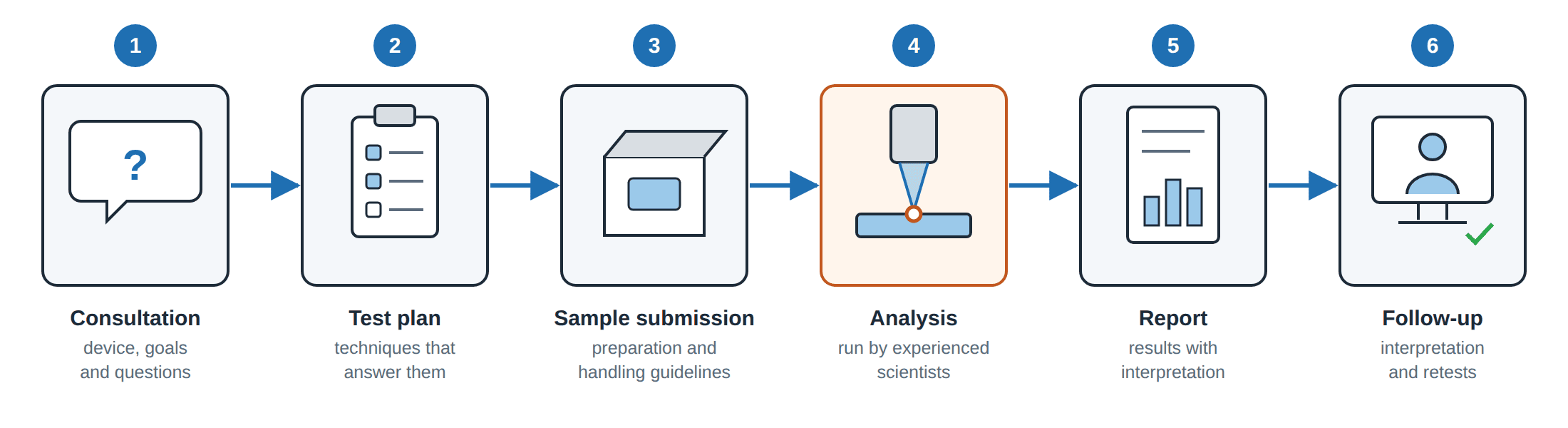
- Consultation: we discuss your device, goals and questions.
- Test plan: our scientists choose the techniques that answer them.
- Sample submission: we give you clear preparation and handling guidelines.
- Analysis: run by experienced scientists.
- Report: clear results with scientific interpretation.
- Follow-up: interpretation sessions and retests if needed.
Techniques for Medical Device Analysis
| Area | Techniques | What you learn |
|---|---|---|
| Surface chemistry | XPS, ToF-SIMS, water contact angle | Coating chemistry, contamination, oxidation and wettability |
| Imaging | SEM, FIB-SEM, AFM, micro-CT | Surface topography, coating cross-sections and internal structure |
| Polymers | FTIR, Raman, DSC, TGA, DMA, GPC | Identity, degradation, thermal and viscoelastic properties |
| Mechanical | Tensile testing, nanoindentation, hardness | Strength, stiffness and coating hardness |
| Composition | ICP-OES, ICP-MS, SEM-EDS | Alloy composition and trace metals |
From R&D to Production
- R&D and material selection: compare candidate polymers, metals and coatings.
- Prototype and pilot production: check coating uniformity, bonding and dimensions on early builds.
- Process development and validation: confirm cleaning, coating and sterilization processes give consistent results.
- Supplier qualification and QC: verify incoming materials and components.
- Aging studies: measure material changes after accelerated aging run by you or your aging lab.
- Failure analysis: investigate field returns and complaints with SEM, FTIR and cross-sections.
Enterprise Metrology Solutions for Medical Device
Device makers work with Covalent's scientists across the product cycle: material and coating selection, process validation, supplier qualification and complaint investigations. A team that knows your devices gives quality and regulatory teams consistent, well-documented data.
Experts on your team
A technical lead and scientists who join your design and quality reviews and know your materials, coatings and processes.
Methods development
New methods for new coatings, polymers and device designs, from coating thickness on a new stent to residue checks after a new cleaning process.
Lab on demand
Extra analytical capacity during design verification, process validation or a complaint investigation, without adding instruments or staff.
One partner, secure data
Surface, polymer and metals analysis in one lab, plus Covalent Connect partner labs, under ISO/IEC 17025 and SOC 2, with documented results in a secure portal.
Medical Device Testing Services at Covalent
Our Sunnyvale lab combines surface analysis, polymer characterization and microscopy under one roof, so a single team can answer a materials question that spans several techniques. You work with scientists who have spent years on medical materials, and reports are written to share with design, quality and regulatory teams. For techniques we don't run in-house, we can place work through Covalent Connect, our network of trusted partner labs.
Turnaround is typically 5–7 business days, with rush options available at an extra cost.
Frequently Asked Questions
Do you perform ISO 10993 biocompatibility testing?
Can you check implant surfaces for contamination?
Can you measure coating thickness on a stent or catheter?
Can you tell whether sterilization changed our polymer?
Can you verify incoming materials from a supplier?
Yes. FTIR, DSC and TGA confirm polymer identity, and ICP-OES and SEM-EDS check alloy composition against your specification.
Can you analyze a device that failed in the field?
Yes. SEM, FTIR and cross-sections show whether a failure comes from the material, the process or how the device was used.