
What We Offer
- R&D support for new chemistries and cell designs, and process development from electrode coating to formation
- Raw material and powder characterization for incoming quality control
- Electrode, separator and electrolyte analysis
- Cell teardown and post-mortem analysis in an inert-gas glovebox
- Degradation and aging studies on cycled cells
- Failure analysis and root cause investigation
- Solar module disassembly and sample preparation
Why Teams Choose Covalent
Speed
Powders, electrodes, electrolytes and gas analysis run in one lab, so a cell teardown doesn't wait on several vendors.
Quality
Cells are opened in an inert-gas glovebox and moved to most instruments in transfer vessels, so samples are measured as they left the cell.
Detailed reporting
Results in a standard format with the key properties for your development work, and a review to turn findings into material and design decisions.
Why Materials Analysis Matters in Energy and Batteries
Small changes in particle size, coating chemistry or trace moisture can cut capacity, cause gassing or lead to thermal runaway. Characterization shows what changed, where and why, so you can fix a material or process before it reaches production.
Common Challenges We Solve
| Challenge | What we measure | Techniques |
|---|---|---|
| Multilayer structures and interfaces | Coating thickness, SEI and CEI layers, interface chemistry | Ion mill + SEM-EDS, XPS, ToF-SIMS, FIB-SEM |
| Moisture and air sensitivity | Samples kept air-free from teardown to measurement | Inert-gas glovebox and transfer vessels |
| Temperature performance | Thermal stability of electrodes, binders and separators | DSC, TGA, TMA |
| Cycle life and degradation | Particle cracking, lithium plating, electrolyte breakdown | SEM, XRD, NMR, FTIR, ICP-OES |
| Safety: gassing and dendrites | Gases released, dendrite growth, separator damage | GC-MS, SEM, micro-CT |
How We Work With You
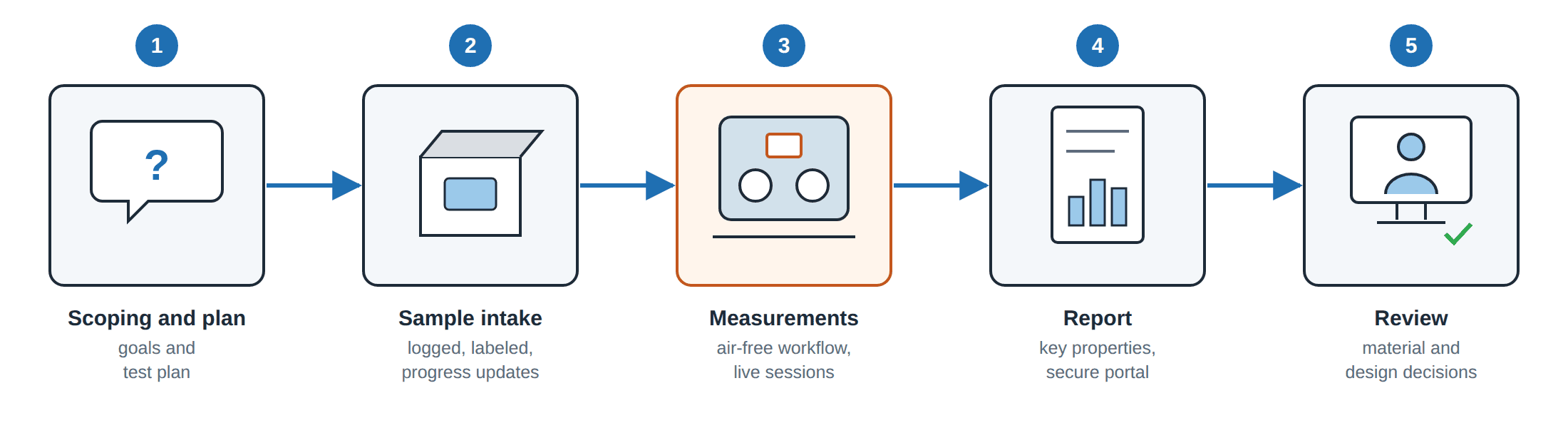
- Scoping and test plan: we define your goals and build a plan around the most relevant analytical and electrochemical methods.
- Sample intake: samples are logged and labeled, with updates as work progresses.
- Measurements: run by our scientists. Live sessions, remote or in person, are available for some techniques.
- Report: results in a standard format, with the key properties for your development work, in your secure portal.
- Review: we help turn the findings into material and design decisions.
Techniques for Battery Analysis
| Area | Techniques | What you learn |
|---|---|---|
| Powders | Laser diffraction, gas pycnometry, tap density, gas adsorption (BET), DLS | Particle size, density, surface area and porosity |
| Microstructure | Ion milling, SEM-EDS, FIB-SEM, TEM | Particle cracking, coatings, porosity and interfaces |
| Surface and interface chemistry | XPS, ToF-SIMS | SEI and CEI composition and lithium distribution |
| Composition | ICP-OES, ICP-MS, CHNS/O | Stoichiometry, impurities and metal dissolution |
| Electrolyte | NMR, FTIR, ion chromatography | Electrolyte composition and degradation products |
| Gas analysis | GC-MS | Gases released during formation, cycling or abuse |
| Nondestructive inspection | 2D X-ray, micro-CT | Internal structure, electrode alignment and defects without opening the cell |
| Electrochemistry | Electrochemical impedance spectroscopy (EIS) | Cell and interface resistance |
| Thermal | DSC, TGA | Thermal stability and binder content |
See also our Battery Electrolyte Characterization service and the Battery Characterization Toolkit.
From R&D to Production
- R&D and process development: compare new chemistries, coatings and electrode processes, and measure the effect of each process change.
- Raw materials and components: particle size, morphology, porosity, density and surface area of powders and separators, checked against spec before fabrication.
- Component validation and QC: structure and chemistry of anodes, cathodes and separators, including integrity, pore structure and uniformity.
- Full-cell teardown and post-mortem: cells opened in an inert atmosphere, each component separated and analyzed for degradation, failure modes, contamination and structural change.
- Reporting and diagnosis: findings across all components, tied to the performance issue you're solving.
Enterprise Metrology Solutions for Energy and Battery
Cell makers, materials suppliers and EV teams bring Covalent's scientists into their development programs, from materials selection and cell design through aging studies, post-mortems and supplier qualification. The same team keeps methods consistent, so results compare over months of development.
Experts on your team
A technical lead and scientists who join your cell development reviews and know your chemistries, electrode processes and earlier teardown results.
Methods development
New methods for new chemistries and cell formats, including solid-state electrolytes, silicon anodes and new electrolyte additives.
Lab on demand
Teardown and characterization capacity during cell development, scale-up or a safety investigation, without building your own glovebox lab.
One partner, secure data
Air-free teardown and analysis in one lab, plus Covalent Connect partner labs, under ISO/IEC 17025 and SOC 2, with results in a secure portal.
Battery Testing Services at Covalent
We combine precise measurements with deep analysis and work as an extension of your R&D team. Beyond measurements, we offer method development, consulting and advanced modeling. Air-sensitive samples stay protected from glovebox to instrument. For techniques we don't run in-house, we can place work through Covalent Connect, our network of trusted partner labs.
Turnaround is typically 5–7 business days, with rush options available at an extra cost.
Frequently Asked Questions
Can you help choose the right techniques?
Can you tear down a battery without exposing it to air?
Yes. We open cells in an inert-gas glovebox and use transfer vessels to move samples to most of our instruments without air exposure.
Can I take part in the measurements?
Can you analyze gases released by a cell?
Do you test solar materials?
Can you measure particle size and surface area of battery powders?
Yes. Laser diffraction, gas pycnometry, tap density and gas adsorption (BET) measure particle size, density, surface area and porosity.
Can you analyze SEI and CEI layers?
Yes. XPS and ToF-SIMS measure SEI and CEI composition and lithium distribution, and ion milling with SEM-EDS shows the layers in cross-section.