
What Is Ion Chromatography (IC)?
Ion chromatography (IC) is a type of liquid chromatography (LC) used to separate and quantify ions. It is primarily used for the analysis of anions and cations (such as chloride, nitrate, sulfate, sodium, potassium and others), as well as amines and small organic acids (formic, acetic, malic and others).
IC is widely applied in electronic manufacturing, environmental testing, pharmaceutical analysis, food and beverage testing, and industrial process control due to its high sensitivity, selectivity, and suitability for water-soluble ionic compounds.
Sensitivity
Separates and quantifies ions at trace level – down to ppb.
Accuracy
Excellent quantitative accuracy and precision – ideal for routine quality control and trace analysis.
High selectivity
Separates ions with similar chemical properties.
Why Use Ion Chromatography?
- Minimal sample requirements – suitable for a wide range of aqueous matrices with straightforward sample preparation (mostly dilution & filtration).
- Suitable for non-volatile and thermally unstable compounds – unlike GC, no need for volatilization.
- Relevant for a wide range of industries and applications – semiconductor manufacturing, environmental testing, pharmaceutical analysis, food and beverage testing, and industrial.
Comprehensive Ion Profiling
Trace-Level Detection
High Accuracy & Reproducibility
How Does Ion Chromatography (IC) Work
Ion chromatography (IC) separates and quantifies ions based on their interaction with an ion-exchange stationary phase (resin).
A liquid mobile phase (eluent) carries the sample through a column containing ion-exchange resin. Ions in the sample compete with eluent ions for binding sites on the resin and are separated according to their charge, size, and affinity for the stationary phase.
After separation, the ions are detected - most commonly by conductivity detection - allowing qualitative identification by retention time and quantitative analysis by peak area.
Equipment Used for IC

ThermoFisher Dionex™ ICS-6000 HPIC
- Advanced modular IC system.
- It features high pressure capabilities – operates continuously at up to 5000 psi.
- Dual-channel system configuration enables simultaneous analysis of anions and cations.
- Equipped with automated eluent generator (Dionex™ ICS-6000 EG), next generation electrolytic suppressor (Dionex™ NGES) and conductivity detector Dionex™ ICS-6000 CD).
- Samples are automatically injected into the system using Dionex™ AS-AP Autosampler.
- Minimized dead volume with finger tight connections (Thermo Scientific Dionex IC PEEK Viper Fittings)
Key differentiators
Strengths
- Highly selective for ionic species.
- High sensitivity — detects ions at trace and ultra-trace levels (ppm to ppb).
- Simultaneous multi-ion analysis.
- Excellent accuracy and reproducibility.
- Minimal sample preparation.
Limitations
- Limited to ionic or ionizable compounds, and small molecules.
- Samples must be in aqueous solution - solid or gaseous samples require extraction or dissolution first.
- Columns are sensitive to contamination by organic solvents, particulates, and strongly retained compounds.
Example Outputs
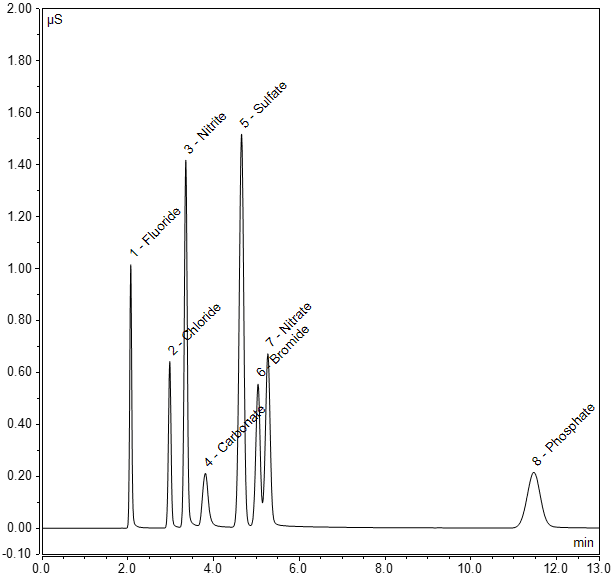
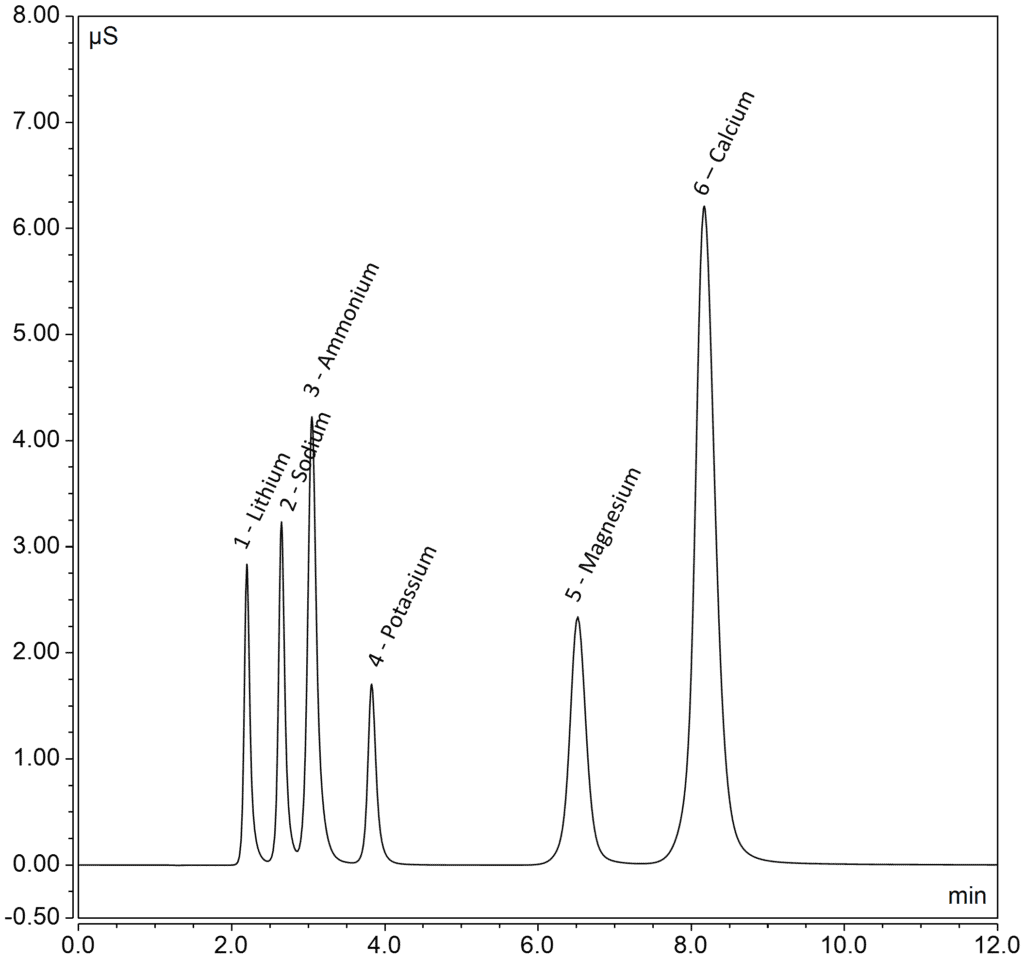
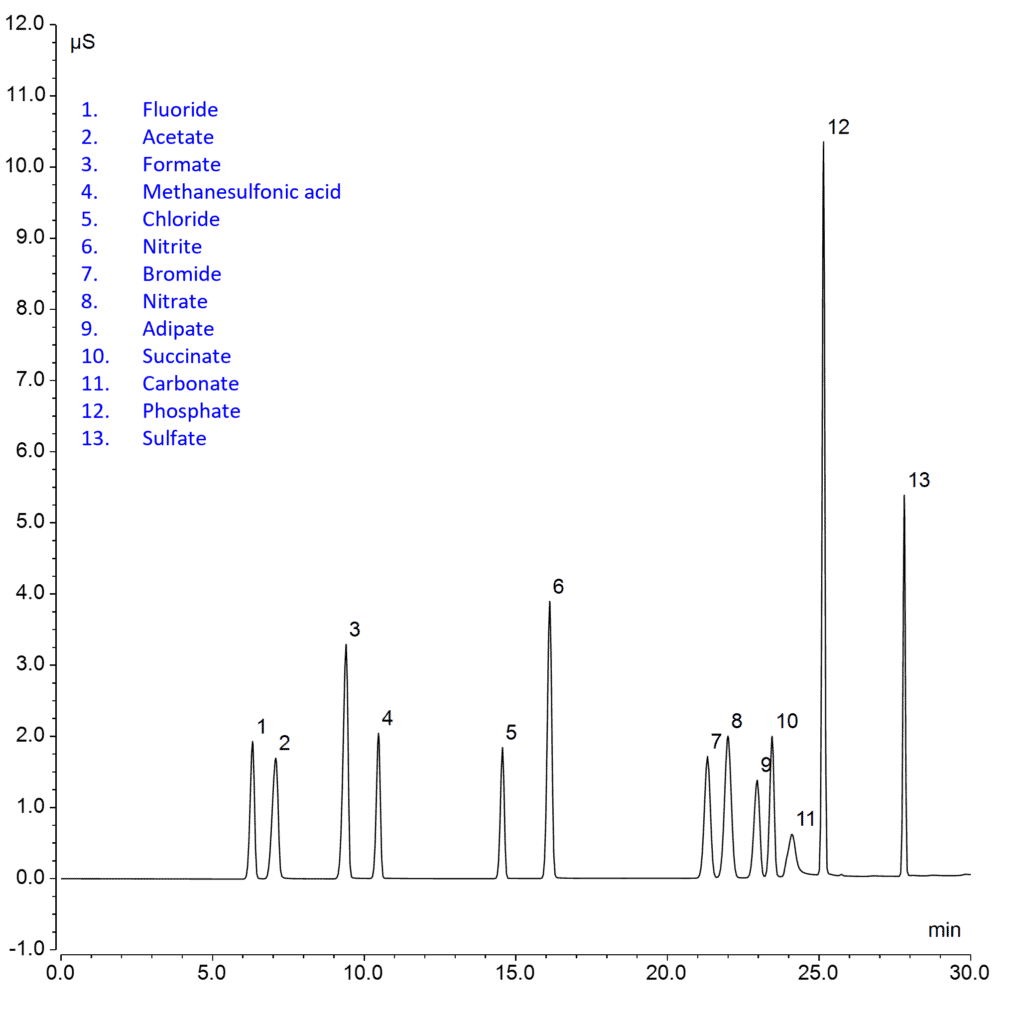
Sample Requirements
- Liquid samples: aqueous solutions and extracts.
- Dissolvable solids: solid materials that can be dissolved into water.
- Environmental samples: filtered environmental samples (e.g., water samples).
- Extracts & rinses: surface extracts or rinse solutions.
Ion Chromatography applications by industry
Electronics Manufacturing
Detects and quantifies trace ionic contaminants that can compromise product reliability and performance.
- PCB ionic cleanliness analysis
- Ultra-pure water (UPW/DI) monitoring
- Cleanroom materials & consumables testing
- Wastewater & environmental monitoring
Food and Beverages
Used for quality control, food safety, and regulatory testing across complex food matrices.
- Organic acids analysis (taste & fermentation)
- Contaminants and adulteration
- Food preservatives
Environmental Water Testing
- Fluoride, chloride, nitrate, nitrite, sulfate, ammonium
- Water quality monitoring & pollution detection
- Regulatory compliance
Techniques That Complement IC
Liquid chromatography technique complements IC well, offering the ability to detect and identify non-ionic and larger molecules.
Complements analysis by identifying volatile and semi-volatile organic compounds after ionic species are analyzed separately.
Why Choose Covalent for Your IC Needs?
Covalent features one of the most advanced ion chromatography systems available - the Dionex™ ICS-6000 HPIC. It delivers high sensitivity, ppm-to-ppb detection limits, and excellent reproducibility. Our dual-channel configuration enables simultaneous anion and cation analyses, supported by next-generation consumables for maximum performance and reliability.
Frequently Asked Questions
What is the difference between Ion Chromatography (IC) and HPLC?
Is IC testing qualitative or quantitative?
What is the difference between IC and ICP-MS?
Ion chromatography (IC) separates and quantifies individual ionic species (e.g., fluoride, chloride, nitrate, sulfate, and organic acids). ICP-MS measures the total concentration of elements (e.g., sodium, calcium, iron, or arsenic) with extremely high sensitivity but does not distinguish between their chemical forms. Together, the two techniques can provide complementary information about both ionic species and elemental composition.