
What Is Vibrating Sample Magnetometry (VSM) Analysis?
Vibrating Sample Magnetometry (VSM) is a magnetic measurement technique that determines a sample’s magnetic moment by vibrating the specimen in a uniform magnetic field and detecting the voltage induced in nearby pickup coils. Because the induced signal is proportional to magnetic moment, VSM provides direct measurement of magnetization behavior over a controlled field range.
VSM is commonly used to generate hysteresis loops and extract key magnetic parameters such as saturation magnetization, remanence, coercivity, susceptibility, and magnetic anisotropy. It is one of the most broadly used methods for routine magnetic characterization because it combines relatively fast measurement speed with good sensitivity and flexible sample handling.
Direct measurement of magnetic moment via induced voltage in pickup coils.
Rapid acquisition of hysteresis loops and key magnetic parameters.
Broad applicability across bulk samples, powders, thin films, and weakly magnetic materials.
Why Use VSM?
VSM is used when quantitative magnetic-property data are needed for materials development, failure analysis, quality control, or research. It is especially useful for comparing the magnetic response of alloys, ferrites, permanent magnets, magnetic nanoparticles, thin films, and weakly magnetic materials under controlled field conditions.
Typical business and R&D drivers include verifying magnetic performance against specification, comparing lot-to-lot consistency, measuring the effect of heat treatment or processing, evaluating coatings or multilayer stacks, and determining whether a material is magnetically soft, hard, weakly magnetic, or superparamagnetic.
Verification of magnetic properties against specification in production materials.
Comparative analysis of magnetic behavior across processing conditions.
Screening and characterization of magnetic nanoparticles and thin films.
How VSM Works
In VSM, the sample is placed in an applied magnetic field generated by an electromagnet or superconducting magnet. Once magnetized, the sample is mechanically vibrated, typically in a sinusoidal motion, near a set of pickup coils. The motion of the magnetic dipole changes the magnetic flux through the coils and induces an AC voltage according to Faraday’s law.
That induced voltage is calibrated against a reference standard and converted to magnetic moment. By sweeping the applied field, the instrument produces a magnetization-versus-field curve. With suitable hardware, VSM can also measure moment as a function of temperature or angle, allowing extraction of Curie behavior, blocking behavior, anisotropy trends, and switching characteristics.

Outputs:
- Magnetization (M) versus magnetic field (H)
- Saturation magnetization (Ms)
- Coercivity (Hc)
- Remanent magnetization (Mr)
- Magnetic susceptibility
- Magnetic moment
- Sensitivity: typically micro-emu range
- Sample size: small bulk coupons, powders, thin films
- Compatibility: wide range of magnetic and weakly magnetic materials
- Corrections: demagnetization effects, holder background, calibration
Equipment Used for VSM

Vibrating Sample Magnetometer (VSM)
- Controlled sample vibration: A vibration source and quartz holder oscillate the sample within a magnetic field.
- Precise field generation: Electromagnet poles create the controlled field required for magnetic measurements.
- Sensitive detection: Pickup coils measure changes in magnetic flux as the sample vibrates.
- Accurate data acquisition: A lock-in amplifier isolates and analyzes the induced magnetic signal.
- Flexible configurations: Optional temperature stages, angular controls, and specialized holders support powders, liquids, thin films, and irregular solids.
Key Differentiators
Strengths
- Fast and quantitative measurements
- Non-destructive in most cases
- Flexible sample handling- adaptable to many forms
- Suitable for routine QC and R&D
- Offers a good balance of sensitivity, measurement speed, and operational simplicity relative to more complex magnetometry methods
Limitations
- Lower sensitivity than SQUID
- Susceptible to mounting and geometry artifacts
- Provides bulk response, not spatial imaging
- Maximum sample size typically less than 25mm
Example Outputs
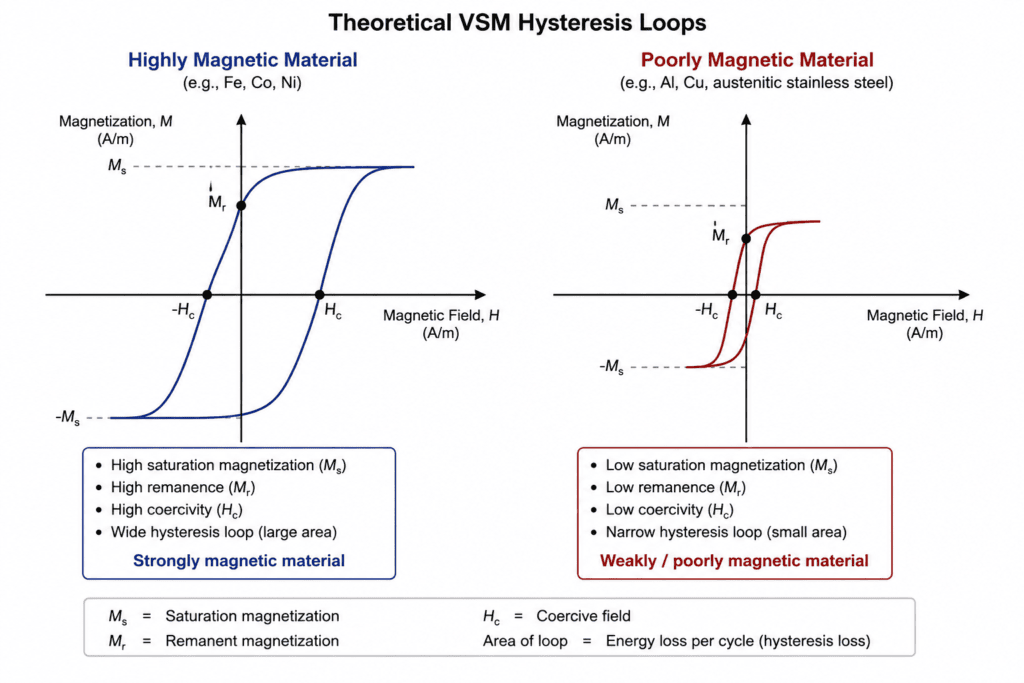
A standard VSM result is a hysteresis loop plotting magnetization versus applied magnetic field. From that loop, we can report saturation magnetization, remanence, coercivity, loop squareness, and evidence of soft- versus hard-magnetic behavior.
For example, a soft magnetic alloy may show high magnetic moment with low coercivity and narrow hysteresis, while a permanent-magnet material may show higher coercivity and stronger remanence. Nanoparticle systems may show reduced coercivity or near-superparamagnetic behavior, and thin films may show orientation-dependent loops that indicate magnetic anisotropy.
VSM Applications
Permanent magnets - Coercivity and Remanence Measurement
VSM is used to quantify key magnetic properties such as coercivity, remanent magnetization, and saturation magnetization. These measurements help determine how strongly a permanent magnet retains its magnetization and how resistant it is to demagnetization.
Nanoparticles - Superparamagnetic Behavior Analysis
VSM can determine whether magnetic nanoparticles exhibit superparamagnetic behavior by evaluating hysteresis, coercivity, remanence, and saturation magnetization. This is especially important for applications such as magnetic separation, biomedical materials, ferrofluids, and magnetic data storage.
Thin Films - Magnetic Anisotropy Characterization
VSM measurements performed with the magnetic field applied in different orientations can reveal magnetic anisotropy in thin films and coatings. The results help identify preferred magnetization directions and assess how deposition conditions, thickness, or microstructure influence magnetic behavior.
Alloys - Heat Treatment Comparison
VSM can compare the magnetic properties of alloys before and after annealing, quenching, aging, or other thermal treatments. Changes in coercivity, remanence, and saturation magnetization can be correlated with phase transformations, grain structure, precipitation, and other microstructural changes.
Ferrites - Magnetic Performance Validation
VSM is used to verify whether ferrite materials meet expected magnetic performance requirements by measuring properties such as saturation magnetization, coercivity, and remanence. These measurements are useful for evaluating ferrites used in transformers, inductors, electromagnetic interference suppression, sensors, and other magnetic components.
Techniques That Complement VSM
Magnetometry
Frequently Asked Questions
What does VSM measure?
Magnetization (M) versus magnetic field (H), Saturation magnetization (Ms), Coercivity (Hc), Remanent magnetization (Mr), Magnetic susceptibility.
What sample types are supported?
Bulk, powders, thin films, nanoparticles.
How sensitive is VSM?
Typically micro-emu range.
What standardized test methos use VSM?
- ASTM A894/A894M – Saturation Magnetization or Saturation Induction of Magnetic Materials Using a Vibrating Sample Magnetometer
- ASTM A342/A342M – Permeability of Feebly Magnetic Materials
- ASTM A773/A773M – DC Magnetic Properties of Low Coercivity Materials
- ASTM A977/A977M – DC Magnetic Properties of High-Coercivity Permanent Magnet Materials
- ASTM A596/A596M – DC Magnetic Properties of Soft Magnetic Materials
- ASTM A772/A772M – Measurement of Magnetic Moment of Materials
How should samples be submitted?
Samples should be securely mounted, free of contamination, and of sufficient magnetic signal. Typical sizes include small solid coupons, packed powders, or mounted thin films.