
What is Atomic Absorption Spectroscopy
Atomic Absorption Spectroscopy (AAS) is an analytical technique used to determine the concentration of specific elements across a range of concentrations. Samples are typically prepared in solution prior to analysis. AAS is recognized for its accuracy, sensitivity, and reliability, and is widely used for targeted elemental analysis in environmental, pharmaceutical, food safety, metallurgical, and industrial applications.
Accurate Trace Metal Analysis
Provides highly selective and sensitive detection of target elements including lead, cadmium, mercury, arsenic, iron, copper, zinc, calcium, and sodium.
Broad Industry Acceptance
Suitable for environmental, pharmaceutical, food, chemical, mining, and academic research applications for routine elemental analysis.
Reliable Quality Control
Supports compliance with regulatory standards and ensures consistent product quality through precise and repeatable elemental monitoring.
Why Use AAS?
AAS is used when selective, high sensitivity analysis of specific elements is required. It provides accurate quantification from parts-per-million (ppm) to parts-per-billion (ppb) levels with relatively low sample volume.
Simple and robust
Well-established technique with decades of proven performance and reliable operation.
Accepted industry standard
AAS is a recognized method for elemental analysis and is specified in certain regulated and industry-defined test methods.
Small sample volume required
Graphite Furnace AAS enables ppb-level detection using very small samples volumes (e.g., ~ 100µL).
How AAS Works
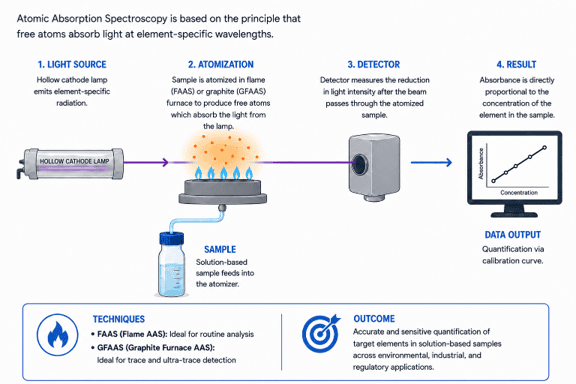
Atomic Absorption Spectroscopy directs element-specific light through a solution-based sample that has been converted into free atoms using a flame or graphite furnace. The target atoms absorb characteristic wavelengths, and a detector measures the decrease in light intensity. This absorbance is compared with a calibration curve to determine the concentration of the target element in the sample.
AAS vs ICP-OES vs ICP-MS
| AAS | ICP-OES | ICP-MS | |
|---|---|---|---|
| Elements per run | One at a time | Many at once | Many at once |
| Typical detection limits | ppm (flame) to ppb (furnace) | Down to ppb | Down to ppt |
| Best for | A few target elements, specified methods | Routine multi-element analysis | Ultra-trace and isotopes |
| Cost per element | Lowest for a few elements | Moderate | Highest |
Key Differentiators
- Quantitative Output: Elemental concentrations are determined from absorbance using calibration curves.
- Flexible Detection Limits:
- Flame AAS: ppm range.
- Graphite Furnace AAS: ppb range.
- Element-Specific Selectivity: Element-specific lamps ensure accurate measurement with minimal interference.
- Versatile Sample Compatibility: Supports liquids and prepared samples, including digested solids, biological samples, and industrial materials.
- Multiple Atomization Modes: Flame and graphite furnace options support both routine and trace-level analysis.
- Configurable Flame Systems: Air–acetylene and nitrous oxide–acetylene flames accommodate a range of elements and matrices.
- Advanced Furnace Capability: Graphite furnace system includes features such as Zeeman background correction for improved accuracy.
Strengths
- High element specificity: Selective measurement of individual elements with minimal interference.
- Strong sensitivity: Capable of ppm to ppb detection depending on method and conditions.
- Proven and widely adopted: Established technique with broad industry and regulatory acceptance.
- Low sample volume requirements: Able to achieve ppm-ppb detection limits from very small aliquots (10mg for solids or 100µl for liquids not requiring digestion).
- Cost-effective for targeted analysis: More economical than multi-element techniques when analyzing a limited number of elements.
- Well-suited for compliance testing: Frequently used in regulated and standardized analytical methods.
Limitations
- Single-element analysis: Each element must be measured individually, reducing throughput.
- Sample preparation required: Solid samples must be digested or otherwise prepared prior to analysis.
- Limited for non-metallic elements: Primarily applicable to metals and select elements.
- Lower throughput: Slower compared to multi-element techniques such as ICP-OES or ICP-MS.
Example Outputs
One of the most common AAS measurements is for Zinc in Insulin. Typical results are shown below:
Lab ID | Client ID | Test | Zn ug/mL | Method | Date |
260124-01 | Lot 3 Day 0 Control | Zinc | 20.30 | USP <591>1 | 2/9/2026 |
260124-02 | Lot 3 Day 1 Sample | Zinc | 20.36 | USP <591>1 | 2/9/2026 |
260124-03 | Lot 3 Day 2 Control | Zinc | 23.69 | USP <591>1 | 2/9/2026 |
260124-04 | Lot 3 Day 2 Sample | Zinc | 20.11 | USP <591>1 | 2/9/2026 |
260124-05 | Lot 3 Day 3 Control | Zinc | 23.02 | USP <591>1 | 2/9/2026 |
260124-06 | Lot 3 Day 3 Sample | Zinc | 22.00 | USP <591>1 | 2/9/2026 |
260124-07 | Lot 3 Day 6 Control | Zinc | 20.89 | USP <591>1 | 2/9/2026 |
260124-08 | Lot 3 Day 6 Sample | Zinc | 23.02 | USP <591>1 | 2/9/2026 |
Sample Requirements
- Sample volume: 5–20 mL of liquid preferred; smaller volumes may be acceptable depending on method and detection limits.
- Solid samples: Must be suitable for acid digestion or provided as a prepared solution.
- Containers: Use clean, contamination-free containers (e.g., acid-washed plastics or glass).
- Contamination control: Avoid metal contamination during handling and transfer.
- Target elements: Specify elements of interest and expected concentration range, if known.
AAS Applications by Industry
Medical / Clinical Analysis
Quantification of elemental content in biological samples for clinical studies and biochemical research.
Environmental Testing
Determination of heavy metals in water, wastewater, and soil for monitoring and regulatory compliance.
Pharmaceutical Analysis
Measurement of elemental impurities and active elemental ingredients in accordance with compendium and regulatory methods.
Food and Beverage Safety
Detection of trace elements, including heavy metals and other impurities to ensure product safety and compliance with regulatory limits.
Metallurgical and Mining Analysis
Determining elemental composition and ore grade for materials containing gold, silver, copper, lead, zinc, iron, and rare earth elements (REE).
Techniques That Complement AAS
SEM-EDS identifies and maps the elements in solid samples without digestion, which is useful for locating metal contamination before quantifying it by AAS.
AAS Testing Services at Covalent
Covalent provides flame and graphite furnace AAS testing through Covalent Connect, our network of trusted partner labs. Our scientists scope your project, help you choose between AAS, ICP-OES, and ICP-MS based on your elements, detection limits, and required test method (such as USP <591>), and coordinate the analysis with the right partner lab. You keep a single point of contact and receive one report, with results interpreted by Covalent scientists and correlated with other techniques when your project needs them.
Frequently Asked Questions
When should I choose AAS over ICP?
When analyzing a small number of elements, when lower cost per analysis is important or when a specific test method requires the use of AAS.
What samples work best?
Liquids or samples that can be prepared in solution, including digested solids.
What are typical detection limits?
Parts-per-million (ppm) for flame AAS and parts-per-billion (ppb) for graphite furnace AAS.
When is flame AAS used versus graphite furnace AAS (GF-AAS)?
Flame AAS is typically used for higher concentration samples and routine analysis, offering faster throughput and good precision. Graphite furnace AAS provides significantly higher sensitivity and is used for trace-level analysis and very small sample volumes.
What compendium methods use AAS?
AAS is used in recognized USP, ISO, ASTM, and Standard Methods procedures across pharmaceutical, environmental, petroleum, and materials testing. Examples include USP <591> for zinc determination, ISO methods for metals in water, ASTM methods for metals in fuels and oils, and Standard Methods 3111 through 3114 for metals in water and wastewater. Contact Covalent to confirm the appropriate method for your sample and testing requirements.