
What Is CHNS/O Elemental Analysis?
Elemental analysis is a group of quantitative techniques that determine how much carbon, hydrogen, nitrogen, sulfur and oxygen a material contains. Most methods burn the sample and measure the gases it produces. The test is also called CHN analysis, CHNS analysis, combustion analysis or LECO analysis, after one of the best-known instrument makers.
Quantitative
Direct measurement of bulk elemental composition, reported in wt% or ppm.
Versatile
Works on materials from organic compounds and polymers to metals, ceramics and minerals.
Small samples
Several elements can be measured from 2 mg or less on micro configurations.
Why Use CHNS/O Analysis?
Few methods can quantify carbon, hydrogen, nitrogen, sulfur and oxygen in a bulk material quickly and accurately. Spectroscopic techniques like XRF and ICP are weak on these light elements or cannot measure them at all. CHNS/O fills that gap and is the standard way to check stoichiometry, measure impurities and additives, and track compositional changes from batch to batch.
Chemicals and polymers
Confirm molecular formula, stoichiometry, purity and polymer formulation.
Metals and manufacturing
Measure carbon, nitrogen, sulfur, hydrogen and oxygen in alloys and processed metals.
Ceramics, minerals and energy materials
Quantify light elements in refractories, catalysts, battery materials and other inorganic products.
How CHNS/O Elemental Analysis Works
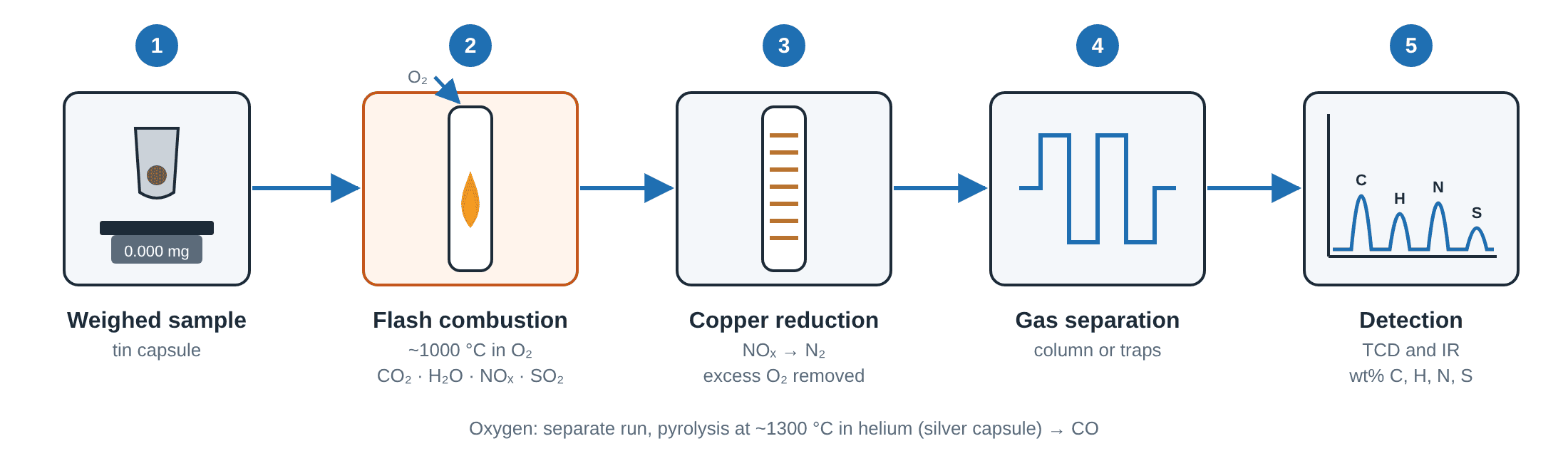
A small sample is weighed on a microbalance to ±0.001 mg and sealed in a tin capsule (1). The capsule drops into a combustion tube held at 950 to 1000 °C under pure oxygen (2). The tin ignites and briefly drives the local temperature to about 1800 °C, so the sample burns completely. Carbon becomes CO₂, hydrogen becomes H₂O, nitrogen becomes N₂ and nitrogen oxides, and sulfur becomes SO₂.
The gas stream then passes over copper at about 600 °C (3), which reduces nitrogen oxides to N₂ and removes leftover oxygen. A chromatographic column or selective traps separate the gases in a helium carrier (4). Thermal conductivity (TCD) and infrared (IR) detectors measure each gas, and the signals are converted to wt% using certified calibration standards (5).
Oxygen is measured in a separate run. The sample, in a silver or quartz capsule, is pyrolyzed at about 1300 °C in helium, and the oxygen it contains is converted to CO and detected by IR. Metals, ceramics and other refractory materials may instead be analyzed by combustion or inert gas fusion in a graphite crucible. We choose the method based on the elements you need, the expected concentrations and the sample matrix.
Typical Analysis Conditions
Parameter | Value |
Combustion temperature | 950 to 1000 °C furnace set point; up to about 1800 °C during tin flash combustion |
Pyrolysis temperature (O) | About 1300 °C in helium |
Sample mass | 0.5 to 300 mg depending on instrument (micro configurations 0.5 to 5 mg) |
Elements measured | C, H, N, S simultaneously; O in a separate run |
Detection | TCD for N₂; IR for CO₂, H₂O, SO₂ and CO (oxygen) |
Measurement range | 0.01 to 100 wt% |
Typical precision | ±0.1 to 0.3 wt% absolute (RSD under 1% for major components) |
Analysis time | 3 to 10 min for CHNS; 5 to 8 min for O |
Carrier gas | Helium (99.999%) |
Key Differentiators
Strengths
- Direct quantitative results, with C, H, N and S measured together in one run
- Bulk measurement that represents the whole sample volume, not just the surface
- Works on a wide range of organic and inorganic materials with minimal preparation
- Wide dynamic range, from 0.01 to 100 wt% on the same calibration
- Small sample sizes, as little as 0.5 mg on micro instruments
- High precision, ±0.1 to 0.3 wt% absolute with certified reference standards
- Backed by established ASTM, ISO and AOAC methods for fuels, food, polymers and pharmaceuticals
Limitations
- Destructive: the analyzed portion is consumed
- Gives the bulk average of the analyzed portion and does not identify bonding, structure or speciation
- Cannot tell organic carbon from inorganic carbonate without acid pretreatment
- High-ash, refractory and halogen-rich samples may need special methods or corrections
- Does not measure metals, phosphorus or elements heavier than sulfur (use ICP-OES or ICP-MS)
- Samples must be homogeneous at the milligram scale, so solids often need thorough grinding
Example Outputs
Results are reported as a table of element concentrations for each sample, in wt% or ppm by weight.
Element (ppm-wt) | Sample 1 | Sample 2 | Sample 3 | Sample 4 |
C | 160 | 2,600 | 2,100 | 1,000 |
N | 35 | 29 | 25 | 36 |
O | 340 | 370 | 400 | 790 |
S | 435 | 333 | 255 | 428 |
H | 92 | 135 | 288 | 111 |
Example CHNS/O results for four samples, reported in ppm by weight. Confirm sample type and method, since ppm-level N and H suggest an inert gas fusion analyzer rather than standard CHNS combustion.
Sample Requirements
- Mass: 1 to 5 mg for micro instruments; 10 to 100 mg for standard instruments
- Form: solids, powders, liquids, films and fibers, most with minimal preparation
- Homogeneity: solids ground to under 200 µm; at least 3 replicates for heterogeneous materials
- Volatile samples: liquid capsules are sealed quickly, and volatile organics may be flash frozen before weighing
- Halogens: tell us if the sample contains more than 1% halogens, since special reagents are needed
- High-ash materials: a larger sample mass may be needed, with blank subtraction for system carbon
Applications by Industry
Pharmaceuticals and fine chemicals
Confirm the molecular formula of APIs and intermediates, screen purity, and tell apart salts, solvates, hydrates and co-crystals.
Energy and fuels
Ultimate analysis of coal, coke and biomass, sulfur content in petroleum products for regulatory limits, and C and H balance in refinery streams and catalysts.
Food, agriculture and fertilizers
Crude protein by the Dumas method, total nitrogen for labeling, and C:N ratio in soils and compost.
Polymers and plastics
Verify polymer composition and co-monomer ratio, nitrogen in polyamides and polyurethanes, and sulfur in vulcanized rubber.
Environmental and geoscience
Total organic carbon and nitrogen in soils, sediments and waste, and characterization of biochar, fly ash and activated carbon.
Advanced materials and ceramics
Residual carbon in sintered ceramics, carbides and nitrides, nitrogen in silicon and aluminum nitride, and C and H in graphite, carbon fiber and CNTs.
Biochemistry
Composition of purified proteins, nucleic acids and peptides, including detection of leftover buffer salts.
Coatings, adhesives and resins
Cure state from C:H:N ratio changes, nitrogen in epoxy hardeners and amine coatings, and sulfur in polysulfide sealants.
Standards for CHNS/O Analysis
- ASTM D5373. Carbon, hydrogen and nitrogen in coal by instrumental combustion.
- ASTM D5291. Carbon, hydrogen and nitrogen in petroleum products and lubricants.
- ASTM D4239. Sulfur in coal and coke by high-temperature combustion.
- ASTM D3176. Ultimate analysis of coal and coke.
- ISO 29541. Total carbon, hydrogen and nitrogen in solid mineral fuels.
- ISO 16948. Total carbon, hydrogen and nitrogen in solid biofuels.
- ISO 16994. Total sulfur and chlorine in solid biofuels.
- ISO 16634. Total nitrogen in food by combustion (Dumas principle).
- AOAC 990.03. Crude protein in animal feed by combustion.
Complementary Techniques
ICP-OES and ICP-MS measure the metals and trace elements CHNS/O cannot, for a complete elemental picture
X-ray Fluorescence (XRF) gives non-destructive bulk analysis from sodium to uranium when the sample cannot be consumed
Analysis (TGA) adds ash, moisture and decomposition data for full proximate and ultimate analysis of fuels
FTIR identifies the functional groups behind the carbon and nitrogen CHNS/O measures
NMR spectroscopy confirms full molecular structure once CHNS/O has checked the empirical formula
Mass spectrometry and GC-MS add molecular weight, which combined with elemental ratios pins down a molecular formula
Ion Chromatography (IC) measures chloride, fluoride and sulfate when halogens or sulfur species matter
CHNS/O Elemental Analysis Services at Covalent
Covalent offers CHNS/O elemental analysis through Covalent Connect, our network of trusted partner labs. We match your samples with a partner lab that runs the right method for your material, whether that is combustion for organics, pyrolysis for oxygen or inert gas fusion for metals. Our team manages the project from quote to final report, and our scientists review the results with you. CHNS/O also pairs well with techniques we run in-house, such as FTIR, NMR, ICP-OES and TGA, so we can combine them in one project when you need the full picture.
Frequently Asked Questions
What is CHNS analysis?
CHNS analysis measures the carbon, hydrogen, nitrogen and sulfur content of a sample by burning it in oxygen and measuring the resulting gases. Adding oxygen, measured in a separate pyrolysis run, makes it CHNS/O analysis.
Can all five elements be measured in one run?
No. Carbon, hydrogen, nitrogen and sulfur can usually be measured together, but oxygen needs a separate pyrolysis or fusion run.
Does elemental analysis identify chemical compounds?
No. It measures how much of each element is present, not how the atoms are bonded. Pair it with FTIR or NMR to identify the compound.
Is CHNS/O analysis destructive?
Yes. Combustion, pyrolysis and fusion all consume the portion of sample that is analyzed, but only a few milligrams are usually needed.
How do I interpret CHNS/O results?
Start with a sum check: C + H + N + S + O + ash should total about 100%. A low total often means the sample contains halogens, phosphorus or metals. To confirm a formula, divide each wt% by the atomic mass, normalize, and compare the mole ratios with the expected formula. A deviation of more than 0.3 wt% absolute is worth investigating.
When should I use CHNS/O instead of ICP or XRF?
Use CHNS/O when you need carbon, hydrogen, nitrogen or sulfur, which standard ICP and XRF cannot measure well. Use ICP-OES or ICP-MS for metals and trace elements, and XRF when the sample cannot be destroyed. CHNS/O and ICP together cover nearly every element.
What is LECO analysis?
LECO analysis is a common name for combustion-based elemental analysis, taken from LECO Corporation, a major maker of these instruments. It usually refers to carbon, sulfur, oxygen, nitrogen and hydrogen measurements in metals and other materials.