
What Is Electrochemical Impedance Spectroscopy?
EIS applies a small sinusoidal voltage or current to a sample held at equilibrium or steady state, then records the response at each frequency. Because the signal is small, the sample is not changed by the test. Fast processes such as ionic conduction show up at high frequency, while slower ones such as charge transfer and diffusion appear at lower frequencies, so one sweep can pull apart contributions that overlap in time-domain methods like cyclic voltammetry.
Non-destructive
A small AC perturbation leaves the sample intact, so the same cell can be tested again after cycling or aging.
Frequency resolved
Sweeping from MHz down to mHz separates fast and slow processes by their time constants.
Bulk and interface
One measurement captures electrolyte resistance, interfacial capacitance and charge transfer resistance.
Quantitative
Fitting an equivalent circuit model returns values in ohms, farads and diffusion terms you can compare across samples.
Why Use EIS?
EIS is one of the few techniques that can test a working device without taking it apart. It is sensitive to small changes at interfaces and in multilayer stacks, which makes it useful for tracking degradation, comparing formulations and screening materials before scale-up. Measurements can run in potentiostatic or galvanostatic mode depending on the sample.
Ionic conductivity
Bulk resistance of liquid, gel and solid electrolytes, converted to conductivity using the cell geometry.
Interfaces
Double-layer capacitance and charge transfer resistance at electrode surfaces and catalyst layers.
Transport
Diffusion coefficients and transference numbers for electrolyte development.
Battery cells
AC internal resistance (ACIR) and impedance growth over cycling for cells and devices tested in-situ.
How EIS Works
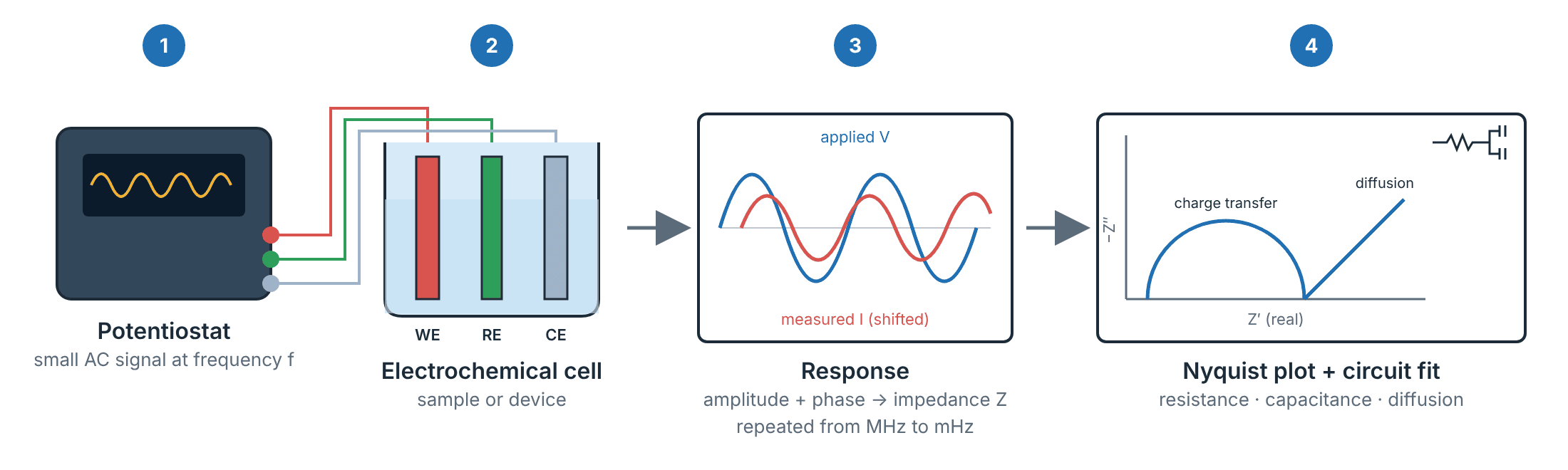
A potentiostat (1) applies a small AC voltage or current at a set frequency to the sample in an electrochemical cell (2), connected through working, reference and counter electrodes. The instrument measures the resulting current or voltage and compares it with the applied signal (3). The ratio of their amplitudes and the phase shift between them give the impedance Z at that frequency. The sweep repeats from MHz down to mHz.
The full spectrum is plotted as a Nyquist plot or as Bode plots of |Z| and phase versus frequency (4). Our analysts then fit an equivalent circuit model to the data. Each element in the circuit maps to a physical process: a resistor for electrolyte resistance, a resistor and capacitor in parallel for charge transfer at an interface, and a Warburg element for diffusion. EIS works on solids and liquids that respond electrically, from coin cells and pouch cells to thin films and wafers.
EIS Equipment at Covalent

Metrohm Autolab PGSTAT302N with FRA32M
- Frequency range up to 1 MHz with the FRA32M impedance module
- Current range ±2 A, potential range ±10 V
- Potential resolution 0.3 µV; current resolution 0.0003% of current range
- Accuracy ±0.2% ±2 mV (potential) and ±0.2% of current range

Gamry Interface 5000E
- Frequency range 10 µHz to 1 MHz, impedance measurements down to 150 µΩ
- Current range ±5 A, potential range ±6 V
- Potential resolution 200, 20 or 2 µV/bit; current resolution 150 pA (0.003% of full scale/bit)
- Built for high-current battery and fuel cell testing

rhd instruments Microcell HC with TSC 1600 Closed and TSC Battery cells
- Air-free, sealed measuring cells for liquid electrolytes and solids
- Temperature control for conductivity versus temperature studies
- TSC 1600 Closed glassy carbon cell compatible with HF-forming electrolytes
- TSC Battery cell for solid electrolytes and electrode materials up to 12 mm diameter
Key Differentiators
VPD-ICPMS provides highly sensitive, surface-specific quantification of metallic contaminants at ultra-trace levels relevant to advanced semiconductor processes.
Strengths
Non-destructive, so samples and devices can be retested over time
Tests complete devices in-situ as well as individual materials
Separates overlapping processes by their time constants
Low-frequency data captures slow processes such as diffusion and corrosion
Gives both quantitative circuit values and qualitative comparisons between samples
Limitations
Samples must be solid or liquid and respond electrically to an AC signal
The sample must stay stable for the full sweep; drift distorts low-frequency data
Equivalent circuit fitting needs expertise, since more than one model can fit the same data
Example Outputs
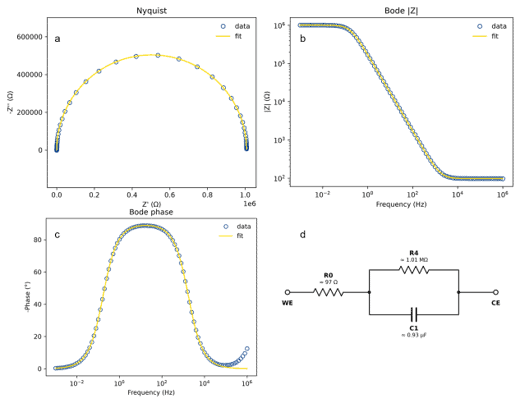
Example EIS data with (a) Nyquist plot, (b) Bode magnitude, (c) Bode phase and (d) the fitted equivalent circuit. The model returns a series resistance of about 97 Ω and a parallel element of about 1.01 MΩ and 0.93 µF, with the fit overlaid on the measured data.
Sample Requirements
Liquids: about 0.9 mL per measurement
Solids: pellets, films or discs up to 12 mm in diameter
Devices: coin cells, pouch cells and other assembled devices can be tested in-situ
Air-sensitive samples can be loaded and measured without air exposure
Tell us the temperature range, bias conditions and any cycling history so we can plan the test
Applications by Industry
Energy storage
Electrolyte ionic conductivity, transference number, diffusion coefficients, ACIR and impedance growth in battery cells.
Fuel cells and hydrogen
High-frequency resistance (HFR) of PEM fuel cells, ionomer and membrane health, and mass transport resistance.
Semiconductors
Charge transport in wafers, dielectrics and interfaces.
Photovoltaics
Light on and light off impedance to study recombination and charge transport in solar cells.
Coatings and corrosion
Barrier performance and coating breakdown over time.
Catalysis and sensors
Charge transfer kinetics at catalyst surfaces and electrode response in sensors and environmental monitoring devices.
Complementary Techniques
EIS is often paired with cyclic voltammetry (CV), a time-domain method that shows redox behavior but blends processes that EIS separates [link to CV page if it exists]. After electrochemical testing, ex-situ analysis explains what changed in the material:
Scanning Electron Microscopy (SEM) to image electrode surfaces, cracks and interphase growth
X-ray Diffraction (XRD) to track phase changes in electrode materials
X-ray Photoelectron Spectroscopy (XPS) to measure surface chemistry and SEI composition [link to XPS page]
EIS Testing Services at Covalent
Covalent runs EIS on three potentiostat platforms, so we can match the instrument to the job, whether that is a high-current cell test or a high-resolution measurement on a thin electrolyte film. Our air-free, temperature-controlled cells handle liquid and solid electrolytes without exposure to moisture or oxygen. Our scientists design the test, run it and fit the data, and the report explains what each circuit element means for your material. When a project needs a technique we do not run in-house, we can source it through Covalent Connect, our network of trusted partner labs.
Frequently Asked Questions
How much does EIS testing cost?
Pricing depends on the number of samples, the number of temperatures or conditions, and any sample preparation. Contact us with your samples and goals and we will send a quote.
What frequency range does EIS cover?
Our instruments measure up to 1 MHz. The lowest useful frequency is usually around 10 mHz, because very long measurements are limited by sample drift. We set the range based on the processes you need to see.
How long does an EIS measurement take?
A single conductivity measurement takes a few minutes. Temperature series, diffusion and transference number measurements can take hours to days.
What is the difference between EIS and cyclic voltammetry?
CV sweeps the potential and records current over time, which shows redox reactions but mixes processes together. EIS uses a small AC signal at steady state and separates processes by frequency, so it can isolate resistance, charge transfer and diffusion.
What is a Nyquist plot?
A Nyquist plot shows the imaginary part of impedance against the real part, with one point per frequency. Semicircles usually point to charge transfer or interfacial processes, and a 45° line at low frequency points to diffusion.
Can you measure ionic conductivity of solid electrolytes?
Yes. We measure pellets and films up to 12 mm in diameter in sealed, temperature-controlled cells and convert bulk resistance to conductivity using the sample thickness and area.
Can you test air-sensitive battery materials?
Yes. Our rhd instruments cells are loaded and sealed without air exposure, which suits lithium and sodium electrolytes and other moisture-sensitive samples.