
What is Laser Micro-Sample Preparation?
Laser micro-sample preparation uses an ultra-short-pulse (femtosecond) laser to ablate material directly from a bulk specimen, producing analysis-ready geometries, including cross-sections, cylindrical pillars, or fully custom shapes, with micron-level precision. Positioning is handled by motorized, piezo-driven stages guided by integrated overview and high-resolution cameras, so operators can navigate to a feature of interest and define the exact geometry to be cut.
Because the laser removes material far faster than an ion beam, it is typically used to perform the bulk of the shaping, including coarse trenching, box milling, or cutting a chunk free from a larger part, before handing the sample off for final polishing with FIB. This division of labor keeps the slow, precise ion beam focused on the last few microns of finishing rather than on removing bulk material.
In practice, laser micro-sample preparation turns hours of FIB milling time into minutes of laser processing, while opening up free-form and custom geometries such as cylindrical pillars, multi-lamella chunks, or user-defined shapes from CAD software which would be slow or impossible to cut with an ion beam alone yet too fine to cut with mechanical sample prep techniques.
Free-Form, Custom Geometries
Cut 2D or 3D shapes to your exact specifications — including cylindrical, multi-lamella, or CAD-defined geometries — directly from bulk material.
Micron-Level Precision
Motorized, piezo-actuated stages with dual cameras position and shape samples with micrometer accuracy.
Minimal Thermal Damage
Ultra-short (femtosecond) laser pulses confine heat-affected zones to a few hundred nanometers or less, preserving the structure you're trying to study.
Why Use Laser Micro-Sample Preparation?
Laser micro-sample preparation adds a fast, flexible bulk-removal step ahead of the precision techniques already used for site-specific analysis. Instead of spending hours milling away bulk material with a focused ion beam, you can rough out the geometry (a lamella, a pillar, a cross-section) with the laser in minutes, then hand the sample to FIB or BIB for finishing. It also opens the door to shapes and materials that are impractical to prepare by ion milling alone.
Rough Cut, Then Refine
Remove bulk material at high speed with the laser, then finish with FIB polishing for a clean, analysis-ready surface.
From Any Material, Any Shape
Ablate metals, semiconductors, ceramics, polymers, and compound materials into free-form 2D or 3D geometries.
Automated, Repeatable Workflows
Software-guided positioning and cutting reduce operator-to-operator variability and shorten time-to-sample across runs.
How Laser Micro-Sample Preparation Works
Laser micro-sample preparation works by focusing an ultra-short-pulse (femtosecond) laser onto a bulk specimen and ablating material along a user-defined path. Using integrated overview and high-resolution process cameras, the operator first navigates to the region of interest, then programs the target geometry: a lamella, an H-bar cross-section, a cylindrical pillar, or a fully custom shape imported from a DXF file. Because the pulses are so short, the laser deposits very little heat into the surrounding material, confining thermal damage to a shallow layer rather than the deeper heat-affected zones associated with longer-pulse lasers.
Once the bulk geometry is defined, motorized and piezo-driven stages execute the cut with micrometer positioning accuracy, and the sample can be transferred directly into the next step of the workflow, whether that's FIB polishing, CT, mechanical testing or something else. Optional CO2 snow-jet cleaning removes debris from the cut surface without chemicals or cross-contamination, leaving the sample ready for downstream processing.
Equipment Used for Laser Micro-Sample Preparation

microPREP PRO FEMTO (3D-Micromac)
- Low-damage preparation: Femtosecond laser ablation minimizes heat-affected zones and material damage.
- Broad material compatibility: Processes metals, semiconductors, ceramics, polymers, and compound materials.
- Flexible geometries: Creates free-form 2D and 3D shapes using standard patterns or imported DXF files.
- Precise positioning: Motorized piezo stages and integrated cameras support accurate, site-specific preparation.
- Streamlined workflows: Compatible with standard mounts, rotation stages, containment, and contactless CO₂ snow cleaning.
Key Differentiators
Strengths
- Femtosecond pulses minimize the heat-affected zone compared with longer-pulse lasers, preserving delicate structures
- Free-form, DXF-programmable geometries, including 2D shapes and cylindrical/3D geometries
- Single platform feeds TEM, FIB/SEM, atom probe (APT), and mechanical-testing sample prep
- High ablation rate cuts bulk-removal time dramatically compared with FIB milling alone
- Automated, software-guided workflows improve repeatability and reduce time-to-sample
- Compatible with standard specimen stubs/mounts for easy hand-off to downstream steps
Limitations
- Laser ablation alone does not deliver a final analysis-ready surface for most techniques; FIB polishing is typically still required to finish
- Not a replacement for ion-beam site-specific milling at the finest length scales
- Best suited to bulk/coarse shaping and geometry definition rather than final surface finishing
- Ablation behavior is material-dependent; highly reflective or thermally conductive materials may need process optimization
- Realizing the full benefit typically means pairing with FIB or another finishing step — an added workflow step to plan for
Example Outputs
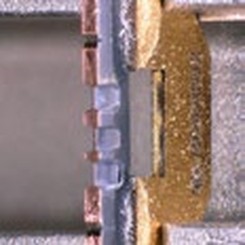
Advanced chunk (total length: 3.2 mm) with multiple lamellae cut from an IC device (lamella size: 150 µm x 50 µm x 10 µm). Source: 3D-Micromac.
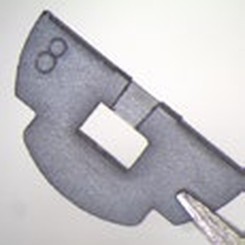
Pre-thinned half-grid structure of a foil/thin sheet of material (here: silicon wafer).
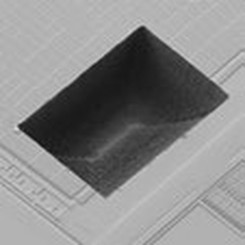
Box milling in preparation for FIB polishing in an IC structure. Source: 3D-Micromac.
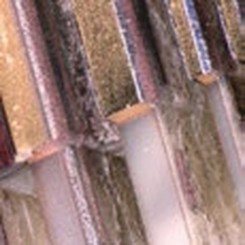
Laser-prepared cross-sections in an IC package.
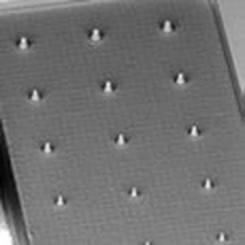
Preparation of a probe card for atom probe analysis with the microPREP PRO FEMTO; each pillar is sized individually. Source: 3D-Micromac.
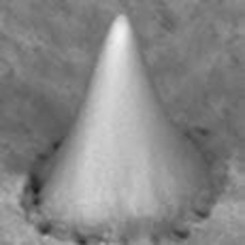
View of a single pillar of the probe card prepared by laser ablation. FIB preparation is required to prepare the final shape.
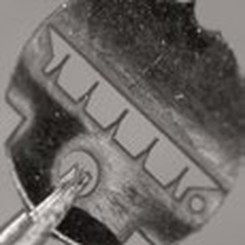
Multi-pillar sample design cut from a steel alloy. Source: 3D-Micromac.
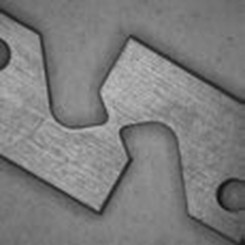
Sample for micromechanical testing cut from Zirconium.
Sample Requirements
Success depends on the starting material and the geometry requested. We can help with sample selection and prep planning.
What we accept: solid phase (metals, semiconductors, ceramics, polymers, and compound materials)
Laser Micro-Sample Preparation Applications by Industry
TEM Specimen Preparation
Laser-defined lamella and H-bar cross-section geometries reduce FIB time to a final polish, speeding up TEM sample turnaround.
FIB/SEM Time Reduction
High-speed box milling and bulk trenching with the laser gives FIB a head start, cutting ion-beam time to a minimum at the target site.
Micro-CT Sample Preparation
Prepare coupons directly from bulk material for high resolution Micro-CT
3D Analysis & Slice-and-View
Operate the system as a lathe to prepare cylindrical samples, or cut slice-and-view geometries to start 3D FIB/tomography workflows directly.
Custom-Shape Cutting for Mechanical Testing
Cut bend, tensile, or other test-specimen geometries to your exact specifications from metals, ceramics, or other structural materials.
Failure Analysis & Process Development
Rapidly expose or isolate a region of interest in a failing part or process-development sample ahead of further analysis.
Techniques That Complement Laser Micro-Sample Preparation
Final polishing and site-specific cross-sectioning after laser bulk removal.
3D imaging of portion of sample removed from a larger bulk sample to improve imaging resolution in CT.
Atomic scale structural characterization of lamellae prepared by laser and FIB.
Electrical characterization of features exposed during sample preparation.
Imaging and navigation during and after preparation
Laser Micro-Sample Preparation Services at Covalent
Our clients trust Covalent to get the right sample, in the right geometry, into the right downstream technique — without losing days to bulk milling. Pairing the microPREP PRO FEMTO with our existing FIB-SEM, TEM, and mechanical testing capabilities lets us take a sample from raw material to finished analysis in one coordinated workflow, cutting turnaround time and cost per sample.
Frequently Asked Questions
What is laser micro-sample preparation?
It's a technique that uses an ultrashort pulse (femtosecond) laser to ablate material from a bulk sample, rapidly cutting it into a target geometry, such as a lamella, a pillar, a cross section, or a custom shape, ahead of further analysis or finishing.
How is this different from FIB milling?
The laser removes material far faster than an ion beam, so it's typically used to rough out the bulk shape. FIB is still used afterward for the fine, final polish most techniques require.
What materials can be processed?
Metals, semiconductors, ceramics, polymers, and compound materials.
Does laser preparation replace FIB polishing?
No. For most analytical techniques, laser preparation removes bulk material and defines geometry, while FIB (or another finishing step) still delivers the final analysis-ready surface.