Skip to main content Skip to footer
Covalent
Login
Covalent
  • Services
    Services
    • Solutions
      Solutions

      Failure Analysis

      Root cause investigation of material, process, and device failures.

      Compositional Analysis

      Compositional analysis identifies the chemistry of a material, down to its elements, molecules, and phases. These measurements verify purity and detect impurities before they impact design, production, or compliance.

      Metrology Consulting Services

      Expert guidance on your metrology strategy and implementation.

      Quality Control Testing

      The difference between good and exceptional lies in the details. Covalent's Quality Control services delve into those details, providing the assurance that your materials and components consistently uphold the highest benchmarks.

      Metallurgical Analysis

      Correlating microstructure to processing, properties, and performance of your metallic alloy systems using advanced sample preparation, testing, imaging, and spectroscopy.

      Material Verification

      Material verification is about knowing exactly what is in your materials. By evaluating materials against the specifications provided, Covalent helps you prevent costly mistakes, failures, and compliance risks.

      Contamination Analysis

      Identify and resolve particulate, chemical, or organic contaminants that compromise material quality, yield, or device function.

      Performance Optimization

      Behind every high‑performing product is a series of deliberate choices about materials and process. Covalent partners with you to refine those choices, translating real‑world behavior into smarter tuning, higher yield, and greater reliability.

    • Applications
      Applications

      Surface & Interface Properties

      Characterize coatings, thin films, and contamination with advanced material analysis to improve reliability and performance.

      Mechanical Testing

      Measure mechanical properties with our engineering testing expertise to validate material integrity and ensure optimal performance.

      Chemical & Compositional Properties

      The elements and structures within a material determine whether a product is safe, reliable, and built to last. Covalent’s chemical composition analysis services give you the clearest possible view of that chemistry.

      Metals Testing

      Identify and quantify metal composition, microstructure, and mechanical properties to ensure performance, reliability, and compliance for your application.

      Coatings Testing 

      From corrosion resistance to biocompatibility, our testing ensures stronger products and global compliance.

      Powder Testing

      Covalent delivers specialized powder characterization services, including powder testing for particle size, shape, and flow. We support metal powder testing services and additive manufacturing powder testing to optimize performance in pharma, energy, and industrial applications.

      Optical Characterization Testing

      Covalent provides precise optical characterization services, delivering critical data on optical properties and thickness for materials, semiconductors, thin films and coatings. Our advanced optical characterization techniques ensure performance, reliability, and compliance.

      Polymer & Plastic Analysis

      Covalent offers comprehensive polymer & plastic testing lab services for polymer analysis, failure analysis, and quality control. Get fast, actionable data to ensure quality, performance, and compliance.

  • Techniques
    Techniques
      • Electron Microscopy
        Electron Microscopy

        Atomic Resolution Electron Microscopy (AEM)

        Images atoms and maps composition, bonding, and strain.

        Differential Phase Contrast

        Visualize local electric fields at the nanoscale.

        Focused Ion Beam Scanning Electron Microscopy (FIB-SEM)

        Combines ion milling and electron imaging for nanoscale analysis.

        Precession Electron Diffraction (PED)

        PED is a TEM-based technique that rotates the electron beam for more precise crystallography at the nanoscale.

        Scanning Electron Microscopy (SEM)

        Images surface topography and composition with electrons.

        Scanning Transmission Electron Microscopy (STEM)

        Provides atomic-scale imaging and spectroscopic mapping.

        Transmission Electron Microscopy (TEM)

        Images atomic structure, defects, interfaces with sub-nm resolution.

      • Chemical Analysis
        Chemical analysis

        Attenuated Total Reflectance Fourier Transform Infrared Spectroscopy (ATR-FTIR)

        Rapid, non-destructive chemical identification.

        Auger Electron Spectroscopy (AES)

        Measures Auger electrons for high-resolution surface analysis.

        Dynamic Secondary Ion Mass Spectrometry (Dynamic SIMS)

        Quantifies elements and isotopes with nanometer depth profiling.

        Electron Probe Microanalysis (EPMA)

        Quantifies elemental composition at the micron scale.

        Energy Dispersive X-ray Fluorescence (EDXRF)

        Quick, non-destructive material composition & thickness analysis.

        Fourier Transform Infrared Spectroscopy (FTIR)

        Rapid, non-destructive molecular fingerprinting across materials.

        Gas Chromatography-Mass Spectrometry (GC-MS)

        Identifies and quantifies small organic molecules in mixtures.

        Gel Permeation Chromatography (GPC)

        Separates molecules by size to determine polymer properties.

        Glow Discharge Optical Emission Spectroscopy (GDOES)

        Sputters surfaces to quantify composition & depth-profile layers.

        Inductively Coupled Plasma Mass Spectrometry (ICP-MS)

        Measures trace elements with high accuracy.

        Inductively Coupled Plasma Optical Emission Spectroscopy (ICP-OES)

        Quantifies multiple elements at very low concentrations.

        Ion Scattering Spectroscopy (ISS)

        Identifies elements in the outermost atomic layer.

        Nanoscale Secondary Ion Mass Spectrometry (NanoSIMS)

        Ultra-high-resolution elemental and isotopic imaging.

        Neutron Activation Analysis (NAA)

        Quantifies elements via gamma rays from irradiated samples.

        Nuclear Magnetic Resonance Spectroscopy (NMR)

        Determines molecular structure, composition, and dynamics.

        Photo-induced Force Microscopy (PiFM)

        Nanoscale chemical characterization & topography at sub-5nm.

        Raman Spectroscopy

        Measures inelastic photon scattering for chemical identification.

        Rutherford Backscattering Spectroscopy (RBS)

        Quantifies elemental composition and thin-film thickness.

        Time of Flight Secondary Ion Mass Spectroscopy (ToF-SIMS)

        Ultra-sensitive surface analysis with chemical imaging & depth profiling.

        Total Reflection X-ray Fluorescence (TXRF)

        TXRF is a surface sensitive elemental analysis technique used to determine the concentration of trace metal contamination on wafer surfaces.

        Ultraviolet Photoelectron Spectroscopy (UPS)

        Determines work function and valence electronic structure of surfaces.

        Ultraviolet Visible Near Infrared Spectrophotometry (UV-Vis-NIR)

        Measures absorbance, reflectance, and transmittance (175–3300 nm).

        Wavelength Dispersive X‑Ray Fluorescence (WDXRF)

        Non-destructive elemental composition & thin-film analysis.

        White Light Interferometry (WLI)

        Measures surface topography with sub-nanometer vertical resolution.

        X-ray Absorption Spectroscopy (XAS)

        Analyzes electronic structure of atoms and molecules.

        X-ray Diffraction (XRD)

        Non-destructive analysis of crystal phases, lattice, and strain.

        X-ray Photoelectron Spectroscopy (XPS)

        Measures surface elemental composition and chemical states.

      • Optical Analysis
        Optical analysis

        Attenuated Total Reflectance Fourier Transform Infrared Spectroscopy (ATR-FTIR)

        Rapid, non-destructive chemical identification.

        Cathodoluminescence (CL)

        Maps bandgap, defects, and strain with SEM correlation.

        Digital Optical Microscopy

        Rapid, high-resolution imaging of a sample.

        Dynamic Light Scattering (DLS)

        Quantifies particle size and uniformity in minutes.

        Electron Probe Microanalysis (EPMA)

        Quantifies elemental composition at the micron scale.

        Energy Dispersive X-ray Fluorescence (EDXRF)

        Quick, non-destructive material composition & thickness analysis.

        Fourier Transform Infrared Spectroscopy (FTIR)

        Rapid, non-destructive molecular fingerprinting across materials.

        Infra-Red (IR) Thermography

        Visualizes surface temperatures to reveal defects & hotspots.

        Laser Scanning Confocal Microscopy (LSCM)

        Non-destructive 3D imaging of sample surfaces.

        Photo-induced Force Microscopy (PiFM)

        Nanoscale chemical characterization & topography at sub-5nm.

        Raman Spectroscopy

        Measures inelastic photon scattering for chemical identification.

        SNOM-Raman

        Maps nanoscale stress and chemistry with 100 nm resolution.

        Spectroscopic Ellipsometry (SE)

        Measures thin-film thickness & optical properties.

        Structured Light Profilometry

        Creates precise 3D models without contact or damage.

        Ultraviolet Visible Near Infrared Spectrophotometry (UV-Vis-NIR)

        Measures absorbance, reflectance, and transmittance (175–3300 nm).

        X-ray Absorption Spectroscopy (XAS)

        Analyzes electronic structure of atoms and molecules.

      • Mechanical Testing
        Mechanical Testing

        Capillary Flow Porometry (CFP)

        Characterizes through-pores in wettable, permeable materials.

        Dye & Pry Testing

        Reveals PCB solder joint cracks & defects.

        Dynamic Mechanical Analysis (DMA)

        Characterizes thermal and mechanical properties of soft materials.

        IPC Compliance Testing (IPC Compliance)

        Verifies IPC-A-610 quality to reduce defects.

        Mechanical Cross-Section Analysis (X-Section)

        Uncovers microstructures and defects causing performance issues.

        Nano-Scratch Test

        Measures lateral/frictional force between tip & sample.

        Nanoindentation

        Determines mechanical properties including hardness & modulus.

        Pendant Drop Surface Tension Measurement

        Provides accurate liquid property analysis for surface tension.

        Rheology

        Evaluates material behavior during processing, storage, and use.

        Tap Density Analysis

        Ratio of sample mass to volume after mechanical tapping.

        Tensile Testing

        Measures material behavior under axial stretching (tension).

        Thermomechanical Analysis (TMA)

        Measures material dimension changes with temp, time, or force.

      • Thermal Analysis
        Thermal Analysis

        Differential Scanning Calorimetry (DSC)

        Quantifies heat flow for material optimization.

        Dynamic Mechanical Analysis (DMA)

        Characterizes thermal and mechanical properties of soft materials.

        Infra-Red (IR) Thermography

        Visualizes surface temperatures to reveal defects & hotspots.

        Thermogravimetric Analysis (TGA)

        Measures material mass changes with temperature or time.

        Thermomechanical Analysis (TMA)

        Measures material dimension changes with temp, time, or force.

      • Morphology & Structural Analysis
        Morphology & Structural Analysis

        2D X-Ray Inspection

        Delivers clear internal views of complex electronics.

        Atomic Force Microscopy (AFM)

        Maps nanoscale topography and material properties with a sharp probe.

        Chromatic Confocal Profilometry & 3D Surface Profiling

        Fast, non-contact 3D surface measurements.

        Dynamic Light Scattering (DLS)

        Quantifies particle size and uniformity in minutes.

        Gas Adsorption Porosimetry

        Characterizes porous materials.

        Gas Pycnometry

        Fast, precise measurements of true volume, density, and porosity.

        Laser Diffraction Particle Size Analysis (LD-PSA)

        Analyzes particle sizes by measuring light scattering.

        Photo-induced Force Microscopy (PiFM)

        Nanoscale chemical characterization & topography at sub-5nm.

        Scanning Acoustic Microscopy (SAM)

        Locates internal flaws like cracks, voids, and delamination.

        Structured Light Profilometry

        Creates precise 3D models without contact or damage.

        X-ray Computed Tomography (Micro-CT)

        Non-contact, non-destructive 2D/3D images at micron scale.

        X-ray Diffraction (XRD)

        Non-destructive analysis of crystal phases, lattice, and strain.

        X-ray Reflectometry (XRR)

        Optimized scans tailored to each sample for best measurements.

        Zeta Potential

        Electric potential at the slipping plane of the EDL.

      • More Techniques
        More Techniques

        4-Point Probe (4PP) Measurement

        Measures sheet resistance and resistivity accurately.

        Scanning Capacitance Microscopy (SCM)

        Maps charge carrier polarity/distribution in semiconductors.

        Surface Free Energy (SFE)

        Quantitative insight into surface energy for adhesion and coatings.

        Water Contact Angle

        Quantitative insight into surface interactions affecting adhesion.

      • Explore All Techniques
    • Resources
      Resources
      • Webinars
        Webinars
        covalent-academy-episode-37-banner-FINAL_Academy-Zoom-scaled

        Battery Material Quality: The Importance of Physical Properties

        Join this webinar to learn what underlying physical properties of battery materials inform the stability and performance of assembled cells,…

        Watch Now
        VF JuneBatteryForum

        Volta Foundation: June Battery Forum

        Covalent offers end-to-end testing of battery materials and assembled cells, and we'll be walking audiences through a robust suite of…

        Watch Now
      • Blogs
        Blogs
        7 Tips for Improving Your “Buy vs. Build” Analysis

        7 Tips for Improving Your “Buy vs. Build” Analysis

        How should you think through the decision of whether to outsource analysis vs. purchase, install, maintain, and support a new…
        Explore
        Strategic Outsourcing of Metrology and Characterization

        Strategic Outsourcing of Metrology and Characterization

        My job provides ample opportunity to speak with engineers, managers, and company leaders about their imaging, measurement, and characterization needs.…
        Explore
      • News
        News

        Expanded Analytical Chemistry Lab at Covalent Provides Comprehensive Testing for Solids and Liquids

        A new ICP-OES and microwave digestor at Covalent round out its chemistry laboratory to deliver complete, modern chemical analysis…

        Explore

        Covalent Offers Fast, High-Res Surface Imaging for Full Wafers With CT300 System

        The new, high-resolution profilometer at Covalent enables non-destructive, high-speed imaging analysis on larger and more intricate samples than ever…

        Explore
      • Library
        Library
        Catalyst Characterization: A Metrology-Driven Approach

        Catalyst Characterization: A Metrology-Driven Approach

        These excerpts of Covalent Academy's webinar on porous materials characterization introduce 3 of the most common techniques in this field.

        Explore
        PCB Failure Analysis: Investigating Defects and Anomalies in Solder Joints

        PCB Failure Analysis: Investigating Defects and Anomalies in Solder Joints

        These excerpts of Covalent Academy's webinar on porous materials characterization introduce 3 of the most common techniques in this field.

        Explore
    • Company
      Company
      • About Us
        About Us
        About

        Covalent transforms complex material testing data into clear, actionable insights. From failure analysis to advanced compositional studies, we partner with innovators across industries to accelerate development and optimize performance.

        Learn more
      • Team
        Team

        We’re scientists, engineers, and problem-solvers first. Over 70% of us hold PhDs or advanced degrees. Every engagement is led by credentialed experts who combine deep technical knowledge with practical solutions tailored to your toughest challenges.

        Meet the team
      • Partners
        Partners

        Trusted by 1,500+ global manufacturers, OEMs, and R&D teams, Covalent builds long-term partnerships that deliver results at scale. Backed by $25M in tools and ISO-accredited methods, we focus on just one thing: data you can act on with confidence.

        Explore our partnerships
      • Careers
        Careers

        Join a team that's shaping the future of material insights. At Covalent, you'll work with world-class scientists, cutting-edge technology, and global industry leaders, all while making a measurable impact.

        View careers
      • Accreditations & Quality
        Accreditations & Quality

        Quality is foundational to our work. Covalent is ISO accredited and operates under a rigorous quality management system. Our processes, data, and results meet internationally recognized standards so you can trust every measurement and insight we deliver.

        Learn more
    • Nexus Membership
    Contact Us
    Get a Quote
    Home/Library

    Library

    Categories

    Application Note

    Measurement of Microscopic Regions Using a High-Speed 2-Dimensional Detector
    Apr 20, 2021

    Measurement of Microscopic Regions Using a High-Speed 2-Dimensional Detector

    Evaluation of microscopic regions of carbide tools Carbide tools used for cutting are provided with various types of coatings to improve durability. Previously, evaluation of…

    Application Note

    Structure Determination of BaTiO3 by PDF Analysis
    Apr 20, 2021

    Structure Determination of BaTiO3 by PDF Analysis

    Ferroelectric BaTiO3 (BT) is widely used as a capacitor material. The ferroelectricity of BT is strongly related to its tetragonal crystal structure, but when the…

    Application Note

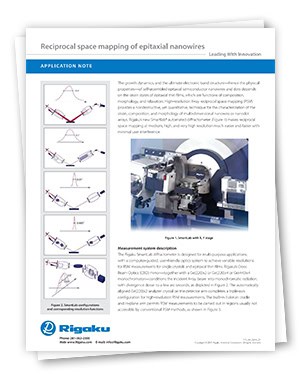
    Reciprocal Space Mapping of Epitaxial Nanowires
    Apr 20, 2021

    Reciprocal Space Mapping of Epitaxial Nanowires

    The growth dynamics, and the ultimate electronic band structure-hence the physical properties-of self-assembled epitaxial semiconductor nanowires and dots depends on the strain states of epitaxial…

    Whitepaper

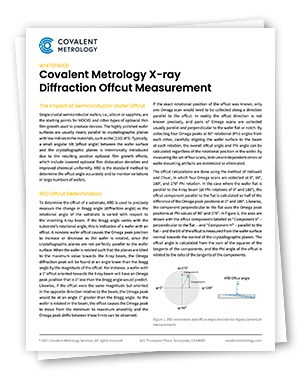
    X-Ray Diffraction Offcut Measurement
    Apr 02, 2021

    X-Ray Diffraction Offcut Measurement

    ABSTRACT In this application note, Dr. Frazer summarizes the impact of offcut angle on thin film growth, and goes on to detail the process by…

    Datasheet

    Covalent Overview
    Jan 21, 2021

    Covalent Overview

    Covalent delivers quality data and expert analysis for advanced materials and device innovation. Our unique combination of cutting-edge analytical instruments and world-class team of scientists…

    Application Note

    AFM Polymer Surface Characterization
    Jan 04, 2021

    AFM Polymer Surface Characterization

    Using Tosca series atomic force microscopes to characterize polymer blends in terms of high-resolution morphology and polymer distribution. The surface properties of polymeric materials are…

    • 1
    • …
    • 10
    • 11
    • 12
    • 13
    • 14
    Subscribe to Our Newsletter

    Subscribe to our newsletter for the latest updates, insights, and breakthroughs - delivered straight to your inbox.

    Covalent

    From specific techniques to complex problem-solving, our platform delivers expert-driven insights.

    Follow us on social media

    • Services by Solutions
    • Services by Applications
    • Techniques
    • FAQs
    • Careers
    • Support
    Contact Information
    925 Thompson Pl
    Sunnyvale, CA, 94085
    hello@covalent.com +1 408-580-0605
    Your Privacy Choices Privacy Policy Terms and Conditions

    Copyright Covalent Corp. 2026. All Rights Reserved.