About Covalent
Our Ecosystem
Solutions
Applications
Electron Microscopy
Chemical Analysis
Optical Analysis
Mechanical Testing
Thermal Analysis
Morphology & Structural
More Techniques
Webinars
Blogs
News
Library
Explore expert-led webinars on failure analysis, interfaces, thin films, and more. Learn how leading R&D teams use advanced analytical techniques to solve real-world engineering problems.
60 mins
Spectroscopic Ellipsometry is a powerful and highly sensitive metrology technique. However, unlocking its full potential requires more than collecting sound data. Nearly all results are only obtained after fitting optical models to the measurements; a sometimes-challenging process with significant repercussions for analytical accuracy. In this webinar recording, ellipsometry expert Dr. Max Junda, Senior Member of…
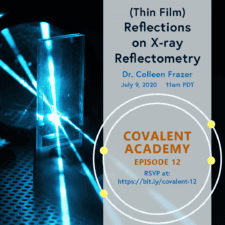
This webinar recording will help you strengthen your knowledge on one of the most useful non-destructive thin film characterization tools available: X-Ray Reflectometry (XRR). This technique provides highly accurate layer thickness measurement as well as electron density and interfacial roughness information on single and multilayer thin film materials. This information can be equally useful in…
In this webinar recording, Dr. Christine Körner, an esteemed guest expert from Anton Paar, will be talking through the fundamentals of Zeta Potential analysis, and highlighting its industrial benefits to a variety of technological applications. Solid surface zeta potential is commonly used as a representative metric for surface charge and gives direct information on processes…
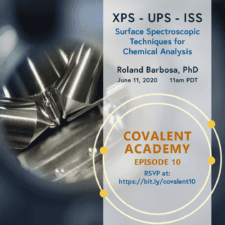
Covalent Metrology previously announced the completed installation of its new Thermo Scientific Nexsa XPS system, which incorporates 3 of the most useful surface chemical techniques available: X-ray photoelectron spectroscopy (XPS), ultraviolet photoelectron spectroscopy (UPS), and ion-scattering spectroscopy (ISS). This webinar recording will deepen your knowledge on those 3 techniques: what they do best, how they…
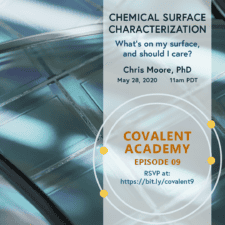
Contamination of surfaces can lead to everything from premature mechanical failure of a part, through delamination issues in films and coatings, to total inactivation of chemical and biological sensors. At the same time, not all material deposited on a surface will pose such risk factors. How can we identify what is, and isn’t, ‘real’ contamination?…
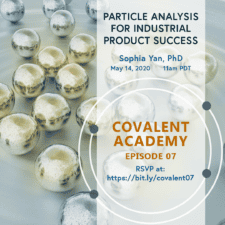
In this webinar, Dr. Sophia Yan will be guiding an exploration of the field of particle characterization: what is entails, why it matters, and how it’s done. Her talk will also highlight key considerations for the industrial applications of these techniques, and comment on some practical aspects of instrumentation. This Webinar will Answer: Frequently Asked Questions