
Jan 19 2026, 5:44 pm
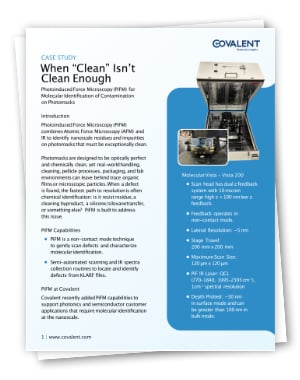
In photonics fabrication, understanding how processing steps (deposition, doping, patterning) alter material chemistry and structure at small scales is essential. Engineers rely on analyses like ellipsometry, reflectometry, and scatterometry to provide bulk or averaged optical properties. Photoinduced Force Microscopy (PiFM) adds local, chemical-specific spectroscopic data, making it valuable when distributed composition or localized defects significantly affect device performance. Covalent recently added PiFM to our toolbox of analytical techniques and it’s proving to be invaluable for developing, manufacturing, and troubleshooting photonic materials and devices.