

What Is Optical Analysis?
Optical analysis quantifies how materials and coatings interact with light across UV, visible, NIR, and mid‑IR bands. Our optical metrology and optical analysis services deliver decision‑ready data and models.
You get:
- Thin-film thickness measurement with sub-nanometer precision (when conditions allow).
- Wavelength-dependent optical constants and refractive index measurement with bandgap estimates (where applicable).
- Spectral transmission and reflectance curves (specular and total/diffuse), plus absorbance and absorption coefficient.
- Color measurement services on request.
- Layer-stack performance versus design targets with fit quality and stated uncertainty.
Where it helps:
- Coating Development: Validate dispersion models and tune deposition with quantitative residuals.
- QA and Incoming Inspection: Transmittance and reflectance testing, and thickness versus acceptance thresholds; drift versus golden lots.
- Design Verification: Compare measured spectra to transfer-matrix predictions; diagnose roughness, intermixing, porosity.
- Process Control: Track run-to-run thickness and optical properties stability; set guard bands.
- Device Correlation: Link optical properties testing results to efficiency, contrast, and uniformity in displays, sensors, photovoltaics, and optics.
We work across dielectrics, semiconductors, polymers, glasses, and metals, covering single films and complex multilayer stacks on planar or slightly curved optics, including textured and porous surfaces that require specialized modeling and measurement.
How It Works
- We align methods to decision criteria and constrain models with multi-technique data. Results are reported with traceable uncertainties and pass or fail tables, which are hallmarks of defensible optical characterization services.
- Define objectives
- Specify spectral range, angles or polarization, and tolerances.
- Establish acceptance criteria and in-use geometry.
- Acquire complementary datasets
- Spectral Ellipsometry to constrain thickness and dispersion.
- UV-Vis-NIR for spectral transmission testing and reflectance, with an integrating sphere for total or diffuse on scattering samples.
- Optional surface or topography inputs (White Light Interferometry) to model roughness-induced scatter.
- Optional FT-IR for vibrational fingerprints and mid-IR optical properties of polymers and organics.
- Model and validate results
- Industry-standard optical models and cross-checks to ensure reliable thickness, refractive index, and spectral results.
- Uncertainty reported with every deliverable.
- Report decision-ready results
- Thickness and n or k versus wavelength with uncertainty.
- Spectral transmittance and reflectance curves, with optional color and haze metrics.
- Acceptance tables with spec thresholds and pass or fail, method notes, and process-tuning recommendations.
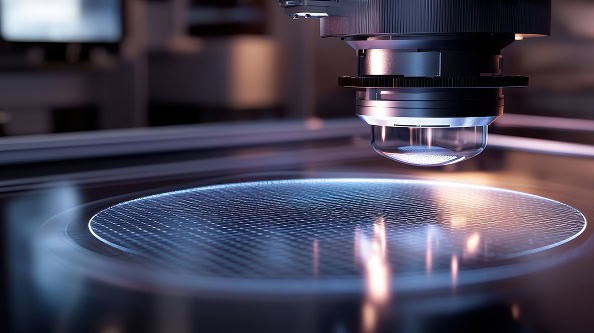
Techniques Used in Optical Analysis
Attenuated Total Reflectance Fourier Transform Infrared Spectroscopy (ATR-FTIR)
Rapid, non-destructive chemical identification. Explore
Cathodoluminescence (CL)
Maps bandgap, defects, and strain with SEM correlation. Explore
Dynamic Light Scattering (DLS)
Quantifies particle size and uniformity in minutes. Explore
Electron Probe Microanalysis (EPMA)
Quantifies elemental composition at the micron scale. Explore
Energy Dispersive X-ray Fluorescence (EDXRF)
Quick, non-destructive material composition & thickness analysis. Explore
Fourier Transform Infrared Spectroscopy (FTIR)
Rapid, non-destructive molecular fingerprinting across materials. Explore
Infra-Red (IR) Thermography
Visualizes surface temperatures to reveal defects & hotspots. Explore
Laser Scanning Confocal Microscopy (LSCM)
Non-destructive 3D imaging of sample surfaces. Explore
Photo-induced Force Microscopy (PiFM)
Nanoscale chemical characterization & topography at sub-5nm. Explore
Raman Spectroscopy
Measures inelastic photon scattering for chemical identification. Explore
Spectroscopic Ellipsometry (SE)
Measures thin-film thickness & optical properties. Explore
Structured Light Profilometry
Creates precise 3D models without contact or damage. Explore
Ultraviolet Visible Near Infrared Spectrophotometry (UV-Vis-NIR)
Measures absorbance, reflectance, and transmittance (175–3300 nm). Explore
X-ray Absorption Spectroscopy (XAS)
Analyzes electronic structure of atoms and molecules. Explore