

What Is Surface Free Energy (SFE)?
Surface free energy (SFE) measurements based on contact angle involve using the contact angles of multiple test liquids (usually with known polar and dispersive components) on a solid surface to calculate the surface energy of that solid. By applying models, data from these contact angles are used to estimate the surface’s total free energy and its polar and dispersive contributions.

Comprehensive
Insights
Comprehensive Insights
Quantifies both polar and dispersive components of surface energy for a full picture.

High
Sensitivity
High Sensitivity
Detects even minor modifications in surface properties through advanced contact angle analysis.

Non-Destructive and
Versatile
Non-Destructive and Versatile
Requires only small samples and works across a wide range of materials.
Why Use SFE?
This technique is widely used to evaluate adhesion, coating performance, and surface modification effectiveness.

Improves Adhesion and Coating Performance
Ensures better bonding, painting, printing, and surface treatments.

Validates Surface Modification
Confirms the effectiveness of treatments like cleaning, plasma, or nanostructuring.

Supports Quality and Process Control
Maintains consistency in surface properties during production and R&D.


Working Principle
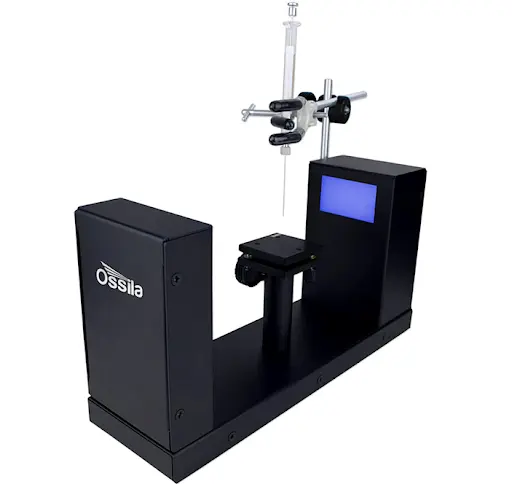
Surface free energy measurement based on contact angle works by carefully depositing microliter droplets of different test liquids from a syringe, typically water, diiodomethane, formamide, and ethylene glycol on a solid surface and measuring their contact angles using a contact angle goniometer. High-resolution images are captured of the backlit droplets and automated image analysis software is used to fit the droplet profile and calculate the angle with the substrate. These angles are then applied to mathematical models, for example, Owens, Wendt, Rabel and Kaelble (OWRK), to calculate the surface’s total free energy, and the individual polar and dispersive components.
Equipment Used for SFE:
Ossila Contact Angle Goniometer
- Angle Range: 5° to 180°.
- Max Measurement Speed: 33 ms (30 fps).
- Maximum Camera Resolution: 1920×1080.
- Typical liquid droplets are on the order of microliters.
- Solvence: Water, Diiodomethane, Ethylene glycol, Formamide.
Key Differentiators
SFE is crucial in applications like coating, adhesion, painting, printing, and surface cleaning. High surface free energies generally lead to better wettability and stronger adhesion, which are essential for effective bonding and coating processes.
Strengths
- Sensitive assessment of polar and dispersive contributions to surface energy.
Limitations
- Doesn’t provide insight into the nature of possible chemical contamination on surfaces, and requires further spectroscopic testing to identify.


Unsure Whether SFE Testing Is Right for You?
By leveraging Covalent surface free energy testing, you gain trustworthy, actionable insight into your material’s surface properties, enabling better process control, higher-quality products, and safer testing practices.
Sample Information
What we accept:
- Solid surface capable of supporting a liquid droplet.
- Typical sample size is ~50x50mm, but smaller or larger is possible.
Use Cases

Surface Cleanliness Verification
Used to assess whether a surface is free of contaminants (like oils or residues), especially in precision manufacturing (e.g., semiconductor wafers, medical implants).
Coating & Adhesion Optimization
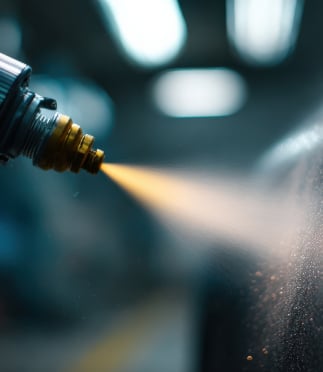
Helps determine if a surface has the right wettability for paints, adhesives, or films to bond properly, critical in automotive, aerospace, and packaging industries.
Hydrophobic & Hydrophilic Surface Design
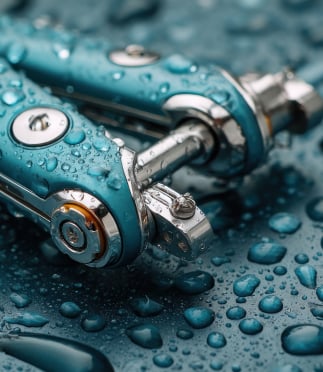
Evaluates surface treatments or modifications (like plasma treatment or nanostructuring) for applications needing water repellency (e.g., waterproof fabrics) or attraction (e.g., biomedical devices).

Quality Control & Process Monitoring
Ensures consistency in surface properties during production, especially in thin-film deposition, surface functionalization, and cleaning processes.
Research in Material Development
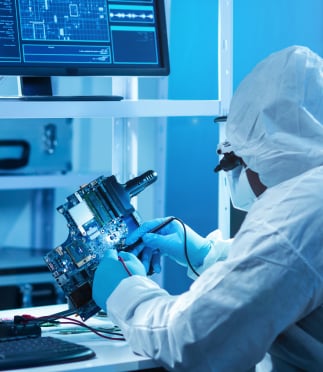
Used in R&D to study new polymers, coatings, or biomaterials where surface interaction with water affects performance or functionality.
Complementary Techniques
- FTIR, XPS and ToF-SIMS enable chemical and elemental analysis of surfaces to identify contamination or further understand wettability and the origin of surface energy differences due to contamination or process changes.
- Pendant drop shape analysis provides complementary surface tension measurements of liquids.
Fourier Transform Infrared Spectroscopy (FTIR)
Rapid, non-destructive molecular fingerprinting across materials. Explore
Pendant Drop Surface Tension Measurement
Provides accurate liquid property analysis for surface tension. Explore
Time of Flight Secondary Ion Mass Spectroscopy (ToF-SIMS)
Ultra-sensitive surface analysis with chemical imaging & depth profiling. Explore
X-ray Photoelectron Spectroscopy (XPS)
Measures surface elemental composition and chemical states. Explore
Why Choose Covalent for Your SFE Needs?
Frequently Asked Questions
Identifying the right test can be complex, but it doesn’t have to be complicated.
Here are some questions we are frequently asked.
How is surface free energy measured?
Surface free energy (SFE) is measured by placing multiple test liquids with known surface tensions on a material’s surface, recording their contact angles, and calculating the SFE using mathematical models.
What equipment is used for SFE testing?
SFE testing uses a contact angle goniometer equipped with high-resolution imaging and analysis software.
What are the common methods for calculating SFE?
The most common SFE calculation methods include the WORK model which analyzes polar and dispersive components of surface energy.
Does surface roughness affect SFE measurement?
Yes, surface roughness can alter liquid spreading behavior and affect SFE results, so smooth, clean surfaces are preferred for accurate measurements.
Which liquids are commonly used as probe liquids?
Water, diiodomethane, ethylene glycol, and formamide are commonly used as probe liquids due to their well-characterized surface tension properties.