

What is X-ray Absorption Spectroscopy (XAS)?
XAS measures the absorption of X-rays as they interact with a sample and provides insights into its chemical composition and bonding. This includes valuable structural and chemical information about the absorbing atom’s local environment, such as coordination number, bond distances, and oxidation state.

Element-Specific
Precision
Element-Specific
Precision
Analyze oxidation state, bonding, and coordination environment of individual elements, even in complex mixtures.

Bulk & Flexible Analysis
Bulk & Flexible Analysis
Works on powders, films, solids, and liquids—suitable for in-situ and operando experiments.

Advanced Structural Insights
Advanced Structural Insights
XAS reveals bond distances and local atomic arrangements, guiding material development and performance optimization.
Why use XAS?
X-ray absorption spectroscopy is element-specific, enabling analysis of specific elements within a sample, even in complex mixtures. XAS provides valuable structural and chemical information about the absorbing atom’s local environment, such as coordination number, bond distances, and oxidation state.
XAS requires easy sample preparation and is bulk sensitive, not limited to sample surfaces. You can perform XAS in situ and operando measurements, for example, during battery cycling.
Other Details:
- Does not require long-range structural order.

Track Materials in Action
Monitor electronic and structural changes in real-time, such as electrode transformations during battery cycling.

Supports Challenging Samples
Analyze air- and moisture-sensitive, dilute, or amorphous samples with high-resolution detection.

Complementary Power
Pair with XPS, SEM/EDS, or XRF for a complete view of both chemical environment and elemental composition.


Working Principle
XAS works by directing X-rays at a sample and measuring how much is absorbed as the X-ray energy varies across a specific element's absorption edge. When the X-ray energy matches the binding energy of core-level electrons, those electrons are ejected, causing an increase in absorption. The spectrum then provides information about the element's oxidation state, electronic structure, and local atomic environment.
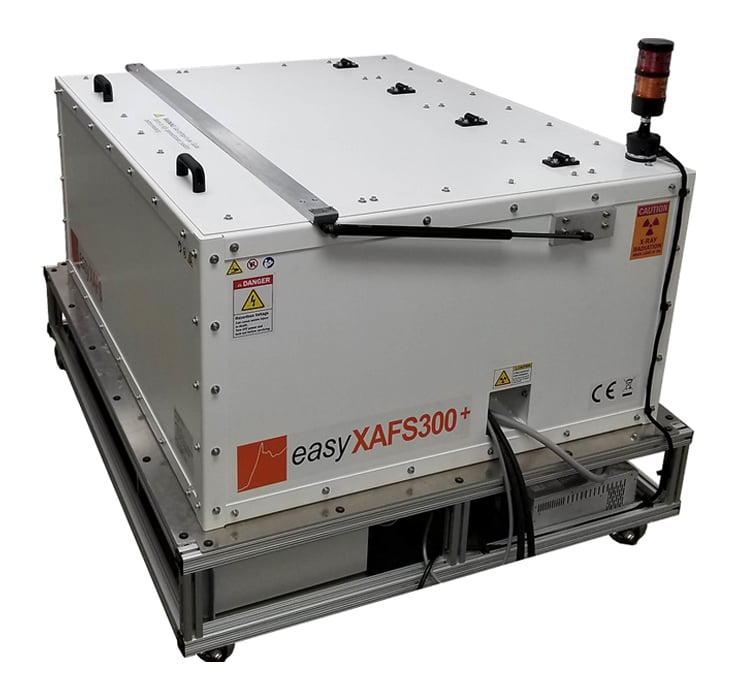
Equipment Used for XAS:
Measurement service makes your X-ray absorption analysis easier and faster.
- Energy range: 4.5–25+ keV, supporting tender and hard X-ray applications in catalysis, batteries, mineralogy, ore processing, and more.
- High-performance spectrometers: Provide synchrotron-level resolution in minutes for routine, high-throughput measurements.
Key Differentiators
XAS provides element-specific precision, flexible analysis in bulk, and reveals advanced structural insights.
Strengths
- Provides quantitative determination of chemical/oxidation state, coordination number, and bonding distances for specific elements in samples.
- XAS provides chemical state information, unlike purely elemental analysis techniques.
- Covalent provides expertise in the interpretation and analysis of data for XAS.
Limitations
- Very low concentrations of samples or materials are not well-suited to XAS.
- Sensitivity is limited to a few tenths of a percent; very low concentrations cannot be measured.
- XPS provides elemental and chemical analysis of the near-surface region of a sample (~5-8nm), while XAS provides bulk information.


Unsure Whether XAS Is Right for You?
Learn how X-ray Absorption Spectroscopy can reveal oxidation states, bonding, and atomic structure in your materials.
Sample Information
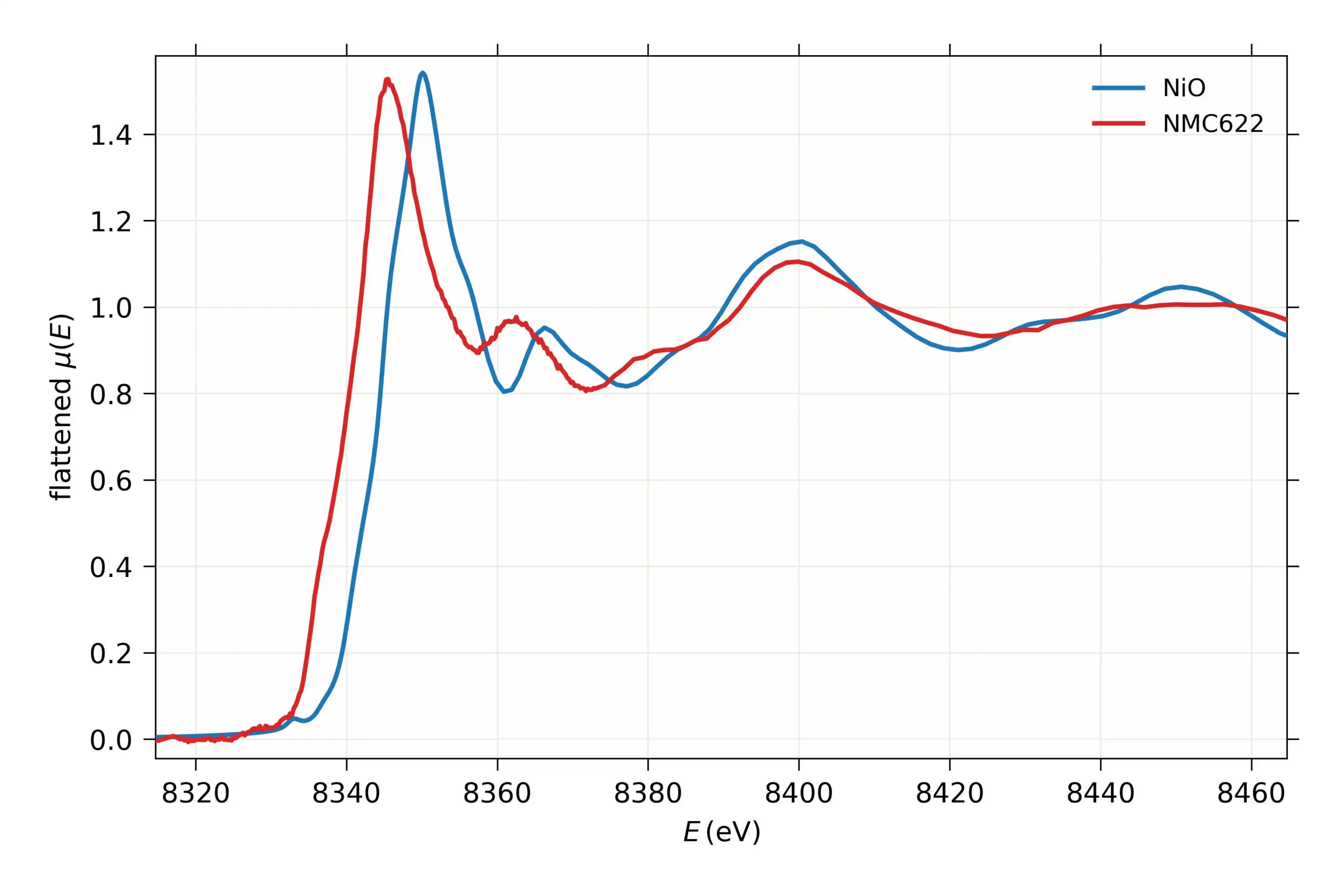
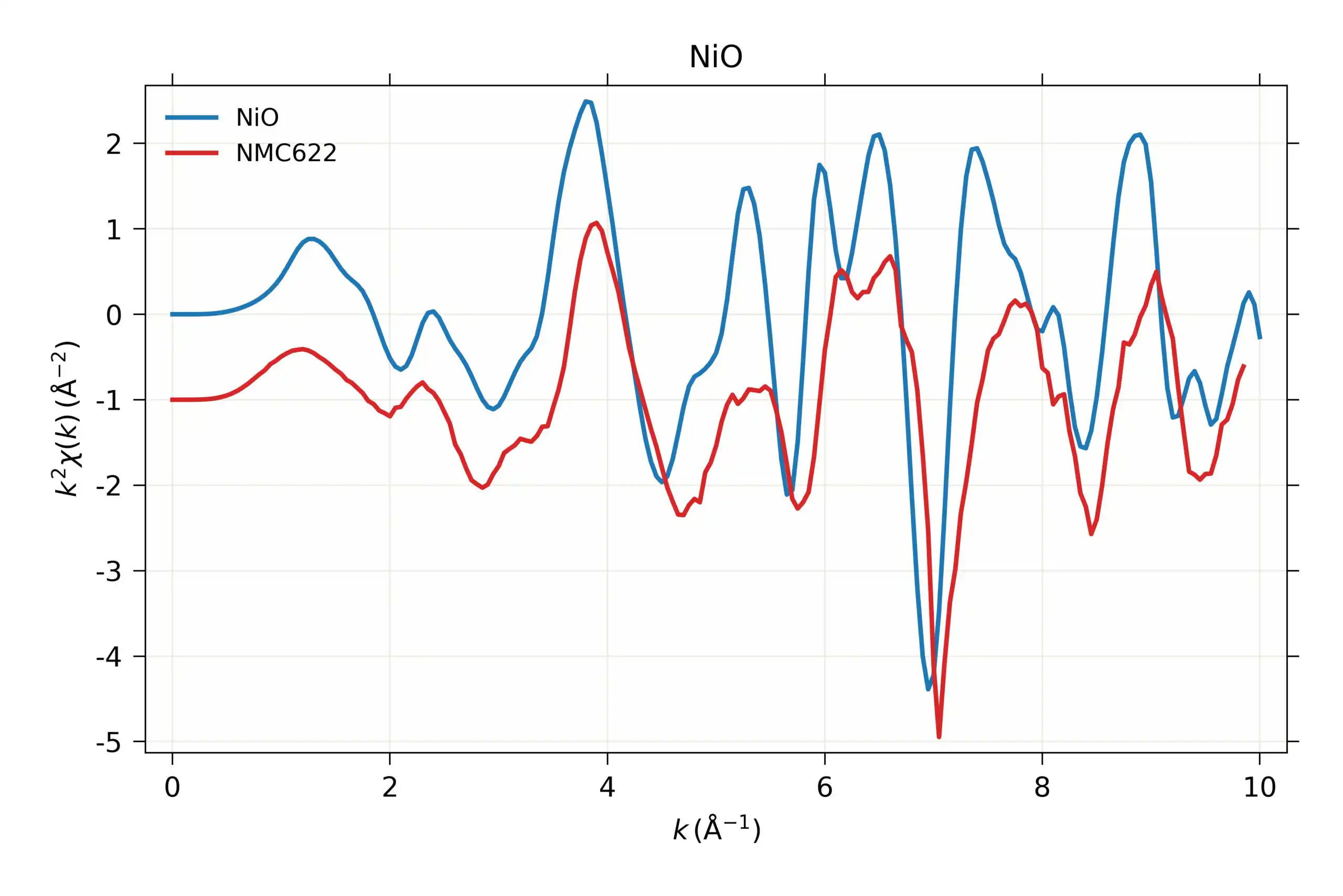
Image of X-ray near-edge spectra of Nickel oxide and Nickel-Manganese-Cobalt lithium-ion battery cathode material.
What we accept:
Solids and liquids are possible to measure. Fine powders and thin films are optimal for transmission measurement. Samples should be uniform or ground to a fine powder and diluted in a matrix.
Use Cases

Catalysis Research
XAS is used to study the oxidation states and local coordination environments of catalytic active sites, helping researchers understand reaction mechanisms and optimize catalyst performance.

Battery & Energy Materials
XAS helps track changes in the electronic structure and local bonding environments of electrode materials during charging and discharging, providing insights into degradation and performance.
Complementary Techniques
- Extended X-ray absorption fine structure (EXAFS): EXAFS is a spectroscopic technique that analyzes the oscillations in the X-ray absorption spectrum beyond the absorption edge to provide information about the local atomic structure and coordination environment of specific elements within a sample.
- X-ray absorption near edge spectroscopy (XANES): XANES is a technique that analyzes the fine structure of X-ray absorption spectra near the absorption edges of specific elements in a sample, providing detailed information about their chemical state and local atomic environment.
- X-ray emission spectroscopy (XES): XES is a technique that analyzes the energy and intensity of X-rays emitted by a sample after it has been irradiated with X-rays, providing information about the electronic structure and composition of the material.
Why Choose Covalent for Your XAS Needs?
Covalent's expert team ensures each scan is interpreted with scientific rigor and contextual relevance, translating complex spectra into meaningful chemical insights. Ideal for catalysis, battery materials, and environmental samples, our XAS services complement elemental techniques like XPS or SEM/EDS, giving researchers a clearer picture of how elements are bonded and behave in real-world materials.
Frequently Asked Questions
Identifying the right text can be complex, but it doesn’t have to be complicated.
Here are some questions we are frequently asked.
What is X-ray Absorption Spectroscopy (XAS) used for?
XAS is used to study the local atomic structure, electronic states, and chemical environment of specific elements in a material.
How does XAS differ from techniques like XRF or XPS?
Unlike XRF (which measures elemental composition) and XPS (which probes surface chemistry), XAS provides element-specific information about local structure and oxidation states.
What types of samples can be analyzed with XAS?
XAS can analyze solids, liquids, thin films, powders, and biological samples across various material types.
What elements can XAS analyze?
XAS can be used to analyze elements from Ti through Ag and Te through U.
Is XAS a non-destructive technique?
Yes, XAS is generally non-destructive, although beam damage can occur for sensitive samples under prolonged exposure.
What kind of information does XAS provide?
XAS reveals details about oxidation states, coordination numbers, bond lengths, and the local chemical environment around specific elements.
What sample preparation is needed for XAS?
Sample preparation depends on the material but typically involves creating thin, uniform specimens. Often, the sample is diluted with an inert low-Z binder and pressed into a pellet to optimize X-ray transmission.