

What Is Ultraviolet Visible Near Infrared Spectrophotometry
(UV-Vis-NIR)?
A UV-Vis-NIR spectrophotometer measures the intensity of light passing through a sample and compares it to the intensity of the incident light. This provides information on how the sample interacts with light at different wavelengths, resulting in the sample’s optical properties spectrum.
The key benefits of using this method include its non-destructive nature, which allows for measurements without damaging the samples or altering their properties. Additionally, it enables rapid measurements, providing faster results that allow for efficient analysis and
decision-making processes.
UV-Vis-NIR also covers a broad wavelength range, measuring samples from 175 nm to 3300 nm. It features a user-friendly platform that supports a diverse range of sample types, including solids, thin films, liquids, and powders.

Non‑Destructive
Optical Measurement
Non‑Destructive
Optical Measurement
Analyzes absorbance, reflectance, and transmittance of samples without altering or damaging them.

Broad Wavelength
Coverage
Broad Wavelength
Coverage
Captures spectral data across
175 to 3300 nm, from ultraviolet through visible to near infrared.

Versatile Sample
Compatibility
Versatile Sample
Compatibility
Reliable measurements on thin films, powders, liquids, coatings, and bulk solids.
Why Use UV-Vis-NIR?
- Offers a non-destructive, flexible, versatile, and yet convenient way to analyze materials across a broad spectral range.
- Provides highly sensitive and precise measurements that can detect subtle changes in optical density or film thickness down to the nanometer scale.
- Very compatible with various sample types such as solids, liquids, powders, and films.
- Relevant for various industries and applications, including semiconductors, coatings, biotechnology, pharmaceuticals, material research, and manufacturing.
- Material characterization, such as determining optical properties, identifying and quantifying compounds, and calculating film thickness, has common applications in various industries.

Precise Optical Characterization
Determines film thickness, refractive index, and subtle spectral shifts with nanometer sensitivity.

Fast and Flexible Analysis
Generates rapid, accurate results across industries from semiconductors to pharmaceuticals and coatings.

Industry‑Relevant Applications
Essential for quality control, optical coatings evaluation, colorimetry, and concentration or band gap studies.

Covalent’s Capabilities Offer UV‑Vis‑NIR for
Non‑Destructive Optical Property
Characterization
Working Principle
A broadband light source is directed through a monochromator or grating system to separate light into a narrow band of wavelengths from the near-infrared (NIR) to ultraviolet (UV). The resulting UV-Vis-NIR spectra interact with the sample, either passing through or reflecting off it, and reach a detector that measures the amount of light absorbed or transmitted at different wavelengths. This process generates a characteristic absorption, transmission, or reflection spectrum, allowing for the extraction of the sample’s optical properties, such as the index of refraction and extinction coefficient, which depend on the sample’s inherent properties. For instance, semiconductors absorb light whose energy exceeds their band gap energy.
- High-Level Advantages (e.g., Broad Spectral Coverage, Quantitative Absorbance Measurement, Non-Destructive Analysis).
- Common Applications (e.g., Optical coating evaluation, haze measurements, Chemical Identification, Band Gap Estimation, Concentration Determination, Kinetic Reaction Monitoring).
- Industries That Benefit from This Technique (e.g., Pharmaceuticals – for drug purity and concentration analysis, Semiconductors – for band gap and thin film optical property evaluation, Chemicals & Materials – for compositional studies and reaction kinetics, Environmental Monitoring – for detecting pollutants and water quality, Energy & Solar – for characterizing photovoltaic and optical coatings).
Equipment Used for UV-Vis-NIR:
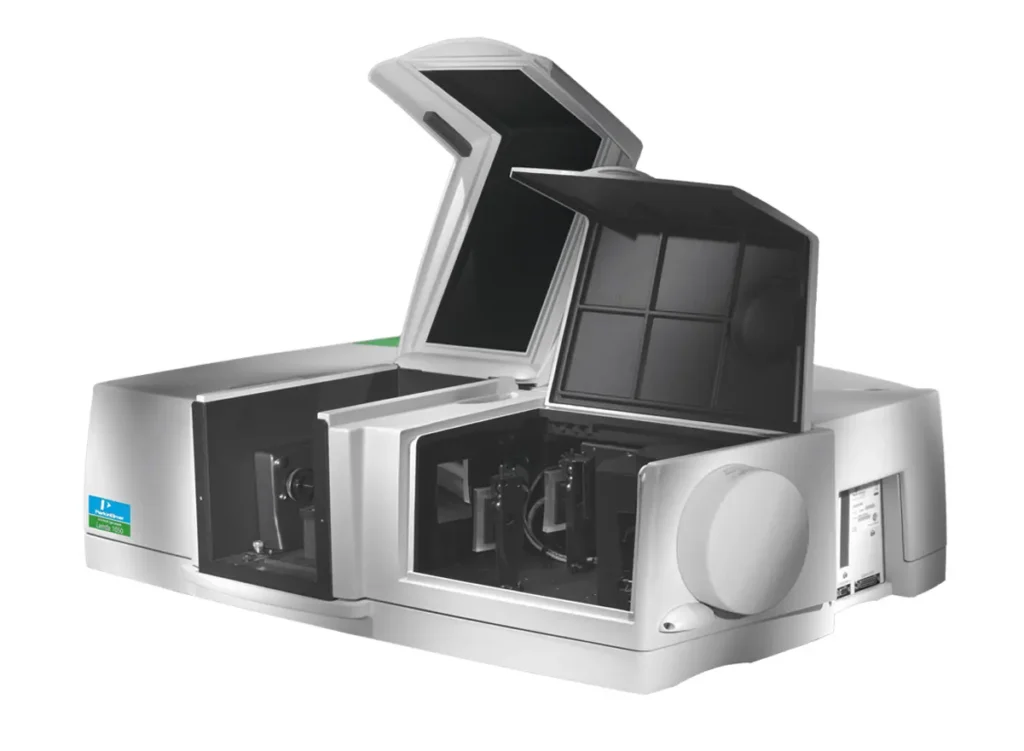
Perkin Elmer LAMBDA 1050
This tool offers the highest performance and flexibility and is well known for its capability for ultra-high UV-Vis-NIR performance.
- Spectral range: 175 to 3300 nm with double-beam, double-monochromator optical design for ultra-high precision.
- Triple-detector configuration: PMT for UV-Vis plus Peltier-cooled InGaAs and PbS detectors for extreme NIR sensitivity and extended range.
- Very low stray light and photometric noise enable accurate measurements on highly absorbing or highly reflective samples.
- Flexible sampling with large primary and secondary compartments and modular snap-in accessories to support a wide variety of UV-Vis-NIR applications.
Key Differentiators
In terms of materials, UV-Vis-NIR can measure a wide spectrum of materials, including semiconductors, dielectrics, biomolecules, and various organic and inorganic compounds in solid, liquid, or powdered forms.
Strengths
- Non-destructive technique allows for sample re-use and further analysis.
- Fast, precise measurements with minimal user training needed.
- Requires less data processing than methods like spectroscopic ellipsometry.
- Compatible with various sample types, not limited to specular reflecting solids.
- At Covalent, we enhance analyses using UV-Vis-NIR and variable angle measurements for greater precision.
Limitations
- Light scattering by suspended solids or bubbles can lead to inaccurate measurements; avoid these areas.
- Overlapping absorption peaks in complex samples hinder the differentiation and quantification of components.
- UV-Vis-NIR spectroscopy offers limited molecular information; FTIR or Raman is more effective.
- Misalignment of components, like sample holders or optics, can result in inaccuracies.
- Below ~190-200nm, nitrogen purging is needed to minimize UV absorption by oxygen.


Unsure Whether UV‑Vis‑NIR Is Right for You?
Learn how non‑contact optical testing can support your materials characterization and product development.
Sample Information
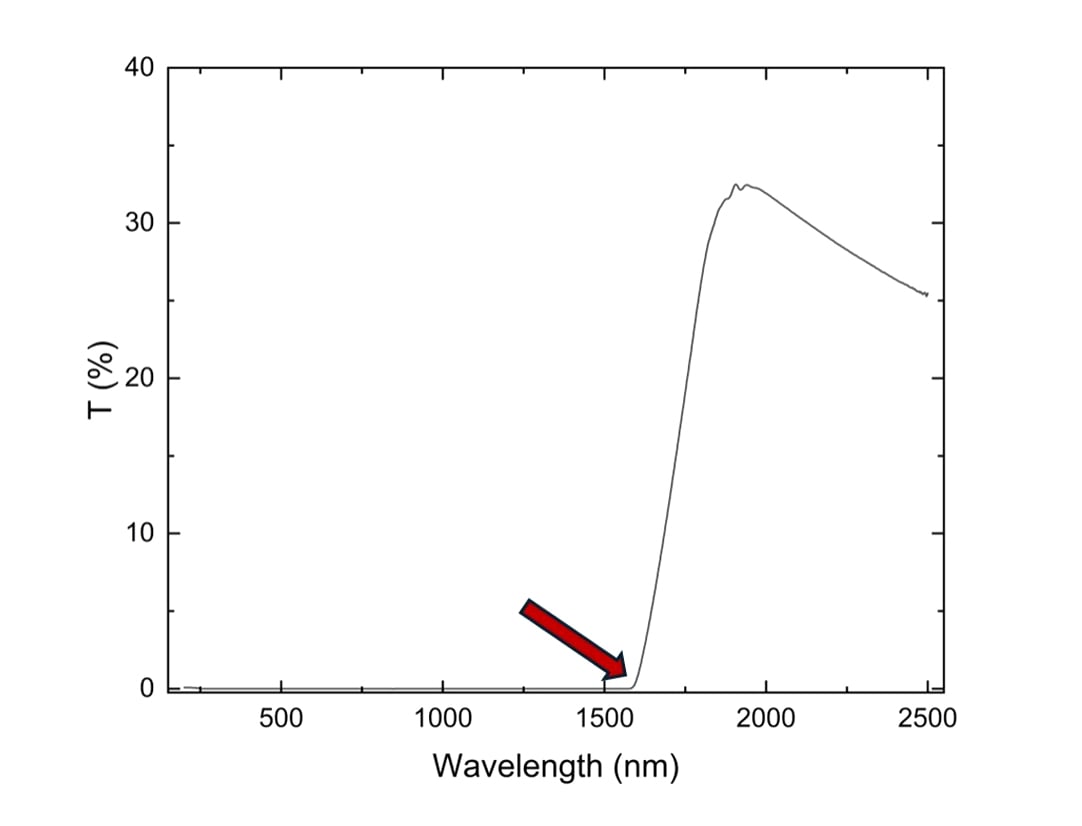
UV-VIis-NIR spectrophotometry has various types of output spectra in the form of transmittance, absorbance, or reflectance. While optical coating results are mostly shown as reflectance or transmittance curves, the output for semiconductors is shown in transmission or absorbance curves. The following is a typical output of a semiconductor transmittance curve. The sample starts absorbing when the energy of light is higher than the bandgap energy of the sample (given by the arrow). In general, Reflectance (R) + Transmittance (T) + Absorbance (A)= 100 A = 100 – (T+R) Material properties such as bandgap can be obtained from the absorbance of sample as long as the sample is a single layer.
What we accept:
Scattering from solids or bubbles can lead to inaccurate measurements, and overlapping peaks in complex samples complicate quantification. UV-Vis-NIR spectroscopy provides limited molecular information, making FTIR or Raman techniques preferable. Misalignment of components and nitrogen purging below 190-200 nm are also critical for accurate results.
Use Cases

Semiconductor
- UV-Vis-NIR spectrophotometry is widely used to measure the thickness and optical constants (refractive index n and extinction coefficient k) of thin films used in semiconductor devices.
- Film properties can be obtained via optical modeling by analyzing the transmission and reflectance spectra.
- Thickness and optical properties of semiconductors and metal oxides are monitored using UV-Vis-NIR spectrophotometers during fabrication.

Biotechnology & Life Sciences
UV-Vis-NIR spectrophotometers are standard tools for assessing the purity and concentration of nucleic acids, enzymes, proteins, etc., by measuring the absorbance at the UV spectral range.
Optics & Coating Industry
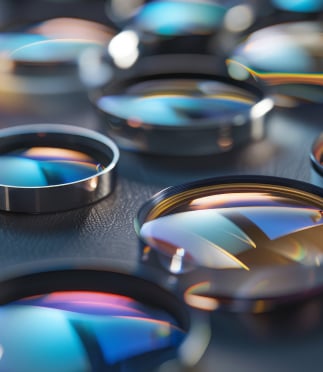
- UV-Vis-NIR spectrophotometry evaluates the transmittance, reflectance, and absorption of optical coatings (e.g., anti-reflective, high-reflective, beam splitters, etc.).
- Spectral data helps monitor coating performance and uniformity.

Materials & Manufacturing
UV-Vis-NIR spectrophotometry measures and quantifies the colors, appearance, haziness, and gloss of materials such as plastics, textiles, paint, and ceramics.
Complementary Techniques
Based on applications, some optical spectroscopy techniques that can complement or replace are given as follows.
- Fourier-Transform Infrared Spectroscopy (FTIR): FTIR identifies chemical bonds in materials with weak UV-Vis-NIR absorption, covering 2.5 µm to 25 µm wavelengths. It can be combined with UV-Vis-NIR for extended measurement.
- Raman Spectroscopy: Raman spectroscopy explores vibrational structures through inelastic light scattering, complementing UV-Vis-NIR absorption data for cross-validation.
- Spectroscopic Ellipsometry (SE): It is a highly accurate and more robust technique formeasuring film thickness and optical constants compared to transmission/reflection measurement offered by UV-Vis-NIR.
Covalent is equipped with alternative optical spectroscopy, such as SE, FTIR, Raman, PL, and XPS, to replace or complement UV-Vis-NIR according to the use cases.
Fourier Transform Infrared Spectroscopy (FTIR)
Rapid, non-destructive molecular fingerprinting across materials. Explore
Raman Spectroscopy
Measures inelastic photon scattering for chemical identification. Explore
Spectroscopic Ellipsometry (SE)
Measures thin-film thickness & optical properties. Explore
Why Choose Covalent for Your UV-Vis-NIR Needs?
Frequently Asked Questions
Identifying the right test can be complex, but it doesn’t have to be complicated.
Here are some questions we are frequently asked.
How does UV-Vis-NIR spectrophotometry work in the analysis of thin films?
UV-Vis-NIR spectrophotometry (also referred to as uv vis nir spectroscopy) measures how much light a thin film absorbs, transmits, or reflects across ultraviolet (UV), visible (Vis), and near-infrared (NIR) wavelengths. By using a uv vis nir spectrophotometer to analyze these light interactions, you can determine film thickness, optical properties, and overall quality without physically altering the sample.
What are the advantages of using UV-Vis-NIR in industrial applications?
UV-Vis-NIR (or uv-vis-nir spectroscopy) provides several key benefits for industrial applications, including fast and accurate measurement, non-destructive analysis, and the ability to evaluate parameters such as optical quality and film thickness. A spectrometer uv vis nir system is also suitable for a wide range of materials and coatings, making it a versatile tool in production and quality control environments.
Is UV-Vis-NIR a non-destructive testing method?
Yes. UV-Vis-NIR is completely non-destructive. Because uv vis nir techniques do not damage or modify the sample during testing, they are ideal for delicate, precision-made, or high-value materials.
How do I choose the right cuvette or sample holder for UV-Vis-NIR?
When working with UV-Vis-NIR or uv-vis-nir spectrophotometer systems, quartz cuvettes are typically the best choice because they transmit UV wavelengths effectively. Glass or plastic cuvettes may be used as long as they are compatible with your measurement range.
What types of samples can be analyzed using UV-Vis-NIR spectroscopy?
UV-Vis-NIR spectroscopy can be used to analyze a wide range of samples, including thin films and coatings, plastics, powders, solids, liquids (held in cuvettes), and, in rare cases, gases. A uv vis nir spectrophotometer provides flexible sample measurement options across these formats.
When should I use UV-Vis-NIR vs. Ellipsometry?
Both techniques use optical measurement, but they serve different purposes. Use uv vis nir methods for absorption, transmission, and reflectance spectra. Use spectroscopic ellipsometry for refractive index (n), extinction coefficient (k), and high-precision film thickness analysis—especially in multilayer structures. UV-Vis-NIR also enables quick measurements on almost any sample type, while ellipsometry typically requires polished, reflective surfaces and is used for detailed optical modeling or nanometer-scale film characterization.
What is the difference between UV-Vis-NIR and FTIR spectroscopy?
UV-Vis-NIR probes electronic transitions—specifically, how valence electrons absorb UV, visible, and NIR light. FTIR (Fourier-transform infrared), by contrast, probes molecular vibrations such as bond stretching and bending. While uv-vis-nir spectroscopy is ideal for optical and electronic property measurements, FTIR is best for identifying chemical bonding patterns and functional groups (molecular fingerprinting).