

What Is Raman Spectroscopy?
Raman spectroscopy analyzes the inelastic scattering of monochromatic light, usually from a laser, to identify molecular vibrations and gain insight into a substance’s structure and composition. Raman scattering occurs when incident photons interact with molecular vibrations or phonons within the sample, causing a shift in energy that results in scattered light with different wavelengths, either higher (anti-Stokes) or lower (Stokes) than the incident light.

High Spatial and Depth Resolution
High Spatial and Depth Resolution
Achieves sub-micron mapping with <0.5 µm spatial and <2 µm depth resolution.

Versatile Sample Compatibility
Versatile Sample Compatibility
Analyzes solids, liquids, and gases, even through transparent containers, without damaging samples.

Enhanced Sensitivity Options
Enhanced Sensitivity Options
Uses SERS and multiple excitation lasers to detect trace compounds across diverse materials.
Why Use Raman Spectroscopy?
To map or identify the structure & chemistry of samples at the sub-micron scale. The Raman signal is often used to identify the type and nature of chemical compounds by comparing the sample signature against reference standards.

Unique Chemical Fingerprinting
Provides distinct molecular signatures for accurate material identification.

Non-Destructive High-Precision Analysis
Delivers structural and chemical insights without altering or damaging samples.

Wide Industry Applications
Supports analysis in semiconductors, pharmaceuticals, polymers, and advanced materials research.

Covalent’s Capabilities Offer Raman Spectroscopy
for Non‑Destructive Sub Micron
Chemical Analysis

Working Principle
A confocal Raman microscope uses a laser to illuminate a microscopic sample and collects the inelastically scattered light through a pinhole to obtain high-resolution chemical information from specific depths within the sample.
Equipment Used for Raman Spectroscopy:
We have many complementary instruments to probe structural and composition of samples to augment information from Raman spectroscopy.
ThermoFisher Scientific DXR3xi Raman Spectrometer
- Multiple Excitation Lasers:
- 455 nm.
- 532 nm.
- 785 nm.
- Laser Power with precision controls: 0.1 mW power increments.
- Spatial Resolution: Better than 0.5 micron.
- Confocal Depth Resolution: Better than 2 micron.
- Maximum image area: 101.6 mm x 76.2 mm.
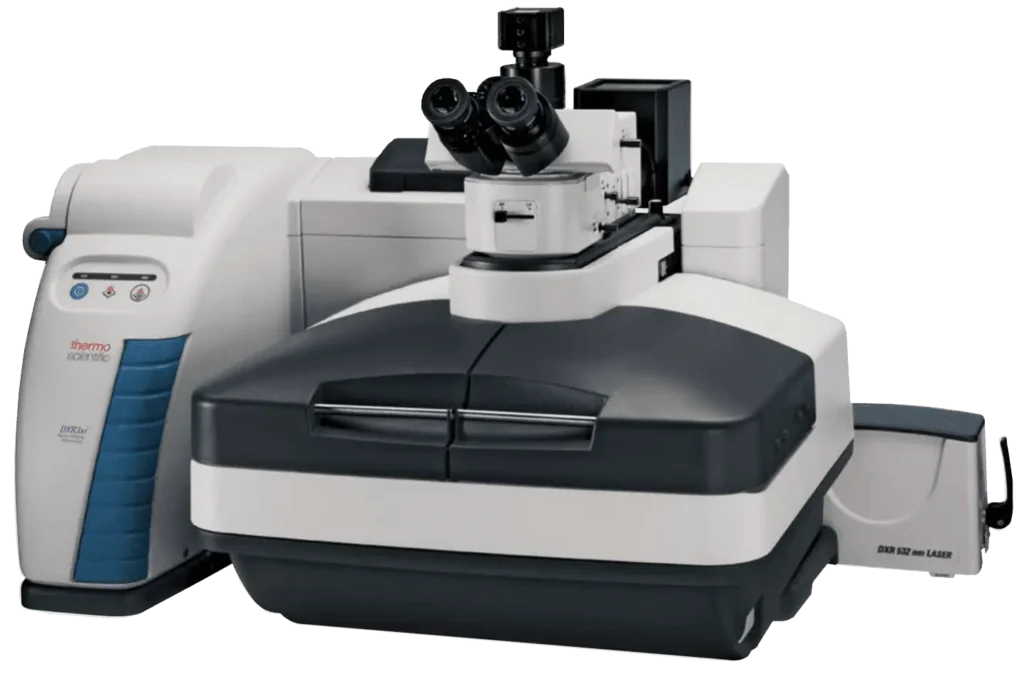
Key Differentiators
- Excitation in the VIS and NIR for various sample types.
- Micron and sub-micro scale information can be obtained.
- Surface enhanced Raman scattering (SERS) can provide enhanced sensitivity for certain compounds.
Strengths
- Non-destructive.
- Can measure samples through glass and other transparent containers.
- Works for most samples, liquids, gases or solids.
- Confocal microscopy provides depth resolution (~1-2um) for non-destructive depth profiling of layered.
Limitations
- Laser confocal microscope configuration probes a small spot/volume, around 1um, which requires multiple spots to adequately sample heterogeneous materials. Fast mapping of many particles or locations can be beneficial.
- Most metals are difficult/impossible to measure.
- Highly fluorescent samples can overwhelm the weaker Raman signal, in certain cases higher or lower excitation wavelengths can overcome this.
- Certain vibrational modes are forbidden due to sample symmetry.


Unsure Whether Raman Spectroscopy Is Right for You?
Learn more about using Raman spectroscopy chemical analysis services today.
Sample Information
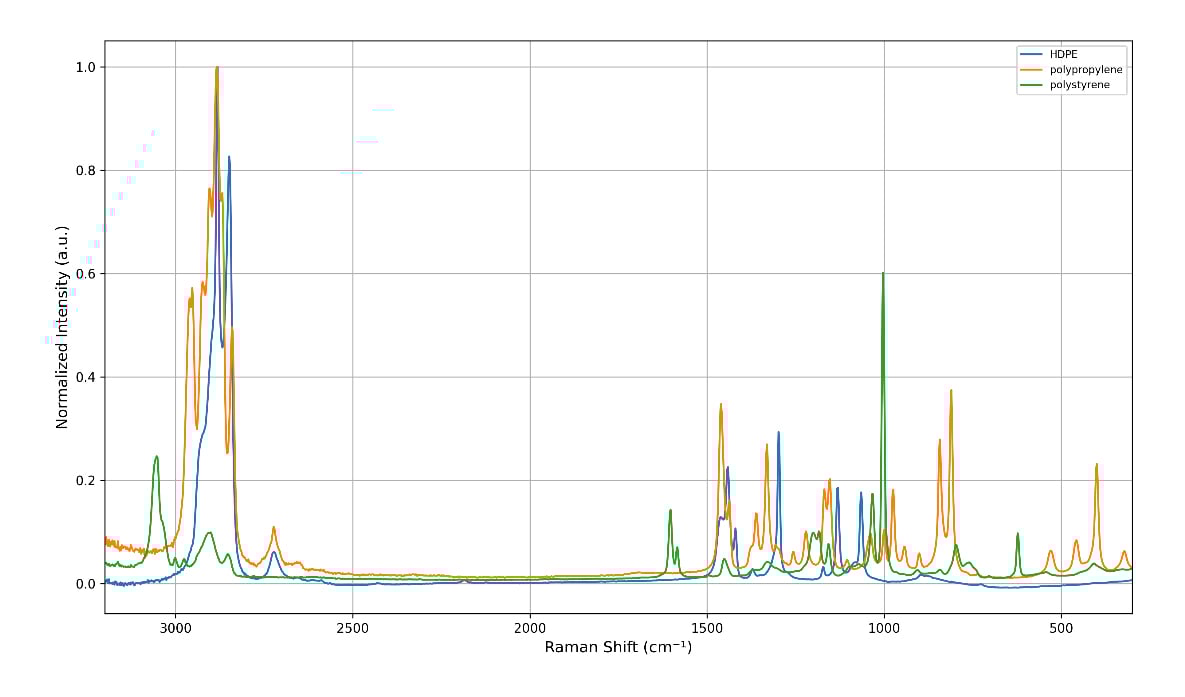
Comparison of Raman spectra for polystyrene, polypropylene, and high-density polyethylene, illustrating distinct peak patterns that enable clear discrimination and identification of these polymers.
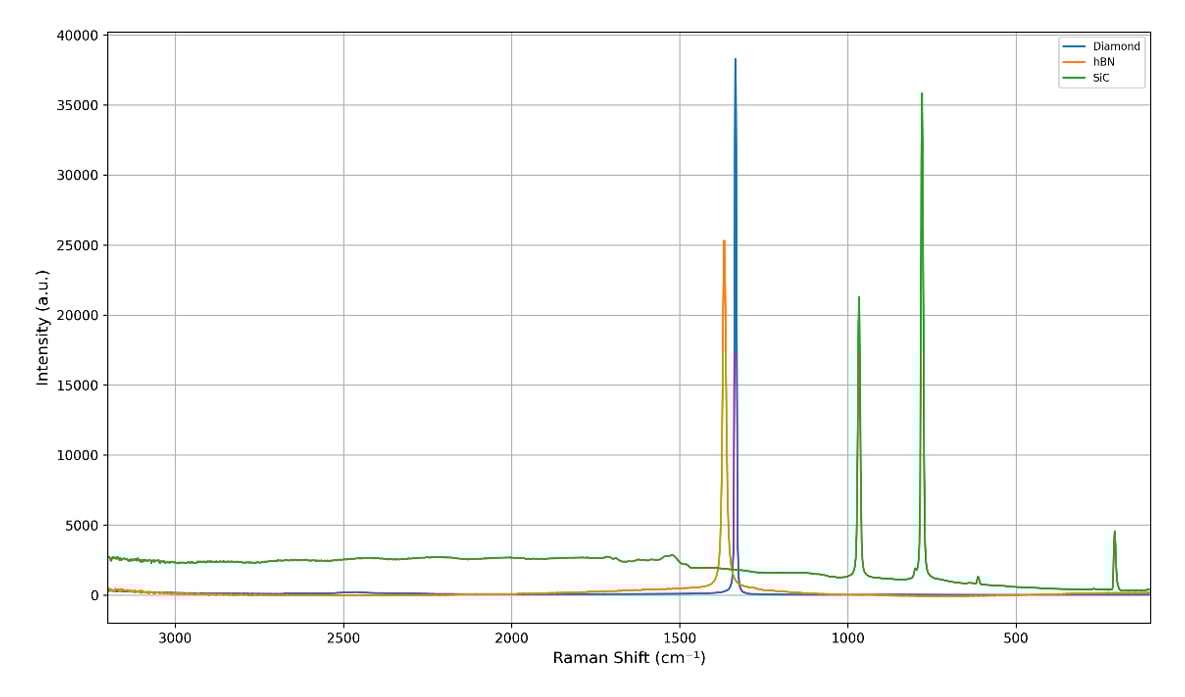
Raman spectra of boron nitride, silicon carbide, and diamond highlighting the distinct strong phonon peaks characteristic of each material.
What we accept:
Sample must be stable under laser irradiation; reduced power can be used to mitigate. Strongly absorbing samples can be sensitive.
Use Cases
Analysis of Graphite Quality
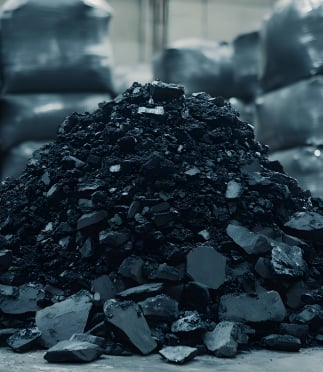
Raman spectroscopy evaluates graphite crystallinity and defect density by examining the intensity and shape of the D, G, and 2D bands. In addition to quality different polymorphs (nanotubes, graphene, C60, diamond, etc.) can be easily distinguished.

Strain Mapping in Semiconductors
Raman shifts of phonon modes are sensitive to strain and provide a non-destructive way to detect and quantify strain/stress in semiconductor wafers and devices. Using the mapping capabilities strain gradients at the microscale can be characterized.

Mapping Active Ingredients in Pharmaceuticals
Raman imaging allows spatially resolved identification and distribution of active pharmaceutical ingredients (APIs) and excipients within tablets and other solid formulations. Often used to QA/QC in pharmaceutical manufacturing. Different crystal polymorphs can also be distinguished.
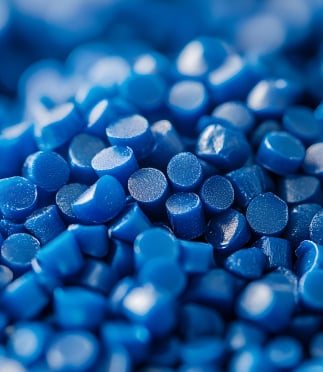
Polymer Identification
Raman spectroscopy enables identification of polymer materials by comparison to an extensive reference library. This is well suited for small particles, thin layers and localized contamination where FTIR is not practical. Raman can also measure particles behind transparent materials like glass as it relies on visible or NIR light.
Complementary Techniques
- FTIR and AFM-IR provide complementary analysis of bonding vibrational modes, particularly for organic samples.
- SEM-EDS provides complementary chemical information.
- XRD provides complementary structural information.
Atomic Force Microscopy (AFM)
Maps nanoscale topography and material properties with a sharp probe. Explore
Fourier Transform Infrared Spectroscopy (FTIR)
Rapid, non-destructive molecular fingerprinting across materials. Explore
X-ray Diffraction (XRD)
Non-destructive analysis of crystal phases, lattice, and strain. Explore
Why Choose Covalent for Your Raman Spectroscopy Needs?
Frequently Asked Questions
Identifying the right test can be complex, but it doesn’t have to be complicated.
Here are some questions we are frequently asked.
What is spatial resolution?
The spatial resolution laterally can be better than 1um using a high numerical aperture objective. Individual point spectra and maps are possible.
What is depth resolution?
Depth resolution is 1-2um using dry objectives and can be improved using oil immersion objectives. A variety of well characterized immersion oils are available to minimize overlap of the oil Raman peaks with the sample.
What types of materials can be analyzed?
Solids, liquids, and gases—including pharmaceuticals, polymers, minerals, biological samples, and more. Non-volatile liquids can be measured easily as drops on metal oil and volatile or hazardous liquids can be measured in a cuvette.