
What is Chromatic Confocal Profilometry (CCP)?
Chromatic confocal is a non-contact and non-destructive technique that can map not only “XY” dimensions, but also the “Z” height of small features. Chromatic Confocal Profilometry is a rapid technique that can map, bow, warp, and provide other 3D features over a large area (e.g., whole wafers).
Other Details:
- Provides 3D height maps of a sample surface.
- Many material surfaces can be measured.
- Scan and step sizes adjustable to fit your specific region of interest.
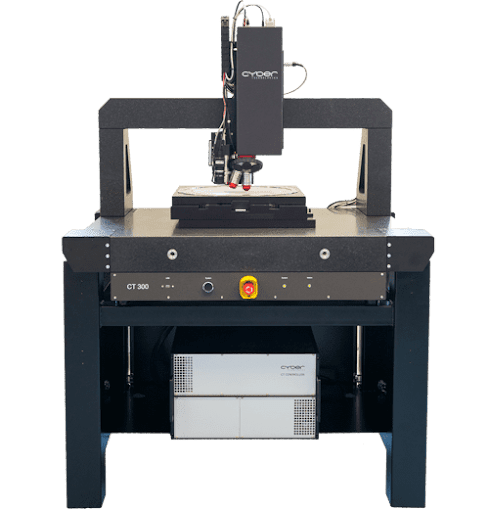
- cyberTECHNOLOGIES CT300 platform with CHRocodile CLS Line sensor used.

Large Profile Surfaces
Large Profile Surfaces
Chromatic Confocal Microscopy is best for wide, flat surfaces.

Broad Array of Tools
Broad Array of Tools
Our broad array of optical profilometry tools means we can optimize.

Non-Destructive
Non-Destructive
Can quickly perform 3D surface profiling non-destructively.
Why Use CCP?
- This method provides 3D height maps over a wide sample surface.
- Flexible platform: Customizable scan region and point spacing.
- Single scans can examine features with micron-scale height over scan areas as large as 315mm x 315mm. This is useful for profiling shallow features across a large, possibly warped surface.

Material Compatibility
Measures diverse solids, films, and coatings; highly reflective, rough, or translucent surfaces may affect signal strength, penetration depth, and spectral quality.

Vertical Spatial Resolution (Z)
Sub‑micrometer height resolution (<1 µm) for profiling surface topography, film thickness steps, and micro‑scale features.

Lateral Spatial Resolution (XY)
Approximately 1.5 µm lateral resolution; larger step sizes recommended for efficient mapping over extensive areas.


Working Principle
Chromatic Confocal Microscopy is a non-destructive, non-contact measurement. Chromatically dispersed light is focused onto the sample, with each color focusing at a different depth. The wavelength that is in focus at the sample surface is reflected back to the spectral sensor, which detects the peak wavelength to measure surface height. The sample can be rastered quickly under the detector to measure height maps across large surfaces up to 300mm wafers.
Equipment Used for CCP:
CT300
- Maximum Sample Dimensions: 315 mm x 315 mm.
- Height Measuring Range (single-scan): 500 µm.
- Multiple images can be stitched together for larger height range.
- Maximum Lateral Resolution: 1.5 µm.
Key Differentiators
Chromatic Confocal Profilometry provides highly detailed 3D surface topography measurement that is both fast and reliable. The data captures everything from broad bow and warp analysis to fine step height and micro-feature profiling.
Strengths
- Best suited for profiling large surfaces.
- Quickly profiles surfaces in 3D with non-contact, non-destructive method, usually with no sample prep.
- We have a broad array of optical profilometry tools to complement this method.
Limitations
- May have difficulties with very matte, transparent, or highly sloped surfaces.
- Takes longer to map features larger than 1 mm.


Unsure Whether CCP Is Right for You?
Learn how non‑contact 3D surface profiling can map bow, warp, and step heights fast.
Sample Information
Output of Chromatic Confocal Profilometry is a 3D colormap of the sample surface, along with measurement of any bow, warp, flatness, lateral features, vertical step heights, and height comparison of the features.
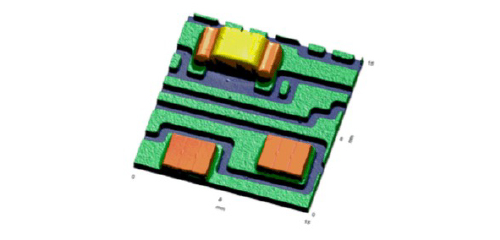
3D CWL Model generated of an assembled SMD device, showing both surface texture and larger-scale components.
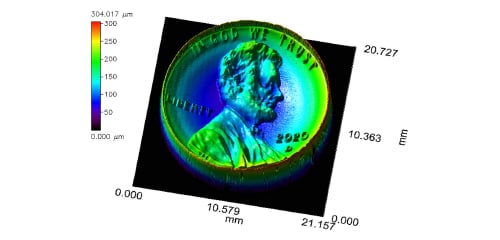
3D surface map of a US 1 cent coin showing overall concave shape as well as topography of individual surface features.
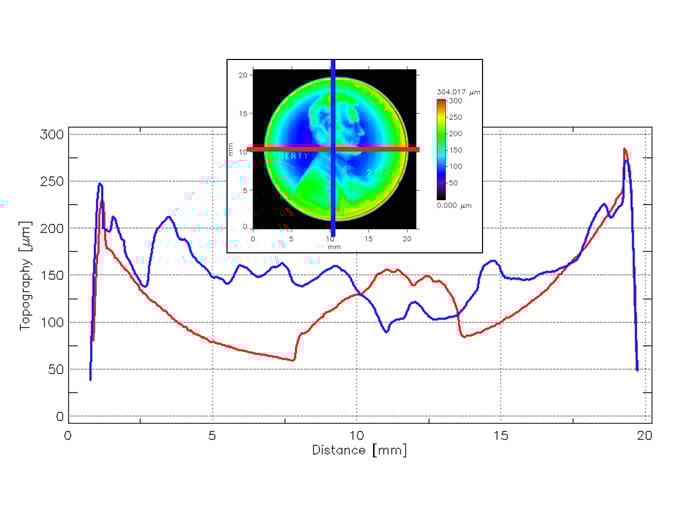
Surface profiles taken from the above 3D surface scan of a US 1 cent coin.
What we accept:
Maximum Sample Weight: ~10 kg.
Use Cases

Semiconductor
- Chromatic Confocal Profilometry can be used for surface inspection of wafers and ICs.
- Measures bow and warp of large wafers and boards.
- Great for measuring components on Surface-Mount Devices (SMDs).
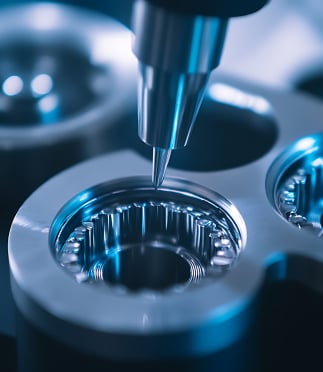
Precision Manufacturing & Metrology
- Non-contact 3D surface profiling ensures dimensions, roughness, and flatness are within specified tolerances.
- Ensure raised or grooved features are at a specific height/depth across a large area.
- Micro-feature measurement.
Complementary Techniques
Chromatic Confocal Profilometry is often the best choice for large‑area measurements, but some applications benefit from pairing it with other tools. Covalent offers a broad array of complementary techniques to fill those gaps:
- Atomic Force Microscopy (AFM): Used when nanometer‑scale profiling is required.
- Laser Confocal Scanning Microscopy (LCSM) and White Light Interferometry(WLI): For higher‑resolution analysis of smaller features.
- Patterned White Light Profilometry: For taller structures that exceed the vertical range of chromatic confocal methods.
- Scanning Acoustic Microscopy (SAM) or Micro-CT imaging: To look beneath the surface of a sample.
Atomic Force Microscopy (AFM)
Maps nanoscale topography and material properties with a sharp probe. Explore
Laser Scanning Confocal Microscopy (LSCM)
Non-destructive 3D imaging of sample surfaces. Explore
Scanning Acoustic Microscopy (SAM)
Locates internal flaws like cracks, voids, and delamination. Explore
White Light Interferometry (WLI)
Measures surface topography with sub-nanometer vertical resolution. Explore
X-ray Computed Tomography (Micro-CT)
Non-contact, non-destructive 2D/3D images at micron scale. Explore
Why Choose Covalent for Your CCP Needs?
Frequently Asked Questions
Identifying the right test can be complex, but it doesn’t have to be complicated.
Here are some questions we are frequently asked.
What is the largest sample area you can measure with this tool?
This tool can measure a 315 mm x 315 mm area in a single scan. If larger areas are needed, multiple scans can be stitched together.
What is the lateral resolution of this tool?
This tool’s best lateral resolution is 1.5 μm. Depending on the scan size and type of features, larger step sizes may be recommended to maintain reasonable data file sizes. For improved lateral resolution, Covalent also offers White Light Interferometry (WLI) and Laser Confocal Scanning Microscopy (LCSM) tools.
What is the axial/vertical resolution in Z?
The axial/vertical resolution is less than 1μm. For finer vertical resolution, Covalent offers White Light Interferometry (WLI) and Laser confocal scanning microscopy (LCSM) tools.
Is this tool a good fit for my needs?
Reach out to us and let’s discuss! We would like to hear a bit more about your sample and what you are trying to learn. Then, we can provide a free consultation and prescribe the right mix of measurements to get you the answers you need.