

What Is Laser Diffraction Particle Size Analysis (LD-PSA)?
Laser diffraction (LD, also called static light scattering (SLS)) is a technique used to analyze particle sizes. It works by passing laser light through a moving stream of dispersed particles and measuring the resulting diffraction pattern. Since the angle of diffraction is a function of the particle size, samples with populations of different particle sizes create unique combined diffraction patterns that can be analyzed to deduce the particle size distribution (PSD), which is representative of the entire sample.

Wide Dynamic Range
Wide Dynamic Range
Accurately measures particle sizes from submicron to millimeter scale for both wet and dry samples.

Fast and Repeatable Results
Fast and Repeatable Results
Delivers statistically reliable particle size data within minutes, ideal for QA/QC.

Process Compatibility
Process Compatibility
Supports real-time monitoring and multi-modal distribution analysis for process optimization.
Why Use LD-PSA?
Laser diffraction is a versatile, efficient, and widely recognized method for particle size analysis (PSA) by various agencies, including but not limited to ISO, ASTM, and USP. It is applicable to wet or dry samples from various industries, can take measurements in just a few minutes with high repeatability, and has a wide dynamic range of particle sizes that can be measured. Results are easily interpretable and, in most cases, directly related to quality control/quality assurance (QA/QC) or process development targets.

Analytical Depth
Quantitative particle size distributions

Detection Limits
Dependent on the nature of particles (wet or dry: 0.04 µm and 0.1 µm minimums respectively, and a maximum of 2500 µm).

Material Compatibility
Suitable for dispersed particulates as dry powder/granules or as wet suspensions.


Working Principle
Laser diffraction works by passing laser light through a stream of particles that are dispersed as dry powder / granules or in a known liquid medium. The particles scatter (diffract) the laser light at angles related to their size, and the resulting diffraction pattern is measured by multiple detectors located at fixed angles. Mathematical models, including Fraunhofer or Mie theory if the optical properties of the particles are known, are applied to provide the 1-D particle size distribution of the sample.
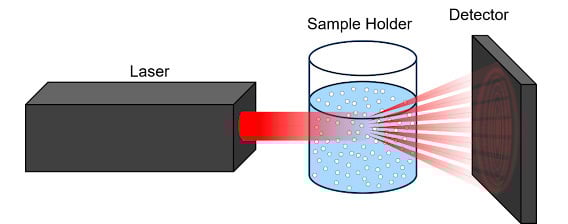
A simplified schematic of the principles of laser diffraction particle size analysis. Laser light is directed at a sample, in this case, a well-dispersed sample of solid white particles in a blue liquid medium, and the light is diffracted into a concentric pattern onto a detector. In real setups, multiple lasers, multiple sensors, and a complex diffraction pattern resulting from particles of all sizes in the sample are present.
Equipment Used for LD-PSA:
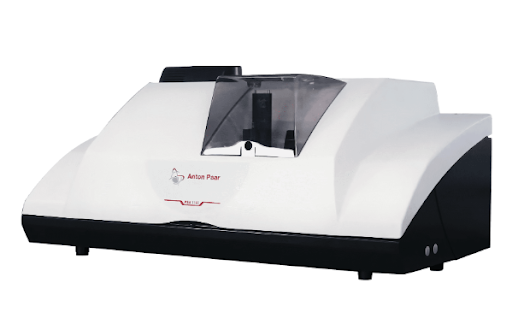
Anton Paar PSA-1190
- Particle Size Measuring Range: 0.4 µm to 2500 µm.
- Repeatability: <1%.
- Particle Size Accuracy: <3%.
- Dry Jet Dispersion (DJD) technology to prevent agglomerate formation and improve accuracy for dry samples.
Key Differentiators
Laser diffraction provides fast, repeatable results across a wide range of particle sizes. This technique works with wet or dry samples, providing statistically relevant data in minutes.
Strengths
- Laser diffraction has an extensive dynamic range of particle sizes that can be measured.
- Results are fast and highly repeatable.
- Non-destructive way of characterizing and quantifying the phases within a material.
- Statistically relevant results that various standards agencies recognize.
- Samples can be measured wet or dry.
Limitations
- Particles are assumed to be spherical in mathematical data processing.
- Samples must be well-dispersed for analysis, either as non-agglomerating dry powders or in a suitable liquid medium.
- For proper measurements, an obscuration of ~5 to 30% is required; very opaque or completely transparent samples cannot be measured as is.
- Sample preparation methods can often resolve these issues.
- Slightly simplified models must be used if the optical properties of the particles themselves are not well-defined.
- Measurement results are representative of the entire sample but are indirect and cannot provide information on morphology or composition.


Unsure Whether LD-PSA Is Right for You?
Learn more about using Laser Diffraction Particle Size Analysis services today.
Sample Information
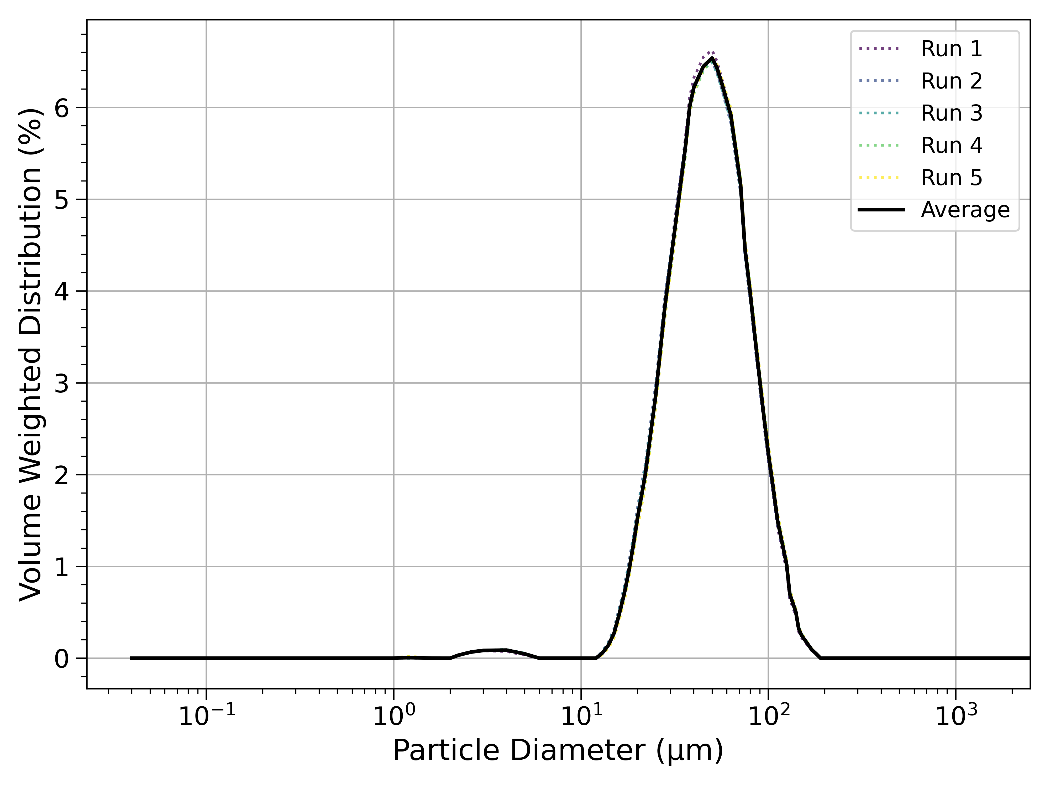
An example output of laser diffraction measurements on 10 to 100 µm polystyrene microspheres. Five consecutive runs show a high degree of repeatability in the measured distribution.
What we accept:
- Laser Diffraction requires samples to be in dispersed particulate form – this can be either as a dry powder, granules, or suspended in solution.
- Maximum Particle Diameter: 2500 µm.
- Minimum Particle Diameter (Dry): 0.1 µm.
- Minimum Particle Diameter (Wet): 0.04 µm.
Many common solvents are compatible with the instrument; optical properties must be known or measured prior to accurate results.
Use Cases

Pharmaceuticals
Laser diffraction ensures drug particle size meets dissolution and bioavailability requirements. Critical for tablet formulations, inhalation powders, and suspension stability, where particle size directly impacts therapeutic efficacy and regulatory compliance.

Food & Beverage
Optimize texture, mouthfeel, and stability in food products by precisely controlling particle size. Essential for powdered ingredients, emulsions, and beverages where consistent particle distribution affects sensory properties and shelf life.

Cosmetics
Achieve desired coverage, spreadability, feel, and appearance in makeup and skincare products. Particle size analysis ensures optimal pigment distribution, smooth application, and enhanced product performance across foundations, lotions, and color cosmetics.
Battery Materials
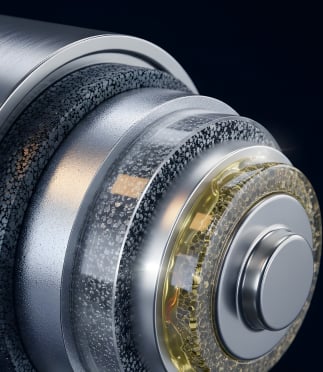
Maximize electrode performance and battery life through controlled particle size distributions. Critical for battery manufacturing, where anode and cathode particle sizes affect charge capacity, cycling stability, and safety characteristics.
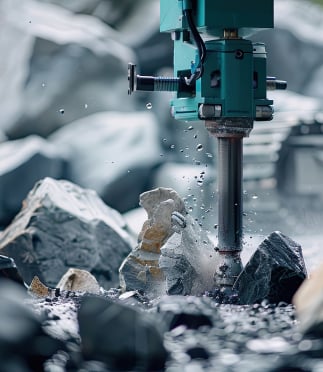
Mining & Mineralogy
Optimize mineral processing efficiency and product quality by characterizing particle size. Essential for flotation processes, grinding optimization, and ore beneficiation, where size distribution impacts recovery rates and final product specifications.

Soil & Agriculture
Analyze soil texture and fertilizer particle sizes to optimize nutrient delivery and crop yields. Critical for understanding soil composition, drainage properties, and ensuring the effective distribution of agricultural amendments and pesticides.
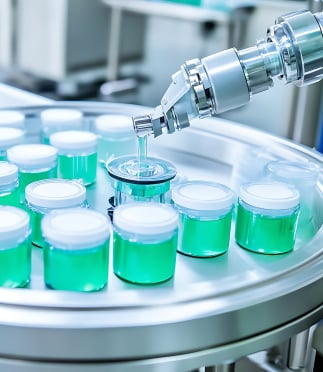
Chemical Processes
Enhance catalyst activity, improve coating uniformity, and optimize PGM dispersion by precisely controlling particle size. Essential for maximizing reaction efficiency, achieving consistent product quality, and meeting performance specifications across industrial applications.
Complementary Techniques
- Dynamic Image Analysis (DIA): A high-speed particle imaging and sizing technique that provides general particle shape classifications and metrics along with number- and volume-weighted particle size distributions for particles from ~ 0.5 μm to ~ 1000 μm in solid or liquid samples.
- Dynamic Light Scattering (DLS): DLS is a complementary technique to particle size analysis (PSA) and operates on similar principles. While there is some overlap in size range, which is useful for verifying micron-sized particles, DLS is much better suited for measuring sub-micron and even nanometer-sized particle sizes in liquid dispersions.
- Electrical Sensing Zone (or Coulter Counter): An alternative particle sizing technique that is not sensitive to color, shape, refractive index, density, or conductivity that counts particles (~ 1 to 260 μm in size) in an electrolyte drawn through a narrow aperture by detecting changes in resistivity to deliver number- and volume-weighted size distributions as well as concentration.
- Nanoparticle Tracking Analysis (NTA or Particle Tracking Analysis (PTA): A complementary light scattering technique that counts particles at high resolution to provide number-based particle size distributions and concentrations for aqueous suspensions with particles from ~ 30 nm to ~ 1 μm.
- Porosimetry : Surface area, pore size distribution, and metal dispersion measurements are often relevant to materials being measured for particle size as well. Chemisorption measurements can also approximate crystallite sizes of active metals on catalyst support particles.
- Scanning Electron Microscopy (SEM): SEM provides direct high-resolution images of surface morphology, particle shape and size, and agglomeration, all of which can provide insight or validation to laser diffraction PSA results.
- Sieving or Sieve Analysis: An alternative sizing technique for large particles (above ~45 μm) that uses mechanical sieving to pass dry powders or granular material through progressively smaller mesh sizes to yield mass-fraction size distributions for each sieve mesh interval.
- Single Particle Optical Sensing (SPOS or Light Obscuration/Extinction): A high-sensitivity, dual approach particle analysis technique that measures dilute liquid dispersions by light obscuration for large particles (~1.5 to 400 μm) and light scattering for small particles (~0.5 to 1.5 μm), delivering number- and volume-weighted size distributions as well as particulate concentration.
- X-ray diffraction (XRD): XRD can estimate crystal sizes and provide information on particle composition and crystal phase.
Dynamic Light Scattering (DLS)
Quantifies particle size and uniformity in minutes. Explore
Scanning Electron Microscopy (SEM)
Images surface topography and composition with electrons. Explore
X-ray Diffraction (XRD)
Non-destructive analysis of crystal phases, lattice, and strain. Explore
Why Choose Covalent for Your LD-PSA Needs?
Frequently Asked Questions
Identifying the right test can be complex, but it doesn’t have to be complicated.
Here are some questions we are frequently asked.
What sample volume is required for accurate LD-PSA analysis?
The key to accurate results in any setup is to be able to obtain and sustain obscuration levels of ~ 5 to 30%. For wet samples, we generally recommend at least 100 mL of total volume. Dry materials typically require tens of grams to be analyzed dry, but as little as tens of milligrams if being analyzed dispersed in an appropriate liquid solvent.
How does temperature affect particle size measurements during testing?
While laser diffraction is performed at ambient temperatures with input values assumed at 25°C, it is essential to consider that some materials may change size or other physical and chemical properties if used at temperatures that differ significantly from this.
Can LD-PSA distinguish between different particle compositions in mixed samples?
To some degree, yes, but it can be challenging or take careful interpretation. Laser diffraction measures and reports particle sizes on a volume-weighted basis. This means that even relatively small populations of large particles can dominate the signal over larger populations of small particles. It can be challenging to distinguish heterogeneous particle size populations, particularly when the size and population differences between these groups are significant.
How long should samples be stored before testing affects the results?
This is entirely sample-dependent. Dry samples have almost no time limit, assuming they are not reactive or hygroscopic in storage conditions. Some wet samples are very stable, while others, particularly with very large particles, may settle out or separate over time.
Can irregularly shaped particles be accurately measured using this technique?
Yes, as long as the limitations and assumptions are taken into account. Laser diffraction modelling calculations assume all particles are spherical, and therefore report equivalent circular area diameters. This parameter may not accurately reflect the actual dimensions of elongated or irregularly shaped samples, but in many cases, it remains physically meaningful and a useful comparative metric.