

What Is Tap Density?
For powdered, granulated, or flaked solids, the tap density is the ratio of the mass of a sample to its volume after mechanical tapping over a certain number of cycles. A powder’s tapped density provides a quantitative metric for its compressibility and maximum packing efficiency.
Its mass must first be measured using a high-sensitivity analytical balance to measure tap density on a sample. Once the mass is known, the sample can be loaded into a calibrated graduated cylinder mounted on the analyzer (sometimes called a “tap volumeter”). The initial bulk density is calculated using the reported volume after the powder settles. Then, the cylinder is mechanically tapped several times to redistribute the particulates until no further volume change is detected. To maximize volume accuracy, the cylinder is automatically rotated to promote a flat powder interface. These combined values help calculate the Carr compressibility index and the Hausner ratio to obtain a metric on flowability:
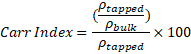
Where  is the Hausner ratio.

Density Measurement
Density Measurement
Measures tapped and bulk density for powders, flakes, and granules with precision.

Automated Tapping
Automated Tapping
Mechanical tapping with calibrated cylinders ensures reproducible and accurate results.

Flowability Metrics
Flowability Metrics
Calculates the Hausner ratio and Carr compressibility index to quantify powder behavior.
Why Use Tap Density?
Tap density analysis is a non-destructive method that precisely measures powder compressibility, packing efficiency, and granular behavior. It offers higher accuracy than bulk density, especially for fine or irregular particles, and delivers reproducible, comparable results. This efficient technique gives valuable insights into powders and particulate solids, with samples limited to solid particulates.

Compressibility Insights
Gives quantitative data on packing efficiency and particle rearrangement under tapping.

Quality Control Support
Helps optimize processes in pharmaceuticals, batteries, food, and additive manufacturing.

Efficient and Non-Destructive
Fast, repeatable, and safe testing without altering the powder or sample structure.


Working Principle
Tap Density Testing measures how powders, granules, or flakes pack under mechanical tapping. The process begins by weighing a known mass of the sample using a precision analytical balance. The powder is then placed in a calibrated graduated cylinder mounted on a tapped density analyzer (or “tap volumeter”). The instrument repeatedly taps and rotates the cylinder to redistribute particles and minimize void spaces. Measurements are taken at intervals until the volume stabilizes, indicating maximum packing efficiency.
These values determine bulk density and tapped density, enabling Hausner ratio calculation and Carr compressibility index estimation—two key metrics used in powder flowability testing.
Equipment Used for Tap Density:
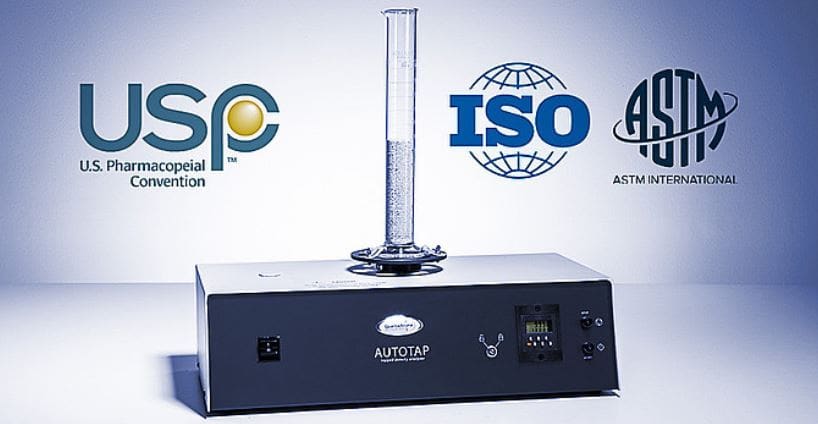
Anton Paar Dual AutoTap Tapped Density Analyzer
This is an industry-standard system designed for precise and repeatable tapped density measurement of powders, flakes, and granules.
Instrument Specifications:
- Cylinder Sizes: 10 mL, 25 mL, 50 mL, 100 mL, 250 mL (standard), 500 mL, and 1000 mL.
- Nominal Tapping Rate: 260 taps per minute (supports up to 300 taps per minute).
- Tapping (Drop) Height: 3 mm.
- Maximum Tap Count per Trial: 999,999.
Key Differentiators
Operating ModeDual-station configuration for simultaneous sample analysis.
| Property | Tap Density |
|---|---|
| Cylinder Sizes | 10 mL, 25 mL, 50 mL, 100 mL, 250 mL (standard), 500 mL, 1000 mL |
| Nominal Tapping Rate | 260 taps per minute; (supports up to 300 taps per minute) |
| Tapping (Drop) Height | 3 mm |
| Maximum Tap Count per Trial | Up to 999,999 taps |
| Precision & Reproducibility | Automated mechanical tapping and rotation ensure consistent, repeatable measurements |
| Data Outputs | Bulk density, tapped density, Hausner ratio, Carr compressibility index |
| Sample Compatibility | Suitable for powdered, granulated, or flaked solids (non-liquid and non-gaseous samples) |
| Analysis Insights | Reveals powder compressibility, packing efficiency, and flowability characteristics |
Strengths
- Inexpensive and straightforward, leading to sample turnover efficiency.
- Results are easily reproducible and comparable.
- Provides insight into how powders and particulate solids behave under handling or vibration.
- Indirect insights into flowability through a combination of bulk and tapped densities to derive the Hausner ratio and the Carr compressibility index.
Limitations
- Only suitable for particulate solid materials.
- This technique does not reveal particle size, shape, or textural information.
- This technique provides no direct compositional information.


Unsure Whether Tap Density Is Right for You?
Learn how tap density analysis quantifies powder packing efficiency and flowability to guide better process and product decisions.
Sample Information
| Taps | Volume (cm³) | Density (g/cm³) |
|---|---|---|
| 0 | V₀ = 96 | 1.41 |
| 2000 | Vf = 67.5 | 2.01 |
An example Tap Density measurement output for 136.07 g of commercial cement measured using the Anton Paar Autotap. The calculated Carr compressibility index is 29.7.
What we accept:
Samples must be solid particulates – powders, flakes, granules, etc.
Use Cases

Food & Beverage
Assess powder (e.g., coffee grains) flow and compaction, which relates to processing, packaging, storage/stability, and shipping.

Pharmaceuticals
Evaluating the flowability and compressibility of both active ingredients and excipients aids in the formulation and design of tablet or capsule form factors.

Batteries & Energy
Assess electrode materials’ packing density, directly affecting uniformity, energy density, and loading.
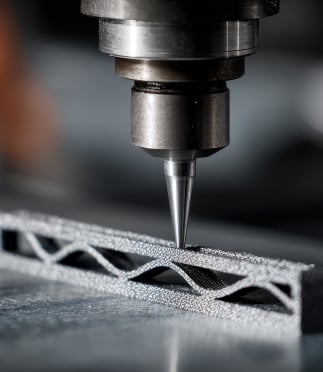
Additive Manufacturing of Metals & Ceramics
Optimization of powder packing for pressing, sintering, and printing, where the precursor physical properties often directly translate to the performance and properties of the end product (i.e., density, strength, durability).
Pigments & Chemicals
Monitoring bulk powders, intermediates, and end products to ensure consistency and reproducibility in blending and dispersion, among other downstream uses.
Complementary Techniques
- Gas Adsorption Porosimetry: If the particulate matter is porous, such as with battery materials, gas adsorption Porosimetry can calculate the specific surface area, pore volume, and pore size distribution of these materials.
- Laser Diffraction Particle Size Analysis (LD-PSA): Measures particle sizes in both liquid and solid samples. Particle size influences how powders pack and perform; combining these methods provides information on packing behaviors and potential reasons for them.
- Pycnometry (or Gas Pycnometry): A non-destructive technique that measures the true, or skeletal density and volume of solids and semi-solids with high precision using as little as ~ 0.15cm3 of material.
- Scanning Electron Microscopy (SEM): SEM provides surface morphology information, which can explain certain packing formations. SEM, along with a focused Ion beam, can analyze internal porosity affecting density and energy dispersive X-ray spectroscopy to perform elemental mapping.
Gas Pycnometry
Fast, precise measurements of true volume, density, and porosity. Explore
Laser Diffraction Particle Size Analysis (LD-PSA)
Analyzes particle sizes by measuring light scattering. Explore
Scanning Electron Microscopy (SEM)
Images surface topography and composition with electrons. Explore
Why Choose Covalent for Your Tap Density Needs?
Frequently Asked Questions
Identifying the right test can be complex, but it doesn’t have to be complicated.
Here are some questions we are frequently asked.
What is the difference between bulk density and tapped density?
In principle, these parameters are similar but have slightly different details. Bulk density is the material’s mass per unit volume when filled freely into a container or measuring device, without intentional packing, compaction, or compression. Thus, bulk density often includes a significant volume from interparticle voids. Tapped density is the same calculation, performed after a specified amount of mechanical tapping, which allows the particles to re-arrange such that interparticle voids are reduced. Therefore, tapped density is in almost all cases higher than bulk density as the same mass occupies less volume.
What do the Hausner Ratio and Carr's Index indicate about powder flowability?
The Hausner ratio and Carr index are useful metrics to quantify flowability and compressibility, where larger values generally indicate poorer flow, higher compressibility, and increased cohesion.
Which industries commonly require tap density testing for quality control?
Industries commonly requiring tap density include Food and Beverage, Pharmaceuticals, Batteries and Energy, and Manufacturing.
Are there standardized methods used in tap density testing?
Yes, several generally material-specific ASTM, USP, etc. standard methods for tap density testing exist. In your request, please notify us of the standard you would like to adhere to. We will verify that we can comply with the standard and proceed with testing in that manner.
What factors influence tap density results?
Many factors influence tap density results. These include, but are not limited to, particle size and distribution, particle shape and texture, porosity, moisture content, and surface chemistry.
How does particle size affect tapped density and compressibility?
In general, smaller, spherical, smooth particles can pack more densely. However, broader particle size distributions can pack more efficiently as small particles can fill the voids between larger particles. For very fine powders, cohesion and electrostatic forces may start to resist packing at a point.
Can tap density testing be applied to powder blends or composite materials?
Yes, with the obvious implication that the resulting tap density represents the entire blend/mixture/composite rather than any individual component. This is very useful for batch or lot comparisons. These materials should be well-mixed before measurements, as segregation can affect measurement results.