
What Are Chemical and Compositional Properties?
The elemental, molecular, and molecular structure of materials determines their chemical and physical properties. These characteristics affect how materials perform under specific conditions, including bonding, reacting, degradation, or deformation.
Our chemical analysis laboratory applies advanced methods to examine composition in bulk and on surfaces. We can identify molecules, quantify elements, and visualize phases. At Covalent, these techniques are combined with expert insights to detect deviations, confirm formulations, and support decision‑making.

Why Invest in Chemical and Compositional Properties Analysis?
Material performance begins with chemistry. Ensuring the right composition drives reliability, safety, and compliance. Organizations use chemical analysis to:
- Qualify products and confirm adherence to chemical and compositional standards.
- Troubleshoot failures and identify contaminants or off‑spec materials.
- Improve processes by understanding chemical reactions and consistency.
- Comply with regulations and meet safety requirements.
- Reduce costs by optimizing material use.
- Support R&D in developing advanced materials.
Robust chemical composition analysis reduces risk, strengthens performance, and accelerates product development.
When Should Chemical and Compositional Properties Testing Be Performed?
Chemical and compositional testing delivers the most value when built into key process and product stages. Targeted analysis at these points helps detect issues early and supports confident decision‑making.
Typical triggers include:
- Incoming raw material verification.
- Batch consistency evaluation.
- Treatment validation.
- Failure analysis and root cause investigation.
- Regulatory or certification submissions.
Industries That Use Chemical and Compositional Properties Testing
Understanding material chemistry is essential across industries where performance cannot be compromised:

Semiconductors
Raw material purity, dopant profiling, and oxide thickness.

Aerospace
Alloy verification, corrosion analysis, and coating uniformity.

Medical Devices
Trace metals, biocompatibility, and passivation layer integrity.

Energy Storage
Electrode composition, electrolyte breakdown, and separator stability.

Pharmaceuticals
Active ingredient quantification, degradation studies, and contaminant identification.
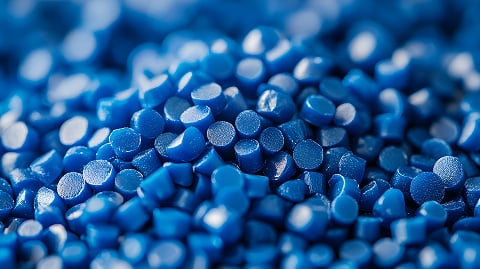
Polymers & Composites
Filler dispersion, crosslink density, and degradation monitoring.
Key Differentiators
Advantages
Traditional mechanical, electrical, or physical tests answer how a material performs. Chemical and compositional testing explains why.
- Versus Electrical Properties Testing: Electrical testing shows if a material behaves correctly in use. Chemical testing verifies purity or additive presence, revealing the reason behind its performance as a conductor or insulator.
- Versus Optical Properties Testing: Optical tests measure visual effects. Chemical analysis identifies impurities or pigment degradation, causing those performance issues.
- Versus Thermal Analysis: Thermal methods show melting or degradation temperatures. Chemical analysis reveals the additives or restricted substances that drive those thermal behaviors.
Limitations
Compositional testing defines identity and purity, but not direct real‑world performance. Other tests address that gap.
- Versus Mechanical (Tensile) Testing: Chemistry can confirm a steel grade, but tensile testing reveals cracks or heat‑treatment damage.
- Versus Corrosion (Salt Spray) Testing: Chemical analysis confirms coating chemistry, while salt spray testing shows how that coating performs in harsh conditions.
- Versus Adhesion Testing: Chemistry validates adhesive formulation, but shear and peel tests prove bond strength and durability.
How Does Chemical & Compositional Properties Testing Work?
Chemical and compositional properties testing involves identifying and quantifying elements, molecules, and phases that make up a material. The characterization is typically performed versus a controlled, contamination-free sample – a reference using advanced analytical techniques. Different types of spectroscopy, chromatography, and microscopy can be used to probe the material’s chemical composition and assess its structural or molecular features. Data collected from these instruments are interpreted through established calibration models and reference standards. By revealing how a material’s chemistry relates to its performance for specific applications, chemical and compositional testing supports a wide range of industries.
What Properties are Measured in Chemical and Compositional Analysis?
- Elemental composition and distribution.
- Molecular structure and chemical bonding.
- Phase identification and quantification.
- Oxidation states and chemical speciation.
- Contaminant presence and attribution.
- Homogeneity across bulk or layered materials.
- Trace metals, dopants, and additives.
- Polymer degradation and formulation ratios.
How Are Results Tracked and Reported?
Data alone doesn’t solve engineering problems. Clear interpretation does. Covalent reports deliver more than raw outputs, providing:
- High‑resolution spectra, maps, and profile data.
- Layer‑specific composition, thickness, or topography.
- Quantitative values with calibration.
- Interpretations tied to process stages or failure modes.
- Structured outputs that fit QA, regulatory, or R&D requirements.
Clients also receive access to raw files and on‑demand sessions with our experts.
Typical Applications
- Confirming alloy, polymer, or coating composition.
- Identifying contamination or unexpected elements.
- Verifying supplier quality and consistency.
- Supporting patent or trade secret protection.
- Investigating material failure or corrosion issues.
- Validating reformulated or recycled materials.
If performance depends on chemistry, analytical testing provides the proof.
Why Choose Covalent for Chemical and Compositional Properties Testing Services?
Covalent’s testing lab is equipped with a broad range of advanced instrumentation and staffed by experienced scientists. Each test is designed around the material, objective, and required scale of analysis.
From tailored method development to expert interpretation, we deliver high‑resolution results that are fast, clear, and ready to support your next decision.
Frequently Asked Questions
What types of samples are suitable for chemical and compositional analysis?
Requirements vary depending on the technique. Please check with our team for guidance on your specific sample and goals.
Do samples need to be pre‑treated or cleaned before measurement?
In most cases, no special preparation is needed. If disassembly or cutting is required, our team will handle it.
Can hazardous or reactive materials be analyzed safely?
Yes, but some sample types may require additional safety documentation or handling procedures. Our team will advise you on the next steps.
Which analytical methods are available for powders?
Depending on whether you need major or trace element detection, we may use OE‑MS or XPS for main elements and ICP‑MS or SIMS for very low‑level analysis.
Commonly Used Techniques for Chemical & Compositional Properties
At Covalent, we apply a tailored suite of complementary techniques across projects:
- Fourier Transform Infrared Spectroscopy (FTIR): Reveals molecular structure, bonding, and functional groups.
- Mass Spectrometry (ICP‑MS, LA‑ICP‑MS, SIMS): Measures trace elements and isotopes at ultra‑low levels.
- Nuclear Magnetic Resonance (NMR): Determines molecular identity, tracks chemical transformations, and measures formulation ratios.
- Optical Emission Spectroscopy (OES, ICP‑OES, GD‑OES): Quantifies elemental composition with high sensitivity.
- Thermogravimetric Analysis (TGA): Tracks weight changes to study stability, additives, and degradation.
- X‑ray Photoelectron Spectroscopy (XPS): Identifies surface chemistry, oxidation states, and thin film composition.
Fourier Transform Infrared Spectroscopy (FTIR)
Rapid, non-destructive molecular fingerprinting across materials. Explore
Glow Discharge Optical Emission Spectroscopy (GDOES)
Sputters surfaces to quantify composition & depth-profile layers. Explore
Inductively Coupled Plasma Mass Spectrometry (ICP-MS)
Measures trace elements with high accuracy. Explore
Inductively Coupled Plasma Optical Emission Spectroscopy (ICP-OES)
Quantifies multiple elements at very low concentrations. Explore
Nuclear Magnetic Resonance Spectroscopy (NMR)
Determines molecular structure, composition, and dynamics. Explore
Thermogravimetric Analysis (TGA)
Measures material mass changes with temperature or time. Explore
X-ray Photoelectron Spectroscopy (XPS)
Measures surface elemental composition and chemical states. Explore



Resources