

Apr 20 2021, 6:00 am
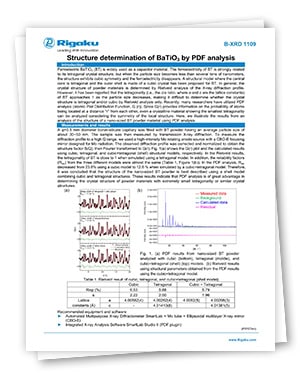
Ferroelectric BaTiO3 (BT) is widely used as a capacitor material. The ferroelectricity of BT is strongly related to its tetragonal crystal structure, but when the particle size becomes less than several tens of nanometers, the structure exhibits cubic symmetry and the ferroelectricity disappears. A structural model where the central core is tetragonal and the outer shell is made of a cubic crystal has been proposed for BT. In general, the crystal structure of powder materials is determined by Rietveld analysis of the X-ray diffraction profile. However, it has been reported that the tetragonality (i.e., the c/a ratio, where a and care the lattice constants) of BT approaches 1 as the particle size decreases, making it difficult to determine whether the crystal structure is tetragonal and/or cubic by Rietveld analysis only. Recently, many researchers have utilized PDF analysis (atomic Pair Distribution Function, G (r)). Since G(r) provides information on the probability of atoms being located at a distance from each other, even a crystalline material showing the smallest tetragonality can be analyzed considering the symmetry of the local structure. Here, we illustrate the results from an analysis of the structure of a nano-sized BT powder material using PDF analysis.