

Feb 11 2026, 5:09 pm
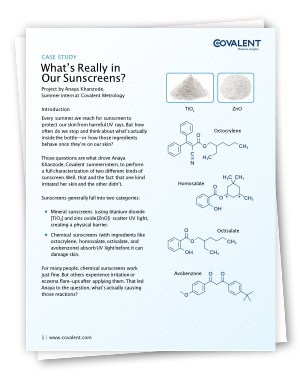
This case study reports a multi-technique characterization of two commercially available sunscreens—one mineral-based (TiO₂/ZnO) and one chemical-based—motivated by real-world differences in skin irritation. Volatile organic compounds in the chemical sunscreen were identified by GC–MS/TOF-MS both immediately after dispensing and after two hours of sunlight exposure; the post-exposure chromatogram showed a shifted chemical profile and new peaks consistent with UV-driven reactions/photodegradation products. Trace metals were quantified by ICP-MS across a broad elemental panel; both sunscreens contained detectable metals, but all were measured at concentrations below topical toxicity thresholds. Finally, SEM-EDS was used to examine mineral sunscreen particulates, revealing two distinct nanoparticle morphologies and confirming (via elemental mapping and spectra) a relatively uniform TiO₂ distribution alongside Zn-rich, rod-like agglomerates that likely contribute to visible “white cast.”