

What Is Gas Chromatography-Mass Spectrometry (GC-MS)?
A combination of multiple techniques, GC-MS analysis is particularly useful for identifying and quantifying small, organic molecules in complex mixtures. To enable gas chromatography, samples must be injected directly in the gas phase or transformed to the gas phase via liquid injection, headspace analysis, solid-phase microextraction (SPME), thermal desorption (TD), pyrolysis, evolved gas analysis (EGA) or field desorption (FD), all of which are supported by Covalent’s state-of-the art laboratory.
After exiting the gas chromatograph, compounds must be ionized for analysis and detection. Covalent supports several modes of either hard or soft ionization, including electron ionization, chemical ionization, field ionization, field desorption, and photoionization.
Finally, ions are separated and counted. Depending on the specific application typical mass analyzers include Single Quadrupole (SQ-MS), Triple Quadrupole (TQ-MS) or Time-Of-Flight (ToF) analysis, which allows for significantly improved mass accuracy over quadrupole systems and simplifies the collection of a wide range of m/z without sacrificing sensitivity.
Other Details:
- Seven available injection methods.
- Five available ionization modes.
- Three available mass analyzers including state-of-the-art ToF GC-MS.
- Ideal for all volatile and semi-volatile organic compounds.

Flexibility
Flexibility
Applicable across a variety of matrices, including complex mixtures.

Specificity
Specificity
Extend the capabilities of techniques like traditional Gas Chromatography or Nuclear Magnetic Resonance.

Sensitivity
Sensitivity
When even trace amounts of a compound are important to detect, the high sensitivity and selectivity of GC-MS allows for precise differentiation between compounds.
Why Use GC-MS?
- Flexible chemical analysis capable of detecting and identifying trace organic molecules.
- Useful for confirming compound identities from other techniques that lack chemical specificity or separation.
- Relevant for a wide range of industries and applications including petrochemical, energy storage, forensics, pharmaceuticals, semiconductors, environmental monitoring, polymer sciences and more.

Analytical Depth
Intensity of characteristic ions generated by volatile and semi-volatile
organic compounds.

Material Compatibility
Organic mixtures, gases, solids and liquids containing volatile organics, polymers.

Mass Accuracy
Delivers 1 ppm precision to confidently identify compounds at trace levels.

Working Principle
Samples injected into a gas chromatographer (GC) are volatilized and swept through a separatory column by an inert carrier gas – usually helium, hydrogen, argon or nitrogen. Compounds separate along the length of the column based on their affinity for the column, and a well-designed method will fully separate all compounds into a mixture. Upon exiting the column, compounds are ionized and transferred to a mass spectrometer (MS), where the generated ions are separated and counted.
Equipment Used for GC-MS:
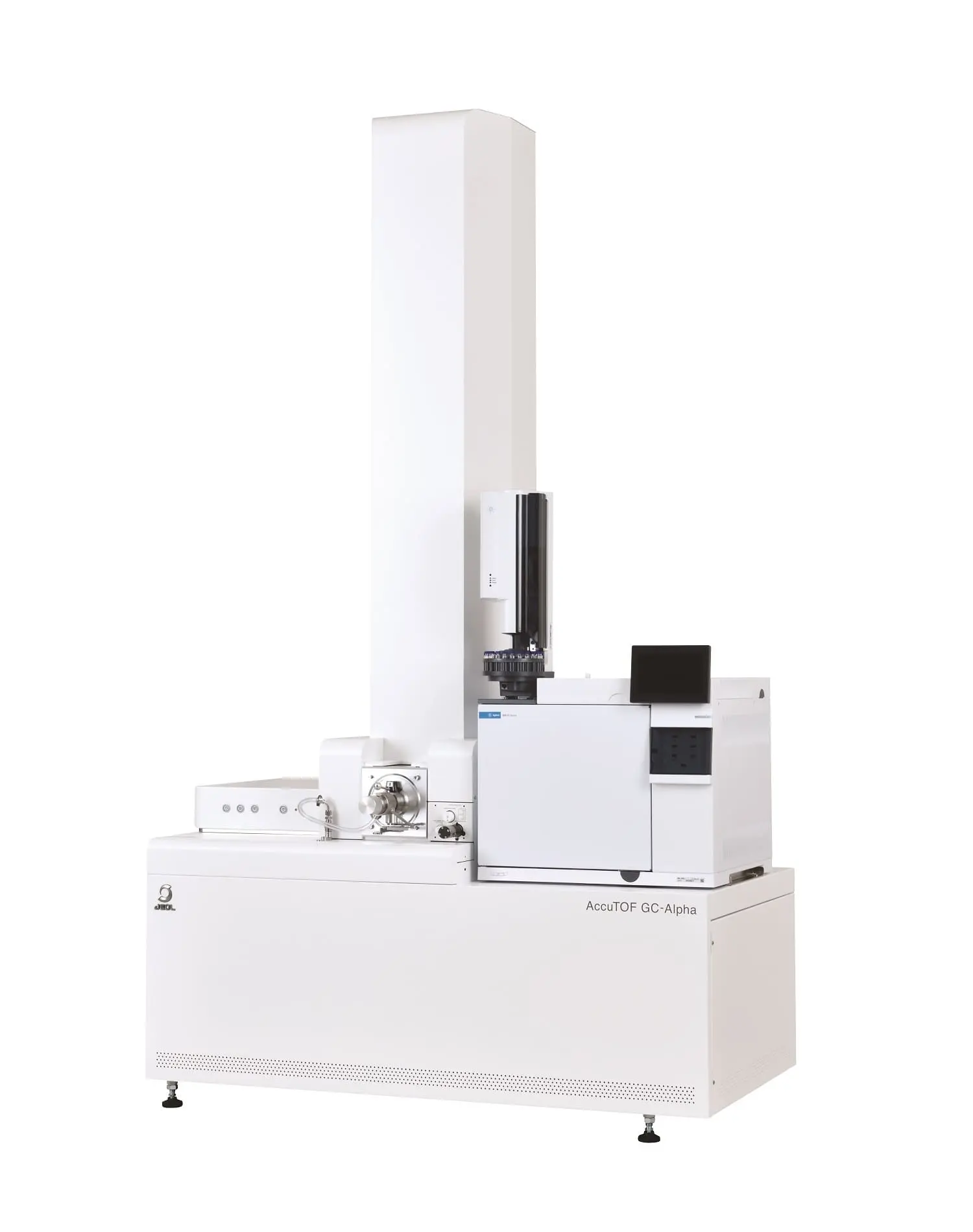
JEOL JMS-T2000 AccuTOF GC-Alpha GC-MS
- Integrated NIST library search software for analyte identification.
- Inert electron ionization source.
- Temperature Range: 150 to 300°C.
- High Sensitivity: Instrument detection limit (IDL) = 18.7 fg.
- Wide Dynamic Range: 4 Orders.
- Wide Mass Range: ~m/z 6,000.
- High Mass Resolving Power: 30,000.
- High Mass Accuracy: to 1 ppm.
Key Differentiators
Strengths
- High sensitivity – order of femtograms.
- Simultaneous detection, identification, and quantification.
- Compatibility with a wide range of sample types.
- Minimal information needed for untargeted analysis.
Limitations
- Requires volatile analytes.
- Analyte-specific calibration required for accurate quantification.
- Significant sample prep may be required.


Unsure Whether GC-MS Is Right for You?
Covalent’s expert team can help understand your sample characteristics and testing needs to craft a solution to your situation.
Sample Information
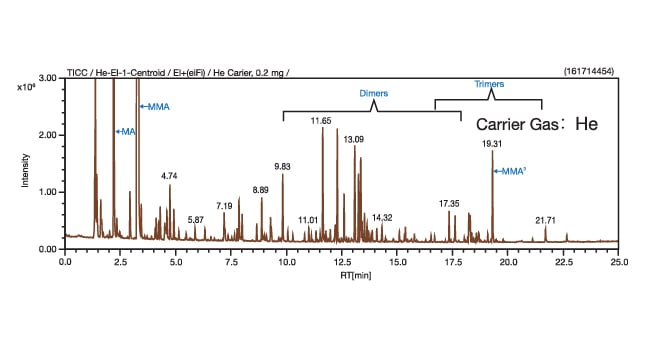
Above image shows a chromatogram of an acrylic resin analyzed by Py-GCMS (Pyrolysis-Gas Chromatography-Mass Spectrometry). Well-separated peaks show the primary monomers (MA and MMA) and larger pyrolysis fragments including dimers and trimers.
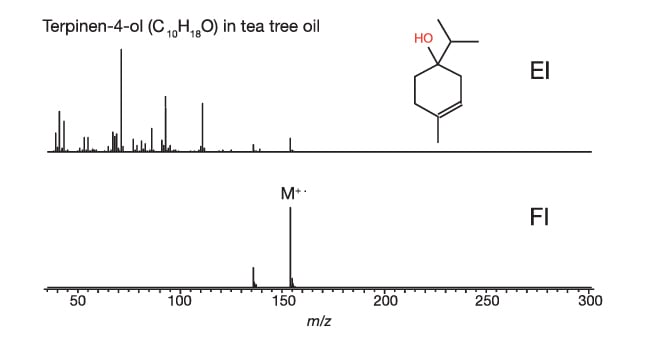
The top mass spectrum shows the fragmentation pattern of a terpene from tea tree oil generated by electron ionization, suitable for library searching. The bottom mass spectrum, produced by field ionization, presents a simplified view confirming the compound’s exact molecular weight, enhancing identification confidence.
What we accept:
Gases, liquids and solids are acceptable depending on specific matrix and measurement goals. GC-MS analysis techniques are compatible with small sample volume or mass; measured analyes are typical on the order of nanograms. Analytes must be volatile below 300°C.
Use Cases
Semiconductor
Critical to identifying yield issues, GC-MS is used in the semiconductor industry to pinpoint sources of yield issues stemming from material purity concerns, monitor the purity of process gas that affects chip quality, and identify organic contaminants to ensure the integrity of cleanroom environments.

Food & Agriculture
GC-MS analysis plays an important role in ensuring the safety of our food supply for manufacturers and regulatory agencies alike. Whether identifying organic residue from pesticide, performing flavor or nutritional analysis, or identifying and eliminating a wide range of contaminants in our food supply, GC-MS plays an essential part in producing the food we eat.

Medical Devices & Biotech
Ranging from medical device chemical characterization to clinical applications for the analysis of bodily fluids, GC-MS plays a critical role in keeping patients healthy, ensuring integrity & fairness in sport, aiding in the treatment of addiction & substance abuse, and aiding in the diagnosis and detection of congenital disease.
Aerospace & Defense
Ensuring the performance of materials under extreme stress in conditions like high temperature or pressure; analysis of critical components in the manufacture of aircraft and engine components; the forensic analysis of HAZMAT, narcotic, or explosive material; and the detection of chemical threats, GC-MS plays a role in ensuring our safety.
Complementary Techniques
- Fourier Transform Infrared Spectroscopy (FTIR): FTIR allows for quick screening of functional groups in organic and certain inorganic compounds. FTIR is more affordable and offers greater flexibility in terms of sample type, but has limited sensitivity and ability to deconvolute complex mixtures.
- Gas Chromatography (GC): GC-MS is a specific application of GC techniques, many of which can be handled without mass spectrometry. Thermal conductivity detection (TCD) and Flame Ionization Detection (FID) detectors are more cost-effective and may offer simpler quantitative analysis. Covalent offers a variety of gas chromatography services.
- Liquid Chromatography (HPLC and LC-MS): Liquid chromatography techniques complement GC-MS well, offering the ability to detect and identify low volatility compounds.
- Nuclear Magnetic Resonance (NMR): While both GC-MS and NMR are used to identify organic compounds, GC-MS offers superior sensitivity and ability to deconvolute complex samples.
Fourier Transform Infrared Spectroscopy (FTIR)
Rapid, non-destructive molecular fingerprinting across materials. Explore
Nuclear Magnetic Resonance Spectroscopy (NMR)
Determines molecular structure, composition, and dynamics. Explore
Why Choose Covalent for Your GC-MS Needs?
Frequently Asked Questions
Identifying the right test can be complex, but it doesn’t have to be complicated.
Here are some questions we are frequently asked.
Is GC-MS testing quantitative or qualitative?
GC-MS is often used for qualitative analysis given it’s exceptional utility for identifying unknown compound. Quantitative analysis is possible with calibration for each analyte to be quantified.
How long does a GC-MS analysis take?
Analysis time depends on the type and complexity of the matrix, ranging from a few minutes up to an hour.
What is the difference between hard and soft ionization in GC-MS?
Hard ionization breaks a molecules into fragments, providing a fingerprint that can be searched against a library for identification. Soft ionization minimizes fragmentation, preserving the molecular ion and enabling exact determination of the compound mass.