
What Is Auger Electron Spectroscopy (AES)?
Energy doesn’t stay put, and Auger Electron Spectroscopy (AES) proves it. When a high–energy electron beam strikes an atom, it ejects a tightly bound core electron, creating a vacancy. An outer-shell electron drops in to occupy this vacancy, and instead of releasing the energy as light, it transfers it to a third electron, which is ejected from the atom: the Auger electron. This electron carries element-specific kinetic energy, acting like a chemical fingerprint of the material.
Also known as Auger Spectroscopy, Auger Emission Spectroscopy, Auger electron analysis, or simply AES, this technique is indispensable for ultra-sensitive surface characterization. It’s ideal for detecting surface contamination, characterizing thin films, monitoring oxide layers, and evaluating interfaces, all with nanometer-scale precision.
At Covalent, AES is our cornerstone technique for analyzing the outermost layers of a material. Whether you are troubleshooting surface defects or validating thin film integrity, our AES labs deliver fast, precise, and actionable data for your materials development pipeline.

Surface
Sensitivity
Surface Sensitivity
Probes only the outermost 0.5–10 nm, delivering ultra-thin surface insights at nanometer precision.

Elemental
Fingerprinting
Elemental Fingerprinting
Identifies nearly all elements (except H, He) through unique Auger energy signatures, acting as chemical fingerprints.

High
Resolution
High Resolution
Lateral resolution down to ~10 nm, enabling pinpoint analysis of defects, thin films, and microfeatures.
Why Use AES?
AES is engineered to explore the most important elements of surface chemistry. Its elemental sensitivity and ultra-thin probing depth make it the method of choice for analyzing thin films, nanostructures, and coatings.
AES also enables rapid surface composition measurements and, when paired with ion sputtering, powerful depth profiling for layer‑by‑layer mapping.

Ultra-Precise Analysis
Unmatched lateral resolution and surface selectivity, detecting atomic-level contamination, diffusion gradients, and interface mismatches.

Thin Film Validation
Gold standard for analyzing coatings, nanostructures, and multilayers, where even a single monolayer can change performance.

Cross-Industry Impact
From semiconductors to aerospace, medical devices, and advanced manufacturing, AES ensures reliability where surface chemistry defines success.

Working Principle
AES operates by scanning a material’s surface with a focused beam of high-energy electrons, typically ranging between 3 to 30 keV. This knocks out a tightly bound inner-shell electron, creating an inner-shell vacancy. An outer-shell electron fills the gap, and the excess energy ejects a third electron, known as an Auger electron.
These Auger electrons have kinetic energies specific to their element and are independent of the beam’s energy. By measuring them, AES produces a spectral “signature” with peaks labeled as KLM, KLL, or LMM, notations that denote the shells involved in the transition.
Because only electrons emitted from the uppermost 0.5-10 nm of the surface can escape without losing energy, AES is one of the most surface-sensitive techniques available. That’s why all AES measurements are conducted in ultra-high vacuum (UHV), to retain the signal purity and avoid atmospheric interference.
Our specialists at Covalent decode these spectral signatures to trace contamination, map elemental diffusion, and investigate surface-level anomalies across industries.
Equipment Used for AES:
PHI 710 Scanning Auger Nanoprobe
- Imaging of textured or curved samples without analyzer-induced shadowing, enabled by the PHI’s coaxial electron gun-analyzer technology.
- Monoatomic argon (Ar⁺) sputter depth profiling for compositional analysis through layered structures.
- Maximum sample size of 60 mm diameter and 20 mm thickness.
- Inert sample transfer for air-sensitive materials.
- Maximum electron beam accelerating voltage of 25 kV.
- Sample must be a solid and compatible with ultra-high vacuum (no liquid).

Key Differentiators
AES is where atomic-level precision meets unmatched clarity.
| Property | AES |
|---|---|
| Surface Sensitivity | Probes the topmost ~0.5-10 nanometers. Ideal for ultra-thin surface analysis |
| Elemental Detection | Detects all elements except Hydrogen (H) and Helium (He) |
| Lateral Resolution | Achieves 10-30 nm resolution |
| Depth Profiling | Available via ion sputtering for compositional layer-by-layer insights |
| Quantification | Semi-quantitative to quantitative results |
| Chemical State Info | Limited (can consult for XPS) |
| Vacuum Requirement | Requires UHV |
| Sample Compatibility | Ideal for conductive solids. Insulator can be thinly coated with conductive layer |
| Sample Damage Risk | Soft or organic layers may be susceptible |
Strengths
Think of AES as a lie detector for surfaces. It interrogates only the few top level atomic layers, with unmatched precision.
Other Strengths of AES:
- Depth Profiling: In combination with ion sputtering, AES provides layer‑by‑layer elemental mapping for multilayer stacks, ideal in failure analysis and thin‑film studies.
- Versatile Applications: Supports contamination analysis, corrosion layer evaluation, and grain boundary mapping across sectors from biomedical to aerospace.
At Covalent, we push this power to deliver multi-modal datasets by integrating AES with complementary techniques like XPS and SEM.
Limitations
AES is a powerful tool, but a one-size-fits-all approach doesn’t fit all materials. Here when AES may not be ideal:
- AES is not suitable for Hydrogen and Helium due to the lack of usable Auger transitions.
- AES only works well with coated and conductive surfaces.
- Tests are conducted in ultra-high vacuum. Therefore, volatile and moisture-sensitive materials will require special handling.
- Not the ideal technique to investigate oxidation states or chemical bonding (at Covalent, we’d use XPS for this).
- Polymers and low-density films can be damaged due to prolonged electron exposure or ion sputtering.
- Should be paired with ToF-SIMS or EDS for deeper material insights.
We recommend consulting an expert at Covalent for evaluating each sample’s characteristics and project goals before defining the right analytical pathway.


Sample Information
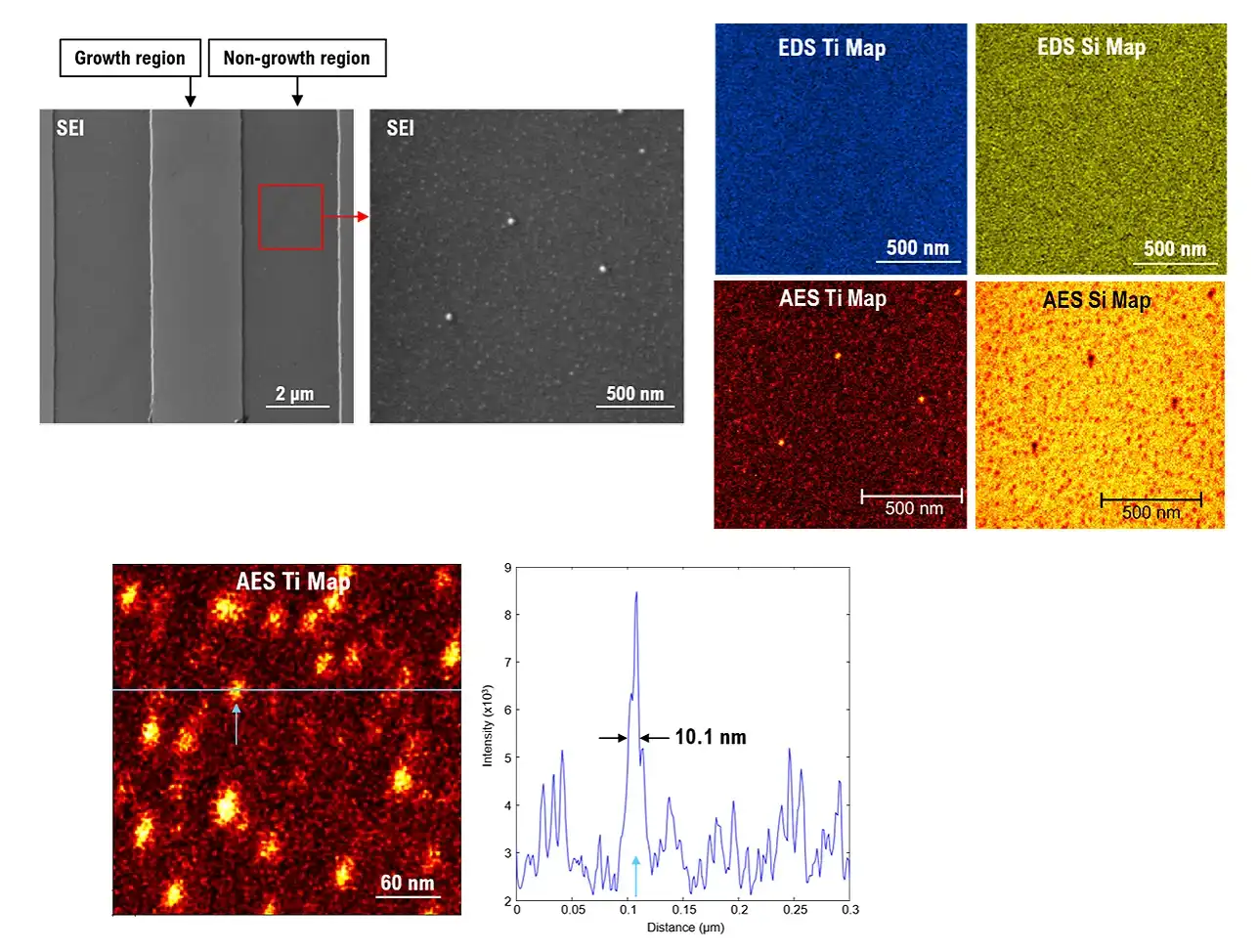
Area selective deposition (ASD) is a critical technique in advanced semiconductor manufacturing, enabling sub-10 nm patterning through iterative atomic layer deposition (ALD) and atomic layer etching (ALE) cycles. However, process-induced selectivity loss, where material unintentionally grows in non-growth regions, can lead to device failure.
In this ASD example, TiO₂ was deposited on SiO₂-patterned surfaces using ALD and ALE cycles. Scanning electron microscopy (SEM) revealed nanoscale particles in the non-growth regions that were not readily visible in energy-dispersive X-ray spectroscopy (EDS) maps. The EDS maps showed uniform titanium and silicon signal intensities.
Auger electron spectroscopy (AES), performed using the PHI 710 Scanning Auger Nanoprobe, provided high-resolution chemical mapping and identified the defect particles as titanium. A line scan of the Ti signal across a different analysis area on the ALD/ALE sample further confirmed the presence of 10 nm titanium particles.
This example highlights the AES’ capability to characterize nanoscale defects providing essential insight into ALD/ALE process control and failure mechanisms.
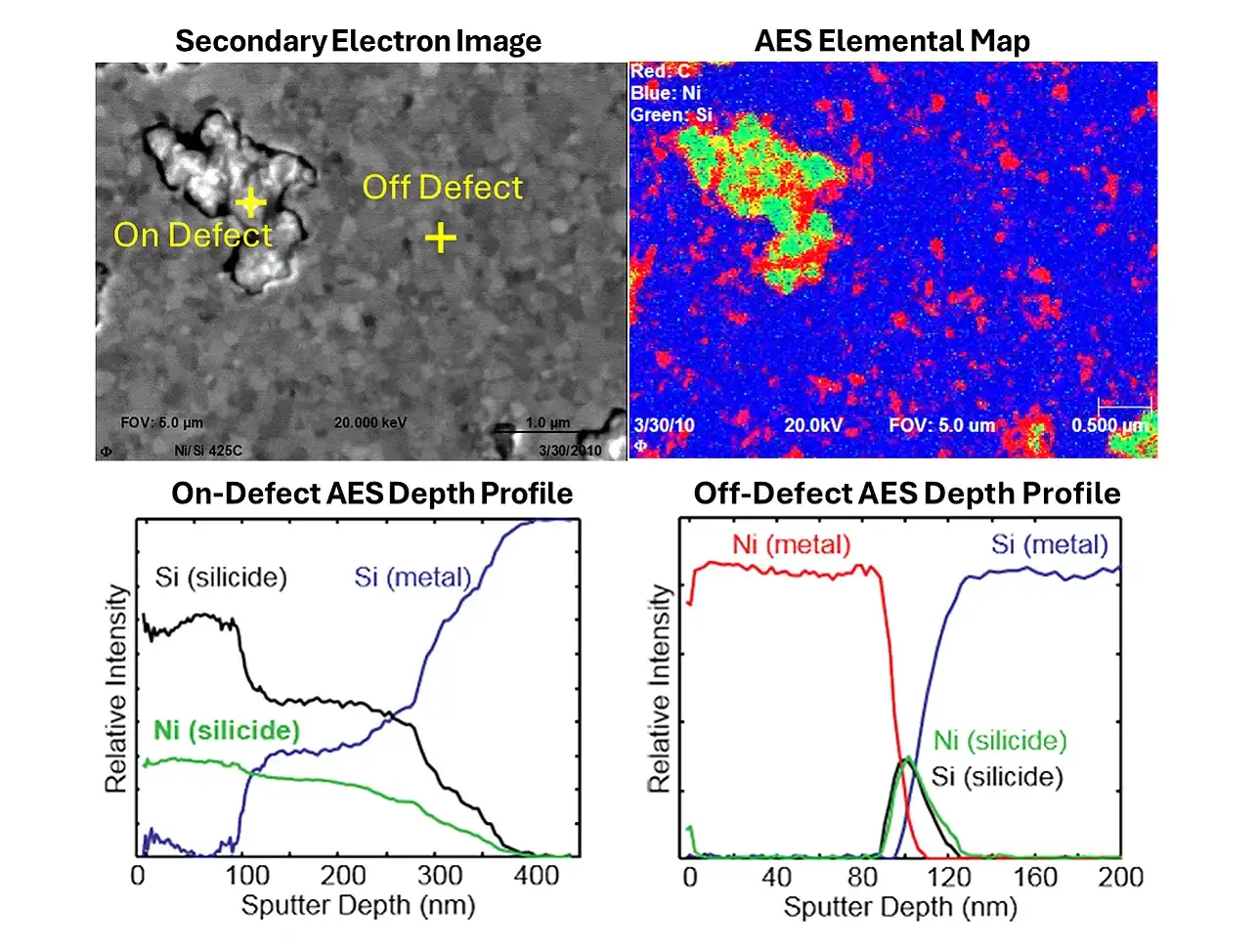
The secondary electron image, acquired with the PHI 710 Scanning Auger Nanoprobe, reveals a defect in a thin nickel film deposited on a silicon substrate. AES elemental mapping of carbon, nickel, and silicon showed a silicon-rich defect region, while the surrounding area remained nickel-dominated.
Using a 500 eV monoatomic argon ion beam for high-resolution, multi-point AES depth-profiling, the On Defect area confirmed the expected nickel overlayer in addition to the formation of a nickel silicide interfacial layer.
In contrast, the Off Defect area revealed a complex, multiphase silicide-based structure. This highlights the system’s ability to resolve nanoscale materials variations and interfacial defects with high spatial and chemical sensitivity (metallic silicon vs. silicide).
What we accept:
To ensure accurate results, AES samples must meet the following criteria:
- Must be vacuum-compatible, dry, and solid.
- The best fit is flat, conductive and thinly coated insulators.
- The sample size should typically be up to 25 x 25 mm.
- Small particles or powders are best mounted on a substrate or a stub.
- Avoid moisture and organics as they interfere with the vacuum and signals.
Use Cases
AES is trusted across industries where surface chemistry defines performance:

Semiconductor
Nanometer‑precision interface chemistry, contamination control, and process validation.
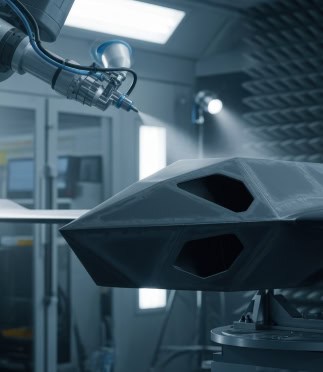
Aerospace & Energy
Protective coating integrity, oxidation monitoring, and degradation tracking under stress.

Medical Devices
Surface cleanliness, biocompatibility validation, and passivation layer verification.
Advanced Manufacturing
Identifies trace contaminants in additive and precision builds to safeguard material performance.
Complementary Techniques
AES, when paired with deeper or more chemically detailed tools, expands the scope of surface-level investigation.
- EDS: AES targets top nanometers whereas EDS captures bulk elemental data at micrometer scale. When paired, they bridge surface and subsurface chemistry.
- ToF-SIMS: AES provides better quantifiable atomic percent data and lateral resolution, whereas ToF-SIMS offers superior sensitivity and sub-nanometer depth resolution. When Combined, they solve both composition and concentration across surfaces.
- XPS: Complements AES by offering deeper probing (~5-10 nm) and richer state information. While AES excels at spatial resolution, XPS wins on quantification. But together, they cover more depth and detail.
Time of Flight Secondary Ion Mass Spectroscopy (ToF-SIMS)
Ultra-sensitive surface analysis with chemical imaging & depth profiling. Explore
X-ray Photoelectron Spectroscopy (XPS)
Measures surface elemental composition and chemical states. Explore
Why Choose Covalent for Your AES Needs?
At Covalent, we deploy precision AES solutions to map elemental composition at nanometer scales, isolate defects in microfeatures, and extract surface-specific insights that traditional techniques simply blur out. If your failure analysis and process validation are present in the top 10 nanometers, you are looking in the right place.
Whether you are dealing with thin films, buried interfaces, or unexplained anomalies, our engineers don’t just deliver data; they decode it. Covalent’s AES includes quantified reporting, spatially resolved mapping, and expert correlation with complementary techniques like SEM, XPS, and ToF-SIMS. Not just actionable insights, but all findings are documented in detail and protected under strict IP protocols.
We don’t just provide results but also interpretations, guidance, and a strategic roadmap tailored to your material system. Ready to understand your surfaces at the level they operate? Get in touch with an expert at Covalent.
Frequently Asked Questions
Identifying the right test can be complex, but it doesn’t have to be complicated.
Here are some questions we are frequently asked.
What kind of samples can be analyzed with AES?
Any solid that is vacuum-compatible can be used as a sample in AES. This includes metals, semiconductors, ceramics, and thin films, provided they are conductive or coated, to avoid charging.
Is AES destructive?
Not inherently. During spot analysis, it can be minimally destructive. But, when paired with ion sputtering for depth profiling, layers will be peeled off making the process destructive.
How does AES compare with ToF-SIMS or XPS?
AES is the best fit to deliver superior lateral resolution and fast quantification. On the other hand, XPS provides better chemical state information, and ToF-SIMS offers higher sensitivity and isotopic data.
Can AES be used on non-conductive materials?
Yes, but not without precautions. Materials should have either a thin conductive coating or charge neutralization to minimize beam charging artifacts.

Resources