
What Is Energy Dispersive X-ray Fluorescence (EDXRF)?
EDXRF is a non-destructive analysis technique used to measure elemental composition by measuring characteristic X-ray fluorescence generated when the sample is excited by X-rays.

Rapid,
Non-Destructive
Rapid,
Non-Destructive
Delivers fast elemental and thickness analysis without damaging samples, ideal for wafers and coatings.

Wide Element Range
Wide Element Range
Detects light to heavy elements with accuracy, enabling comprehensive material characterization.

Hybrid Precision
Hybrid Precision
Combines EDXRF and XRR for sub-nanometer thickness precision and improved measurement confidence.
Why Use EDXRF?
EDXRF provides rapid and non-destructive quantification of the composition of bulk materials and thin films, as well as measurement of film thickness and impurity levels.
EDXRF enables verification of metal film deposition, control over process drift, and identifies contamination that could affect device performance. Focused sources for XRF enable micro-spot mapping of composition variation across wafers and patterned structures. EDXRF is fast and well-suited for quick quantification of metallic and dielectric film components.

Accelerate Process Control
Quick, repeatable results enable tighter monitoring of film deposition and contamination.

Support for R&D & Production
Suited for both inline QA and research applications across semiconductors and advanced materials.

Expert-Driven Insights
Data interpretation and guidance from Covalent scientists ensure clear, actionable outcomes.


Working Principle
Energy Dispersive X-ray Fluorescence (EDXRF) excites atoms in the sample with X-rays and detects the energy of emitted fluorescence, providing elemental composition information. The energy of the emitted fluorescent X-rays is measured in parallel using a high-speed silicon drift detector (SDD).
Equipment Used for EDXRF:
At Covalent, we offer high-precision XRF on advanced thin films and multilayer stacks using the Rigaku Xtraia MF‑3000, operated at Rigaku. This allows us to provide small-spot, whole-wafer mapping with fab-grade throughput and repeatability.
Rigaku Xtraia MF-3000
- Micro‑spot beam engineering: Recipe‑selectable COLORS optics down to ~20 µm for scribe‑line and tiny pad targets.
- Fast, high‑fidelity XRR: HyPix‑3000 photon‑counting detector with ~10^8 dynamic range for rapid multilayer scans.
- Robust site targeting: Integrated pattern recognition and autofocus (BF/DF) for consistent hit‑rate on patterned wafers.
- Stack‑level insight: Resolves thickness, density, and interface roughness where XRF alone cannot (e.g., MTJ stacks).
Measurements Possible:
- Thin film thickness.
- Film density.
- Interface roughness.
- Elemental composition.
- Multilayer structure analysis.
- Uniformity mapping.
- Contamination detection (via EDXRF).

Key Differentiators
| Property | EDXRF |
|---|---|
| Film Thickness Range | ~1 nm to 50 µm (optical); up to ~500 nm (XRR) |
| Lateral Resolution | <1 mm |
| Wafer Size | 200 mm and 300 mm |
| Measurement Time | <2 minutes per site |
| Element Range | Al (Z=13) to U (Z=92) |
| Software | Integrated analysis and modeling tools |
| Application Range | Thickness and composition of thin films, nm to µm level |
| FEOL Applications | SiGe, CoSix, NiSix, SOI, Al, SiON, Hi-k dielectric/metal gate |
| BEOL Applications | Cu seed, Cu barrier, Cu plating, Ti/TiN, Ta/TaN, W |
| Other Applications | Ru, Pt, PZT |
| Incident Optics for XRF | Recipe-selectable COLORS™ micro spot optics, 25 W (50 kV / 0.5 mA) |
| Beam Modules | COLORS™-s (85 µm FWHM) or COLORS™-t (20 µm FWHM) |
| X-ray Sources | Cu-Kα (low-Z), Mo-Kα (high-Z), Au-Lβ (mid-Z) |
| Receiving Optics | Peltier-cooled Silicon Drift Detector (SDD) |
| Energy Resolution | 123 ± 5 eV |
| Goniometer Type | Theta-Theta goniometer (Horizontal Sample Placement) |
| Sample Stage | Vacuum chuck for ϕ300 mm or 200 mm wafers; supports coupons or smaller samples via carrier wafer |
| Sample Height Adjustment | Optical microscope with 5x lens and CCD camera for Autofocus |
| Pattern Recognition | Bright Field and Dark Field capability |
Strengths
- Combines XRR and EDXRF in a single tool.
- Non-destructive, high-throughput analysis.
- Wide range of measurable film types (metallic, dielectric, transparent).
- Sub-nanometer thickness precision.
- Automated wafer handling and mapping.
- Ideal for inline process control and R&D environments.
- Supports 200 mm and 300 mm wafers.
Limitations
- Requires flat, uniform sample surfaces for accurate results.
- Complex multilayers may require modeling for accurate interpretation.
- XRR limited to thicknesses below ~500 nm for optimal precision.
- EDXRF has limited sensitivity to Al, Mg.


Sample Information
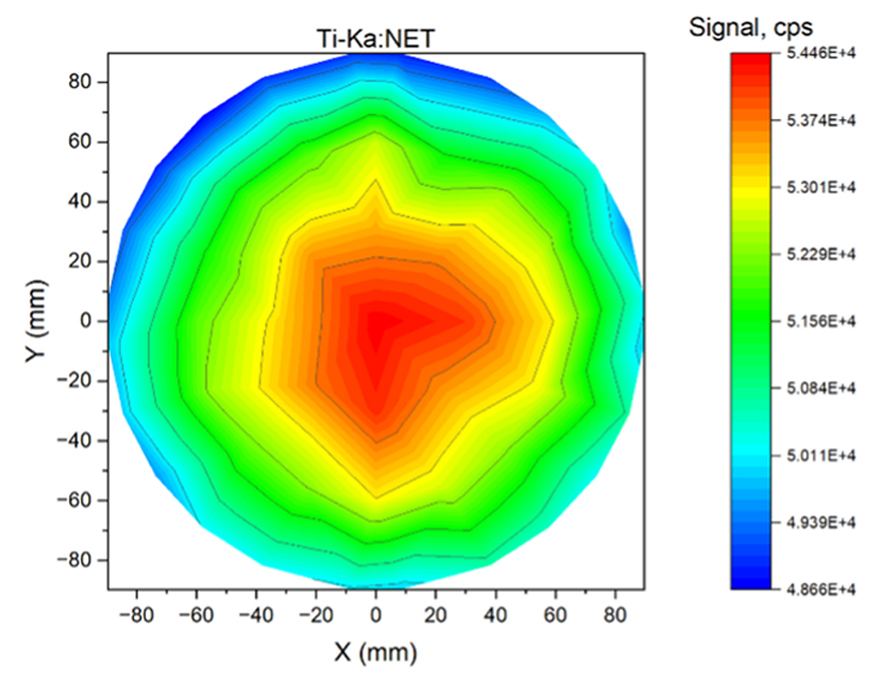
Variation of the Ti X-ray fluorescence signal over a TiN coated wafer.
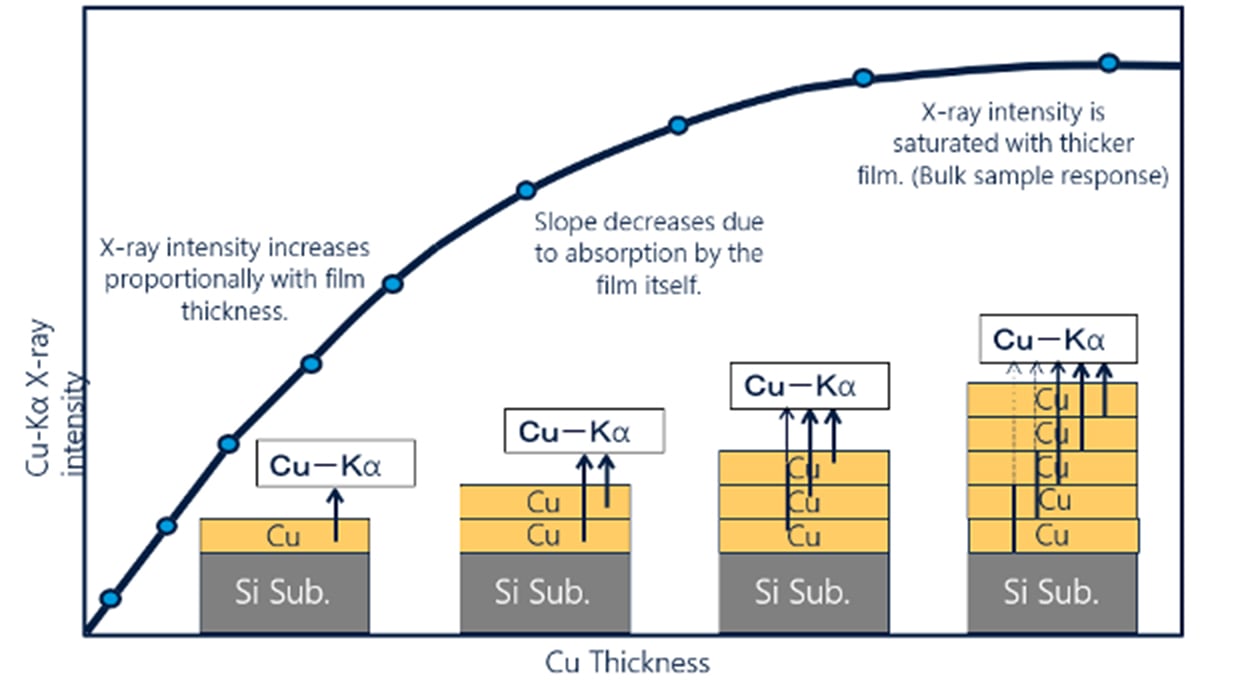
Film thickness is obtained by calibration based on the relationship between thickness and X-ray intensity.
What we accept:
- 200 mm or 300 mm wafers.
- Flat and uniform surfaces.
- Compatible with standard semiconductor materials.
- Clean and particle-free surfaces recommended.
Other instruments are available to measure powders through Covalent partners.
Use Cases

Semiconductor
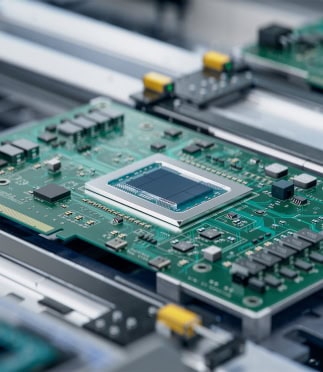
Analyze thin films, coatings, and interconnects on 200–300 mm wafers for elemental composition and thickness uniformity.
Data Storage & Electronics
Verify layer composition and detect trace contaminants in magnetic films, PCBs, and advanced storage devices.

Solar & Photovoltaics
Assess thin-film solar panels, OLED, and LCD displays for uniformity, contamination, and material quality.
R&D & Advanced Packaging
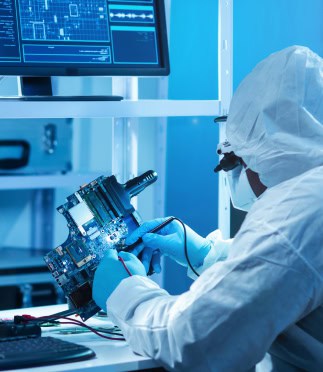
Support research labs with rapid elemental quantification, thickness mapping, and contamination analysis.

Metallurgy & Coatings
Measure alloy composition, coating thickness, and surface uniformity for quality control and process optimization.
Complementary Techniques
- Fourier Transform Infrared Spectroscopy (FTIR): Identifies molecular bonds and functional groups, providing complementary chemical information to EDXRF’s elemental analysis.
- Secondary Ion Mass Spectrometry (SIMS): Offers extremely sensitive depth profiling and isotopic analysis, complementing EDXRF’s non-destructive, layer-averaged composition data.
- Spectroscopic Ellipsometry: Measures optical properties and thickness of transparent or semi-transparent films with high precision, complementing EDXRF’s thickness measurements for opaque or multi-layer structures.
- Total Reflection XRF (TXRF): Provides ultra-sensitive detection of trace contaminants on flat, smooth surfaces, complementing EDXRF’s broader applicability to bulk and layered materials.
- Wavelength Dispersive XRF (WDXRF): Offers higher spectral resolution than EDXRF, enabling more precise quantification and separation of overlapping elemental peaks, especially for trace analysis.
- X-ray Photoelectron Spectroscopy (XPS): Chemical state and bonding information for surface elements, extending beyond EDXRF’s elemental identification to include chemical information.
Dynamic Secondary Ion Mass Spectrometry (Dynamic SIMS)
Quantifies elements and isotopes with nanometer depth profiling. Explore
Fourier Transform Infrared Spectroscopy (FTIR)
Rapid, non-destructive molecular fingerprinting across materials. Explore
Spectroscopic Ellipsometry (SE)
Measures thin-film thickness & optical properties. Explore
Wavelength Dispersive X‑Ray Fluorescence (WDXRF)
Non-destructive elemental composition & thin-film analysis. Explore
X-ray Photoelectron Spectroscopy (XPS)
Measures surface elemental composition and chemical states. Explore
Why Choose Covalent for Your EDXRF Needs?
Covalent’s EDXRF services are an excellent choice for fast, non-destructive, and versatile thin film and elemental analysis, backed by sophisticated instrumentation and hybrid metrology options tailored to demanding research and industrial applications.
- Full wafer (and larger sample handling).
- Complementary techniques available.
- High-sensitivity instrument.
- Micro spot mapping capability.
Frequently Asked Questions
Identifying the right test can be complex, but it doesn’t have to be complicated.
Here are some questions we are frequently asked.
Why EDXRF vs. WDXRF?
EDXRF enables rapid simultaneous collection of all X-ray energies for quick mapping and higher spatial resolution when overlapping X-rays are not a concern.
How does Covalent ensure high accuracy in EDXRF analysis for thin films
Through a hybrid approach combining XRR and EDXRF we can calibrate the thickness for high accuracy EDXRF measurements of thin films.
What industries benefit most from Covalent's EDXRF services
Semiconductor industry characterizes different types of thin films on wafers.
Why is EDXRF preferred over other techniques for rapid elemental analysis
Quick and non-destructive mapping of thin films on wafers using rapid parallel measurement of all elements instead.

Resources