
What Is Gel Permeation Chromatography (GPC)?
Gel Permeation Chromatography (GPC), also known as Size-Exclusion Chromatography (SEC), is a liquid chromatography technique that separates molecules dissolved in solution according to their size or hydrodynamic volume. Unlike other chromatographic methods that rely on chemical or physical interactions between analytes and the stationary phase, GPC operates solely based on molecular size exclusion.

Accurate Molecular Weight Profiling
Accurate Molecular Weight Profiling
Precise measurement of polymer mass, distribution, and polydispersity.

Size‑Based Separation
Size‑Based Separation
Separates molecules purely by size/hydrodynamic volume, independent of chemical interactions.

Essential for Polymer Characterization
Essential for Polymer Characterization
Cornerstone method to study polymer structure, performance, and quality.
Why Use GPC?
GPC is used to determine the average molecular-weight and size distributions of polymers, proteins, or other macromolecules. GPC analysis services help accelerate product development and support quality control in various industries.

Reliable Quality Control
Ensures batch consistency and detects polymer degradation or molecular weight shifts.

Accelerated Product Development
Delivers critical data to optimize formulations and reduce R&D cycles.

Broad Industry Applications
Supports innovation across plastics, biotech, pharmaceuticals, and advanced materials.


Working Principle
In GPC the polymer flows through a column packed with porous beads. Larger polymer molecules are too bulky to enter many pores, so they quickly travel around the beads and elute earlier, while smaller molecules enter more pores, taking a longer path, and eluting later.
The amount of polymer eluting from the columns (often determined with a refractive-index detector) is measured versus time. The elution time to molecular weight is calibrated with a set of standards and then a full molecular-weight distribution for the sample can be determined.
Key Differentiators
GPC remains the cornerstone technique for analyzing polymer size and distribution, essential for understanding the properties and behaviors of complex macromolecules in scientific and industrial settings.
Strengths
- GPC cleanly separates molecules by size to determine the molecular-weight distribution, this information can help understand viscosity, strength, and other properties of the polymer.
- GPC can also be used to determine degradation of polymers causing reduction in molecular weight.
Limitations
- Closely spaced oligomers may not be individually resolved in a typical analysis.
- Insoluble polymers cannot be analyzed by GPC.


Unsure Whether GPC Is Right for You?
Our GPC analysis services help accelerate product development and support quality control in various industries.
Sample Information
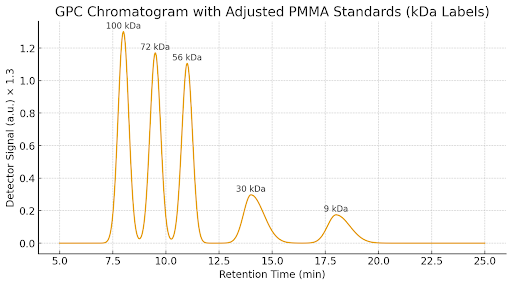
GPC Chromatogram with PMMA standards.
What we accept:
A few milligrams of a polymer soluble in a suitable solvent is required. Polymer already dissolved in solutions can also be provided.
Use Cases
Polymer Molecular Weight Determination
GPC is routinely used to determine the molecular weight distribution of synthetic and natural polymers.

Quality Control in Polymer Manufacturing
GPC is used to monitor batch consistency and verify that the polymerization process produces the desired product profile.
Protein Purification & Analysis
In biotechnology and biochemistry, GPC helps separate proteins and peptides based on size, useful for purifying or studying structural properties of biomolecules.

Detection of Polymer Degradation
GPC can detect molecular weight shifts caused by polymer degradation, such as oxidation, hydrolysis, or UV damage.
Complementary Techniques
- FTIR: Provides light elements sensitivity and depth profiling, including hydrogen.
- NMR: Reveals detailed polymer structure and composition, complementing FTIR for a deeper understanding of chemical changes.
- Pyrolysis GC-MS: Provides chemical composition with highly sensitive detection of trace additives and components in polymers and blends.
Fourier Transform Infrared Spectroscopy (FTIR)
Rapid, non-destructive molecular fingerprinting across materials. Explore
Gas Chromatography-Mass Spectrometry (GC-MS)
Identifies and quantifies small organic molecules in mixtures. Explore
Nuclear Magnetic Resonance Spectroscopy (NMR)
Determines molecular structure, composition, and dynamics. Explore
Why Choose Covalent for Your GPC Needs?
Frequently Asked Questions
Identifying the right test can be complex, but it doesn’t have to be complicated.
Here are some questions we are frequently asked.
What are the main differences between GPC and other chromatography techniques?
GPC separates molecules by size while other chromatography separates by polarity.
Why is GPC particularly useful for polymer characterization in industry?
GPC is the workhorse for the polymer industry because polymer MW information is crucial for understanding other material properties and achieving consistent manufacturing quality.
What challenges can affect the reliability of GPC results in molecular analysis?
Complex mixtures with various solubilities can make GPC results interpretation difficult. There is no chemical identity information from GPC results.
How might advancements in gel materials improve the sensitivity of GPC analysis?
Column packing materials that are engineered with a more uniform pore size distribution or with special surface functionalization can improve separation efficiency.

Resources