
What Is Neutron Activation Analysis (NAA) ?
Neutron Activation is a method for quantifying the concentration of elements in materials. Samples are irradiated with neutrons, which causes elements to form unstable radioactive isotopes. As the elements decay, they release gamma rays that are measured to identify the material’s composition. This method is helpful in detecting small amounts of material, especially in fields such as semiconductors, nanotechnology, and advanced coatings, where precision is important. At Covalent, we focus on delivering accurate results while keeping the sample prep as simple and straightforward as possible.

Ultra-Trace Detection
Ultra-Trace Detection
Measures elements down to parts-per-billion levels.

Multi-Element Analysis
Multi-Element Analysis
Detects and quantifies multiple elements in a single run.

Matrix-Independent Accuracy
Matrix-Independent Accuracy
Provides reliable results regardless of sample composition.
Why Use NAA?
Neutron Activation is ideal when ultra-trace, multi-element quantification is needed, especially for samples that are difficult to digest or analyze by other methods. Its minimal sample preparation, matrix-independent accuracy, and high sensitivity make it well-suited for semiconductors, advanced materials, geological studies, and any application requiring precise, reliable elemental analysis.
Neutron Activation is especially useful for samples—solid or liquid—that cannot be digested for ICP analysis, contain halides, or include elements like H, N, or O that are difficult to measure by standard methods. It also offers a more sensitive or cost-effective option when only a few elements need quantification, or when elements cannot be measured by ICP, such as noble or atmospheric gases.

High Sensitivity
Captures ultra-low concentrations that other techniques may miss.

Minimal Sample Prep
Works with solids, powders, and liquids with little to no preparation.

Versatile Applications
Ideal for semiconductors, advanced coatings, and geological samples.

Covalent’s Capabilities Offer NAA for Trace Multi‑Element Analysis and
Reliable Quantification

Working Principle
Instrumental Neutron Activation Analysis (INAA) works by irradiating samples with neutrons in a nuclear reactor or with a neutron generator. Irradiation which causes certain stable nuclei to capture neutrons and become radioactive isotopes. As these unstable isotopes decay, they emit characteristic gamma rays that are measured to identify and quantify the elements present in the sample.
Equipment Used for NAA:
Nuclear reactor or neutron generator and gamma ray detectors. High-speed pneumatic rabbit sample transfer is available for very short half-life nuclides, ex: 20F. Prompt gamma neutron activation for H, B, Gd and other elements. Fast neutron activation for N & O.
Key Differentiators
Neutron activation analysis requires minimal or no sample preparation and has limited sensitivity to the chemistry of the sample matrix, enabling robust quantification to trace levels in a wide variety of samples.
Strengths
- Neutron activation can give higher precision (more repeatable measurements) than most other methods.
- Isotope dilution and possible qNMR are better/comparable.
- Unlike SIMS and LA-ICP-MS, matched calibration standards are typically not needed.
- Liquids or solids can be easily measured.
Limitations
- High boron content can cause self-shielding; He, Li, Be, C, S, Pb not measurable.
- Samples may become radioactive and cannot always be returned.
- Short-lived isotopes (e.g., 20F) limit sensitivity; long-lived matrix elements may require extended decay times.
- Certain matrices (Na, Al, Mn) reduce accuracy; Si, C, Ca, N, H, O are preferred.
- Gas samples are difficult to measure; argon detection is challenging.
- Requires careful consideration of interferences and isotope half-lives.


Unsure Whether NAA Is Right for You?
Our experts are here to help you determine if Neutron Activation Analysis is the best fit based on your material, detection limits, industry needs, and project goals.
Sample Information
- Elemental composition reports showing relative concentrations of multiple elements in a single run.
- Gamma-ray spectra with characteristic peaks identifying specific elements in the sample.
- Detection limit tables indicating sensitivity from <1 ppb to percent-level concentrations.
- Isotope-specific data highlighting ultra-trace elements in complex matrices.
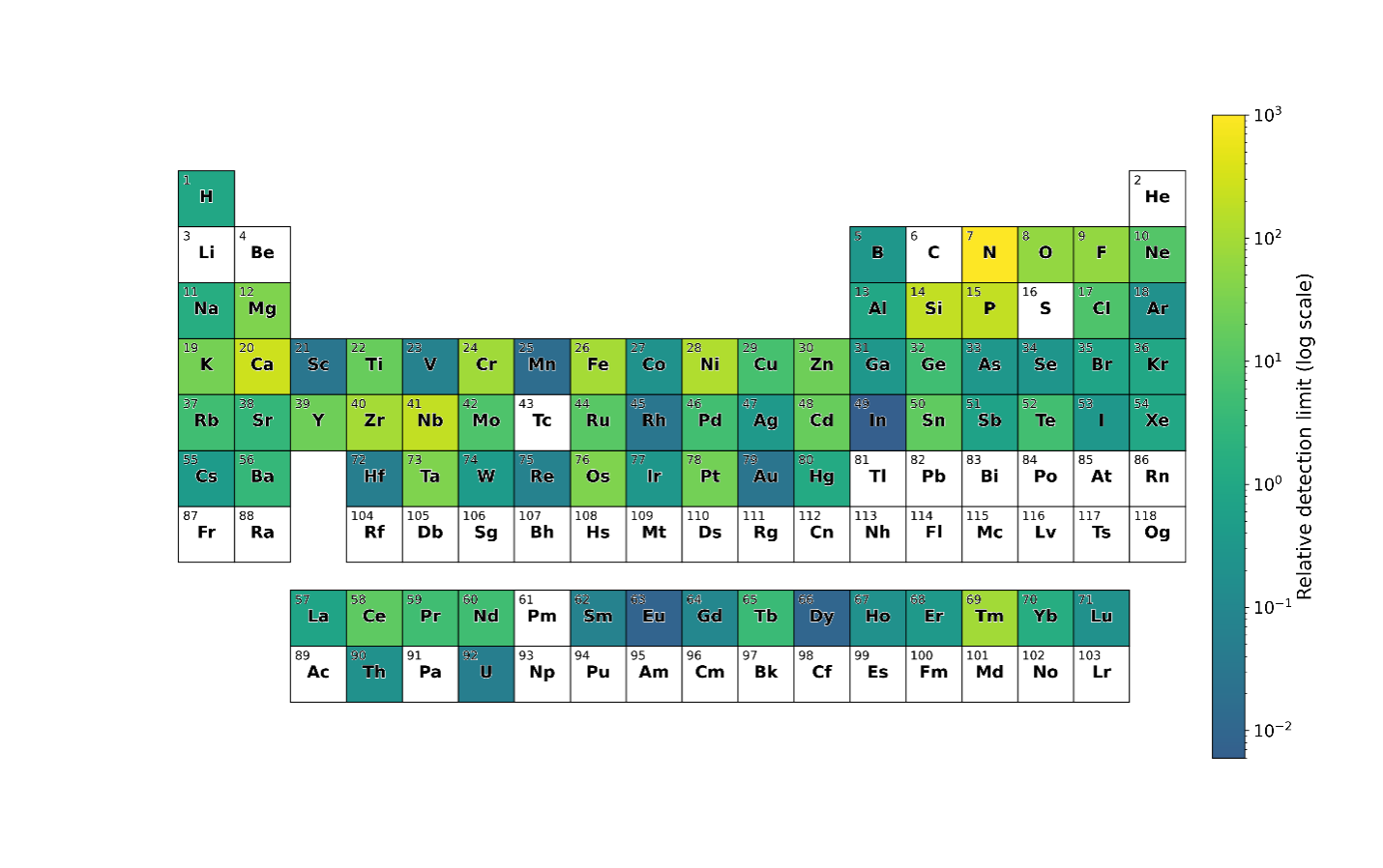
Relative detection limits of elements by neutron activation analysis, from percent-levels. Elements that are not measured by neutron activation are not colored.
What we accept:
Use Cases

Environmental Monitoring
Quantifying trace metals and pollutants in soil, water, and air particulates.
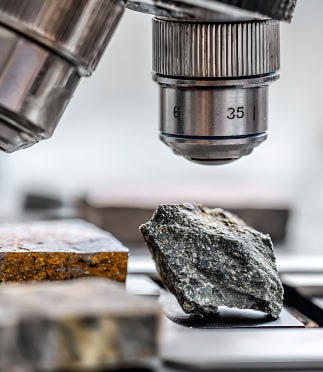
Geological Exploration
Determining elemental composition of rocks and minerals for mining and resource assessment.

Semiconductor Manufacturing
Measuring ultra-trace metal contaminants in silicon wafers and process chemicals.

Metallurgy & Materials Science
Determining trace elements in alloys and ceramic materials for development and quality control.

Agriculture & Food Science
Analyzing nutrient and contaminant levels in crops, fertilizers, and food products.

Medical & Biological Research
Measuring trace element concentrations in tissues and biological samples.

Pharmaceutical Production
Verifying elemental purity and detecting contaminants in raw materials and formulations.
Complementary Techniques
- ICP: ICP gives precise elemental concentrations, while neutron activation confirms elemental presence based on nuclear properties. Together they provide cross validation when matrix or interference issues limit either method alone.
- Ion chromatography: Ion chromatography separates and quantifies ionic species, giving detailed information about specific anions or cations. Neutron activation identifies elements through nuclear signatures, so the two complement each other by linking elemental composition to specific ionic forms that neutron activation cannot distinguish.
- Inert gas fusion: Inert gas fusion measures light elements like oxygen, nitrogen, and hydrogen with high sensitivity. Neutron activation identifies elemental content through nuclear signatures, so together they cover both light gas forming elements and heavier elements that neutron activation detects more effectively.
Inductively Coupled Plasma Mass Spectrometry (ICP-MS)
Measures trace elements with high accuracy. Explore
Why Choose Covalent for Your NAA Needs ?
Frequently Asked Questions
Identifying the right test can be complex, but it doesn’t have to be complicated.
Here are some questions we are frequently asked.
How long does the entire NAA process take, from submission to results?
Typical turn around time is 1-2 weeks.
Can NAA distinguish between different chemical forms (speciation) of an element in a sample?
NAA is only sensitive to the element and not different chemical forms.
Are there any regulatory or licensing requirements for clients submitting samples for NAA?
There are no regulatory or licensing requirements to submit samples for NAA.

Resources