

What Is Time Of Flight Secondary Ion Mass Spectroscopy (ToF-SIMS)?
Time-of-flight Secondary Ion Mass Spectroscopy (ToF-SIMS), also known as ToF-SIMS or Time-of-Flight SIMS, is a highly sensitive surface analysis technique that provides detailed elemental and molecular information from a sample’s outermost layers. ToF-SIMS combines traditional Secondary Ion Mass Spectroscopy (SIMS) with a time-of-flight (ToF) mass analyzer to create exceptional sensitivity, high mass resolution, and comprehensive chemical mapping capabilities.

Ultra-Sensitive
Surface Analysis
Ultra-Sensitive
Surface Analysis
Captures surface chemistry from the top 1–2 nanometers with exceptional detection limits and precision.

Molecular and Isotopic
Detection
Molecular and Isotopic
Detection
Provides detailed identification of elements, molecules, and isotopes with unparalleled mass resolution and sensitivity.

High-Resolution
Chemical Imaging
High-Resolution
Chemical Imaging
Generates chemical maps and 3D depth profiles to visualize spatial distributions with submicron resolution.
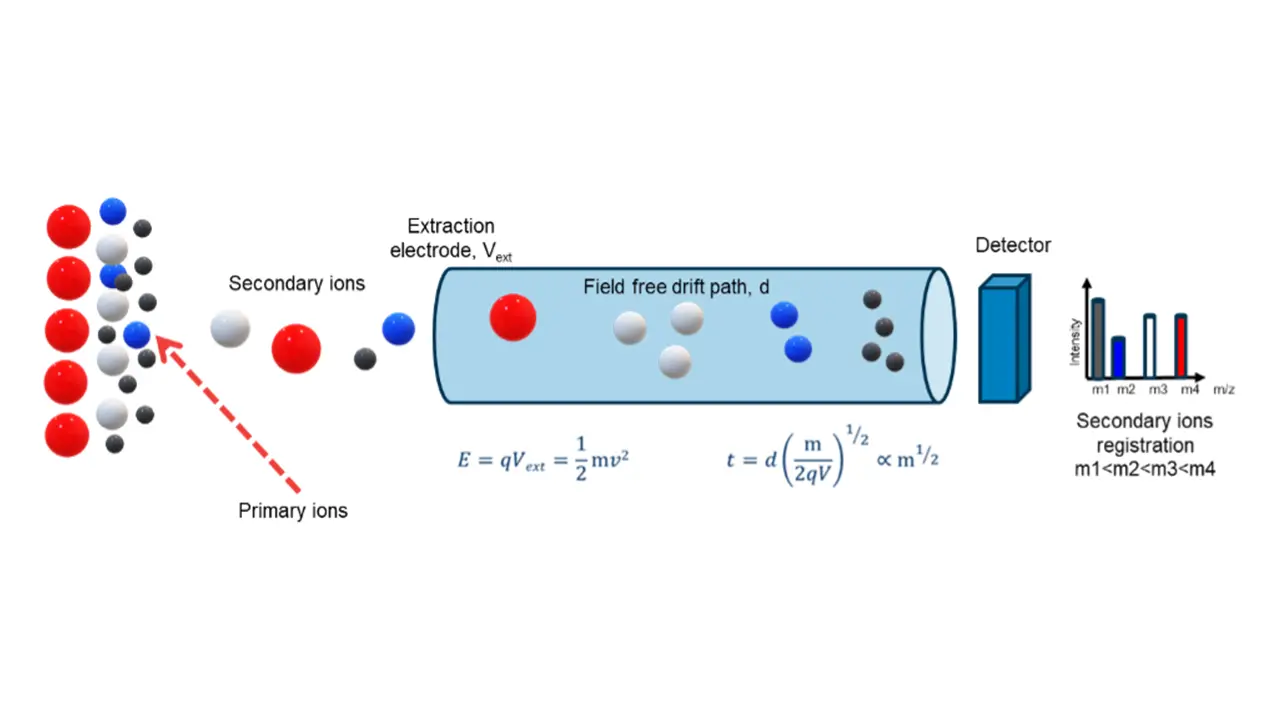
The ToF-SIMS working principle diagram shows a primary ion beam hitting a sample surface and ejecting secondary ions, which are then separated by mass inside the time-of-flight analyzer.
Why Use ToF-SIMS?
ToF-SIMS delivers powerful insights into contamination, thin films, and surface chemistry with unmatched sensitivity.
Advantages of ToF-SIMS:
- Extreme Surface Sensitivity: Analyzes only the top 1–2 nm of the surface.
- Exceptional Detection Limits: Detects species down to parts-per-billion levels.
- Wide Mass Range: Identifies all elements (H–U), isotopes, and molecular fragments up to 10,000 amu.
- High Spatial Resolution: Produces chemical maps with submicron lateral resolution (as fine as ~50 nm in some modes).

Trace Contamination Detection
Identifies contaminants and impurities at ultra-low concentrations that other surface methods miss.

Nanometer-Scale Depth Profiling
Resolves compositional changes in thin films and multilayers with ~1 nm precision.

3D Chemical Visualization
Combines imaging and depth analysis to reconstruct full three-dimensional chemical maps.

Working Principle
ToF-SIMS works by bombarding a sample surface with primary ions (typically Bi), causing the ejection of secondary ions from the surface's top 1-2 nanometers. These secondary ions are then accelerated in an electric field and travel through a flight tube, with lighter ions reaching the detector before heavier ones. By precisely measuring these flight times, the technique identifies elements and molecules present on the surface with extraordinary sensitivity.
Equipment Used for ToF-SIMS:
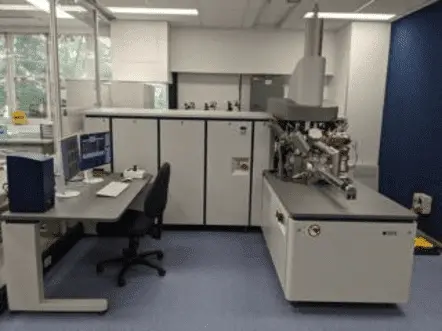
IONTOF M6 System
- Primary Beam: 30 keV BiGa cluster Nanoprobe 50.
- Secondary beam:
- Thermal Ionization Cesium Source.
- Oxygen Electron Impact Gas Ion Source.
- Fully Integrated Ar Gas Cluster Ion Source.
- Analyzed Depth: 2nm.
- Mass Resolution: > 30,000.
- Analytical Sensitivity: Down to high ppb.
- Spatial Resolution: ~50nm.
- Sputter Depth: 2-3 mic.
Key Differentiators
The key benefits of ToF-SIMS include its ability to detect all elements (including isotopes), its extremely high sensitivity (parts per billion range), excellent surface specificity, and the capacity to generate high-resolution 2D chemical maps and 3D chemical reconstructions. These capabilities make ToF-SIMS testing an invaluable tool for investigating surface chemistry, contamination, layer structures, and interfaces across various materials and industries.
Common Applications of ToF-SIMS:
- Contamination detection on all types of solid samples.
- Depth profiling in thin films to investigate layer uniformity, diffusion, and thickness.
- Investigating element distributions in battery materials.
- Understanding the chemical composition of polymers.
- Analyzing drug distribution in tissue.
- Mapping the distribution of isotopes in geological samples.
Strengths
- Extreme surface sensitivity (top 1–2 nm).
- Very high mass resolution and ppb detection limits.
- Detects all elements, isotopes, and many molecules.
- Enables high-resolution chemical imaging and mapping.
- Supports depth profiling and 3D chemical reconstruction.
Limitations
- Destructive when performing depth profiling.
- Limited quantification without proper standards.
- Requires vacuum-stable, solid samples.
- Sensitive to surface roughness and topography.
- Provides limited chemical-state information.


Unsure whether ToF-SIMS Is Right for You?
Learn how surface chemical imaging and depth profiling can advance your materials research.
Sample Information
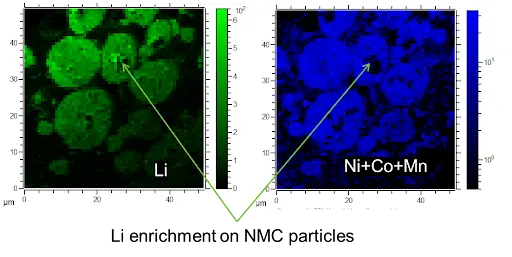
High-resolution ToF-SIMS maps reveal lithium enrichment at the surfaces of NMC particles relative to the Ni+Co+Mn matrix.
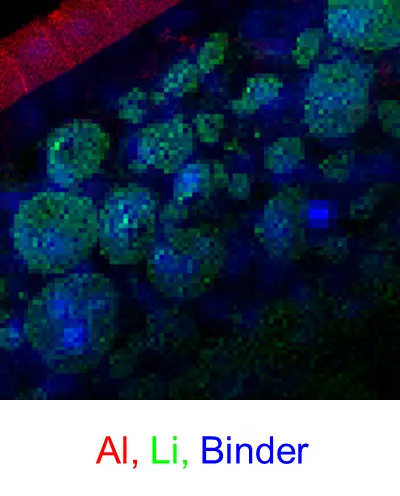
Multicolor elemental mapping highlights the spatial distribution of Al, Li, and binder.
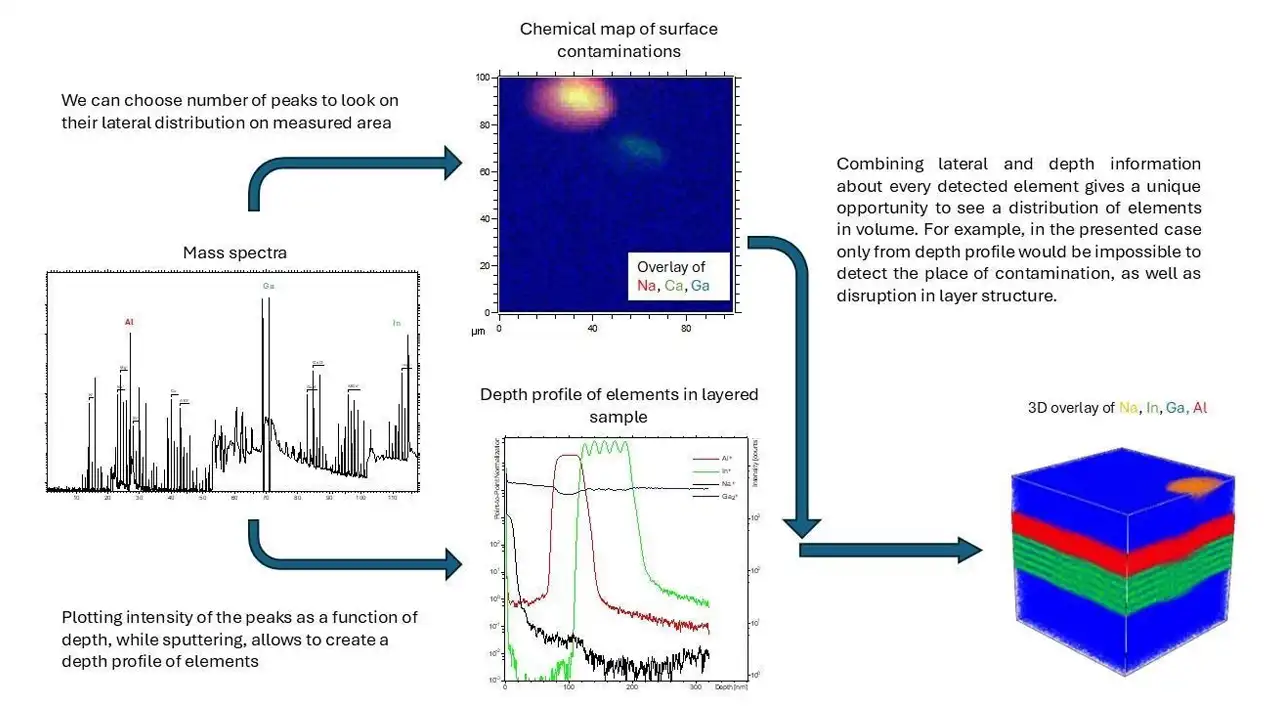
This case study highlights the capabilities of ToF-SIMS for contamination analysis using a multilayer In/Ga/Al sample containing sodium. By combining depth profiling with chemical mapping, the origin of the contamination was identified. The results indicate that sodium is a surface contaminant, most likely from a fingerprint, rather than gallium contamination, which would have appeared uniformly across all upper-layer materials.
What we accept:
- Solid phase.
- Stable under ultra-high vacuum conditions.
- Max dimensions: 60 mm (L) x 60 mm (W) x 20 mm (H).
- Flatter topographies improve signal detection.
- For powder samples, 5-10 mg is sufficient.
- Handle samples with gloves.
- Pack in a glass, hard plastic box, or aluminum foil.
Use Cases

Semiconductor
ToF-SIMS is crucial for quality control, process optimization, and device reliability in the industry.

Energy Storage
ToF-SIMS is instrumental in analyzing and delivering insights crucial for developing high-performance, long-lasting energy storage solutions.

Medical Device
ToF-SIMS helps assess the longevity of medical implants and devices, which in turn improves material selection and surface modification.

Pharmaceutical
ToF-SIMS analyzes essential information for developing effective drug delivery systems and ensuring the safety and performance of biomedical products.
Polymers & Coatings
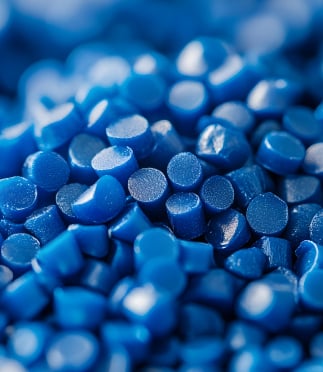
ToF-SIMS provides detailed chemical composition, which helps optimize formulations and enhance product durability.
Environmental & Geological Sciences
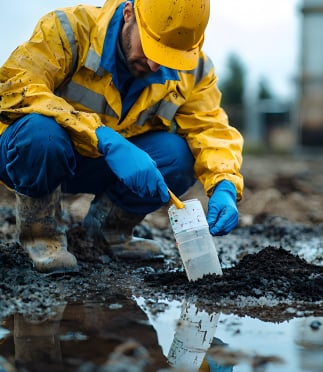
ToF-SIMS analyzes various materials to help understand pollutant dispersion, assess soil contamination, and characterize mineral surfaces for research and industrial purposes.
Complementary Techniques
ToF-SIMS analysis has the ability to combine with many other analytical techniques to provide a more comprehensive understanding of materials:
- Atomic Force Microscopy (AFM): Combines well with ToF-SIMS to correlate surface topography with chemical information.
- Auger Electron Spectroscopy (AES): Like ToF-SIMS, AES is surface-sensitive but offers faster quantification and better spatial resolution for specific elements.
- Scanning Electron Microscopy with Energy Dispersive X-ray Spectroscopy (SEM-EDS): SEM-EDS provides high spatial resolution morphological information alongside bulk elemental analysis, complementing the surface-specific chemistry from ToF-SIMS.
- X-ray Photoelectron Spectroscopy (XPS): XPS provides quantitative elemental composition and chemical state information.
Atomic Force Microscopy (AFM)
Maps nanoscale topography and material properties with a sharp probe. Explore
Auger Electron Spectroscopy (AES)
Measures Auger electrons for high-resolution surface analysis. Explore
X-ray Photoelectron Spectroscopy (XPS)
Measures surface elemental composition and chemical states. Explore
Why Choose Covalent for Your ToF-SIMS Needs?
Covalent provides enhanced complementary capabilities, including a variety of techniques for chemical and composition insights that can help accelerate your research and development processes, and an industry leading data platform to organize and analyze your results.
We provide detailed analysis and documentation of measurement conditions and results, offering actionable insights into surface properties and chemical bonding environments.
At Covalent, we guarantee absolute confidentiality for all client data and proprietary information. We are committed to maintaining the highest standards of discretion and are prepared to sign any non-disclosure agreement you require to ensure your intellectual property remains fully protected.
Frequently Asked Questions
Identifying the right test can be complex, but it doesn’t have to be complicated.
Here are some questions we are frequently asked.
What sample types are suitable for ToF-SIMS analysis?
ToF-SIMS can analyze most solid materials that are vacuum compatible, including metals, semiconductors, polymers, ceramics, glass, paper, and biological samples. Samples should ideally be flat and stable under ion bombardment.
Is ToF-SIMS destructive?
ToF-SIMS can be operated in both static (minimally destructive) and dynamic (destructive) modes. Static SIMS analyzes only the outermost surface with minimal damage, while dynamic SIMS intentionally removes material for depth profiling. We can advise on the best approach for your specific needs.
How deep can ToF-SIMS analyze into the sample?
In static mode, ToF-SIMS is sensitive to the top 1-2 nm of the surface. In dynamic depth profiling mode, it can analyze up to several micrometers, depending on the material and sputtering conditions.
Can ToF-SIMS provide quantitative results?
ToF-SIMS is primarily qualitative or semi-quantitative. Quantification requires appropriate standards with known concentrations of the elements of interest in a matrix similar to your sample. We can discuss quantification options based on your specific analytical needs.