
What Is Ultraviolet Photoelectron Spectroscopy (UPS)?
Ultraviolet photoelectron spectroscopy (UPS) is a highly surface-sensitive analytical method that employs ultraviolet light to remove electrons from the surface of a material. It gathers electrons from the Fermi level (if occupied) to the down to states with binding energies near the ultraviolet probe energy. It’s most typically used to calculate the work function (WF) of the target sample surface.
This enables scientists to investigate the electronic structure at the material’s surface.
By measuring the kinetic energy of these ejected electrons (photoelectrons), researchers can obtain valuable information about:
- The structure of the material’s valence band.
- Energies of molecular orbitals.
- The work function of the surface.
This technique provides detailed insights into the material’s electronic characteristics by focusing on the properties of electrons located near the outermost surface region.

High Resolution
High Resolution
Provides precise measurement of surface electron energies and work function with high signal-to-noise ratio.

Surface Sensitivity
Surface Sensitivity
Measures electronic structure in the outermost ~2 nm of the sample surface for targeted characterization.

Surface Cleaning
Surface Cleaning
The Nexsa system uses Argon ion clusters to remove contamination, ensuring accurate work function measurements.
Why Use UPS?
UPS is one of the few means of measuring WF, and for clean samples, often the most accurate. It is non-destructive, so a sample can be measured and then further patterned for device measurement.
There are two common alternatives for WF measurement: XPS and KPFM.
- XPS can be used in place of UPS when:
- UPS is not available, in which case it’s an acceptable though slightly lower resolution technique, or when ultraviolet light is found to alter the chemistry of the sample surface, as is frequently the case with ITO or some polymers.
- KPFM can be used in place of UPS when:
- UPS is not available, in which case it’s an acceptable though slightly lower resolution technique, or for samples that are unstable in vacuum, or for insulating samples that cannot achieve surface charge compensation.

Accurate Work Function
Determines the minimum energy required to remove an electron from a surface, critical for device design.

Electronic Structure Insights
Reveals valence band features, density of states, and surface bonding properties.

Non-Destructive Analysis
Samples remain intact and can be further processed or patterned after measurement.


Working Principle
UPS can be described as a 3-step process, composed of light absorption, photoelectron emission, and photoelectron detection. Ultraviolet light, produced by a He lamp and filtered to the He I line (21.22 eV), is incident on the sample surface. This energy is absorbed by the molecular orbitals at the sample surface, exciting electrons at varying rates. Excited electrons escape their orbitals and may travel in a variety of directions, but a significant portion travels toward the surface and reaches it without inelastic collisions. The electrons that have enough residual energy (after escaping their orbital and reaching their surface) elevate beyond the material surface and enter vacuum are able to get to the detector system. The analyzer splits the incoming electrons by their kinetic energies into differently angled trajectories and captures them in different channels, producing a readout of counts vs kinetic energy.
The native output of UPS is a spectrum, showing counts of electrons detected vs. their kinetic energies as measured at the detector. There are multiple transformations to perform on this data, including converting kinetic energy to binding energy, differentiating the data to define cutoff levels for e.g. WF measurements, etc. DOS can be approximated from the data as collected, but accurate modeling requires multiple extra factors to be considered, like (but not limited to) absorption cross-section and inelastic scattering.
Work function, density of states, and band-bending analyses are beyond the scope of this article, but they are covered in some of the linked references.
Equipment Used for UPS:
ThermoFisher Nexsa
- Spot Size: 1 mm.
- Sensitivity: Depends on the noble gas species used for the ion beam.
- X-ray Source: Monochromated, micro-focused, high-efficiency Al Kα X-ray Anode.

Key Differentiators
The Nexsa surface analysis system can clean the surface using Argon ion clusters ensuring that work function measurements can be done with clean rather than environmentally contaminated surfaces.
Strengths
- UPS is a relatively fast, high-resolution, and high signal-to-noise method of measuring surface electron energies and of calculating WF.
- Covalent’s ThermoFisher Nexsa system is a combination UPS, XPS, and ISS system with built-in depth profiling, charge compensation, and sample tilt control.
- It can combine XPS and UPS to provide a clearer picture of surface chemistry, and utilize ionized Argon to clean or depth profile the surface.
Limitations
- UPS is sensitive to all occupied electron states near the surface (~2 nm) of the material. It is not exclusively sensitive to monolayers, nor is it sensitive to buried materials.
- Sensitivity to occupied states means that it is not able to detect the Fermi level of materials with unoccupied band gaps, and it will detect defect states, trap states, or states from undesired materials such as surface contamination or oxidation. These extra states can lead to confused analysis.


Unsure Whether UPS Is Right for You?
Our expert team can help you understand the testing or analysis you need. Learn more about using Ultraviolet Photoelectron Spectroscopy services today.
Sample Information
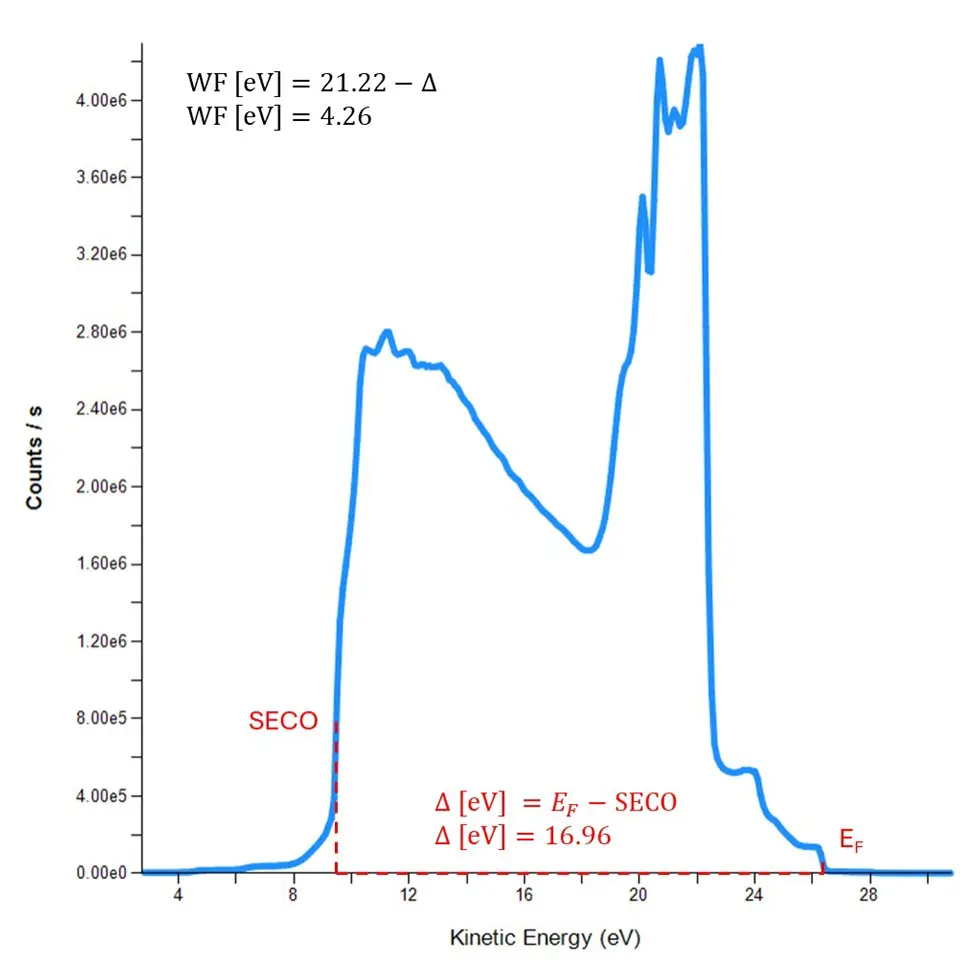
UPS spectrum gathered on a pure silver surface. This is a common reference material for WF measurements.
What we accept:
- Material Compatibility : UPS requires a high vacuum environment, so samples must be stable under those conditions. A typical sample is a flat solid, like a wafer coupon. Insulating surfaces may produce incorrect results due to surface charge accumulation and should be grounded during the measurement if possible. Surface cleanliness is a requirement, so care should be taken in sample handling. Typical lateral sample size is 1×1 cm, and maximum size is 6×6 cm.
- Spatial Resolution: The spatial resolution of the tool is not well characterized. The probe is estimated to be ~2 mm wide. This should be considered a limitation for small feature targeting, and mapping may not be feasible or practical.
- Depth Profiling: Depth profiling is possible with UPS, but requires a very cautious approach, and may not work for many materials. Typically, depth profiling is performed with a monoatomic Argon beam. This effectively removes material at a nms-per-minute pace, but damages and mixes the material during the etch, causing chemical changes, and varying the WF and DOS of the remaining material. Depth profiling may be possible with alternation between monoatomic and cluster argon beam usage, wherein the latter would be used to remove a thin layer of damage and recover a ‘pristine’ surface, but this often requires experimentation.
Use Cases

Semiconductor Manufacturing
In-situ UPS in fabrication chambers measures work function and ionization energy at metal/metal and metal/semiconductor junctions, enabling determination of Schottky barrier height and built‑in potential, which directly drive device performance.

Academic Research
UPS is used to study the electronic properties of semiconductor materials and layered structures, including work function, ionization energy, and phenomena such as Schottky junction behavior and Fermi level pinning.
Complementary Techniques
- UPS and XPS can be used complementarily to understand the chemical composition, bonding environment, and electronic structure of surface materials.
- UPS and XPS can both provide work function, but UPS has a much higher signal-to-noise ratio and higher energy resolution. UPS provides richer information about valence states in general. However, UPS is more likely to induce surface chemistry changes, and XPS can be used to distinguish surface dipole effects by adding measurements of core electron energies. Overall, UPS is recommended for WF analysis.
- UPS and KPFM can both provide work function, but again, UPS is a higher resolution instrument, and provides work function as an absolute measure (after calibration), whereas KPFM requires accurate knowledge of the probe work function, which can be altered during this experiment, especially in the case of unclean surfaces. KPFM excels in measuring small target (nm-to-um range).
X-ray Photoelectron Spectroscopy (XPS)
Measures surface elemental composition and chemical states. Explore
Why Choose Covalent for Your UPS Needs?
Frequently Asked Questions
Identifying the right test can be complex, but it doesn’t have to be complicated.
Here are some questions we are frequently asked.
What’s the precision of a UPS work function? How do I know the analysis is reliable?
Covalent uses a silver calibration standard before every UPS WF measurement. This standard has a work function of 4.26 eV. It ensures that our measurements of WF are consistent and correct. Variations on the sample surface, or poor surface preparation, can provide unexpected results. Typically, error bars of +/- 0.15 eV are expected for UPS WF measurements.
What are the main applications of UPS?
UPS is most often used to study the work function of semiconductor systems. Atomically clean surfaces can be inspected for work function, which can then provide information about Schottky barrier heights.
What sample preparation is needed for UPS experiments?
Because the mean free path of photoelectrons generated and detected with UPS is so small, UPS can only measure the material at the top ~2 nm of a sample surface. Any contamination on the sample surface, even a monolayer of adsorbed atmospheric carbon, can create extra photoelectrons that can confuse the signal from underlying materials. Samples should be fabricated in a clean environment and transported either in vacuum or ultraclean metal foil packaging to avoid contamination in UPS experiments. The Nexsa’s cluster ion gun is effective at cleaning some organic material from surfaces, but should not be exclusively relied on.
Can UPS be used for polymers and organic materials?
Yes, UPS can be used to study polymers and organic materials. If the polymer is non-conductive, it must be nanoscopically thin to allow charge compensation during the experiment. If conductivity, cleanliness, and stability requirements are met, polymers and organics can be studied for their electronic properties similarly to other materials.
How is quantitative analysis performed in UPS?
UPS is not typically used to assess the amounts of electrons that occupy individual states.
.

Resources