
What Is White Light Interferometry (WLI)?
WLI is a non-destructive, non-contact, optical profilometry measurement that uses coherence scanning interferometry to generate 3D models of surface height. White light interferometry is an optical profilometry technique with excellent height resolution that works with reflected light off the sample surface, which interferes with the reference beam to form a narrow coherence envelope. This process allows for sub-nanometer vertical resolution in constructing full 3D surface maps.

High Precision
High Precision
Measures surface topography with sub-nanometer vertical and
sub-micron lateral resolution.

Comprehensive Profiling
Comprehensive Profiling
Quantifies step height, flatness, surface roughness, and particle dimensions.

Non-Destructive & Non-Contact
Non-Destructive and
Non-Contact
Ideal for delicate or valuable samples requiring repeatable analysis.
Why Use WLI?
- WLI surface profilometry is a non-destructive, non-contact measurement with excellent height resolution.
- WLI captures a range of measurements, including step height, flatness, surface roughness, particle sizing, and examining features from etched or photolithography processes.
- WLI interferometry services have found use for semiconductors, materials science, biomedical, and precision manufacturing.

High-Resolution Mapping
WLI surface profilometry delivers 3D height maps with <1 nm vertical and <1 µm lateral resolution.

Optimal Use
Best for examining small features on flat, reflective surfaces.

Instrument Capability
Zygo Zegage Plus captures up to 8 × 8 mm FOV in a single frame with sub-nanometer height precision.


Working Principle
WLI works with a beam-splitter that divides a white light beam into two optical paths, one that reflects or scatters from the sample and one from a flat, known reference mirror. When mixed, the two beams form an interference pattern whose intensity can be related to the sample surface height: any difference in optical path length between the reference and sample beams changes the measured interference intensity at each scanned point, providing a measure of the height variance in the sample.
Equipment Used for WLI:
Zygo Zegage Plus
- Magnification Range: 1x to 20x.
- Surface Topography Reproducibility: ≤ 0.15 nm.
- Optical Lateral Resolution: 0.52 μm.
- Step Height Accuracy: ≤ 3%.

Key Differentiators
Combines exceptional vertical resolution (<1 nm) with a large field of view (up to 8 × 8 mm) in a single frame—achieving both precision and scale unmatched by most other optical profilometry techniques.
Strengths
- Profiling the height of nanometer- or micron-scale surface features.
- Non-destructive and non-contact.
- Measuring feature dimensions, surface roughness and flatness.
Limitations
- Difficulty with very matte, transparent, or highly sloped surfaces.
- Based on the sample’s optical properties, dimensions, and resolution, use alternate techniques at Covalent for better results.


Unsure Whether WLI Is Right for You?
Find out whether WLI is the best choice for your high‑resolution surface profiling needs, from step height and roughness to micro‑feature inspection on flat, reflective samples.
Sample Information
WLI surface profilometry provides an output that is a 3D colormap of the sample surface, showing the measurements of any lateral features, vertical step heights, flatness, surface roughness, or feature height comparisons.
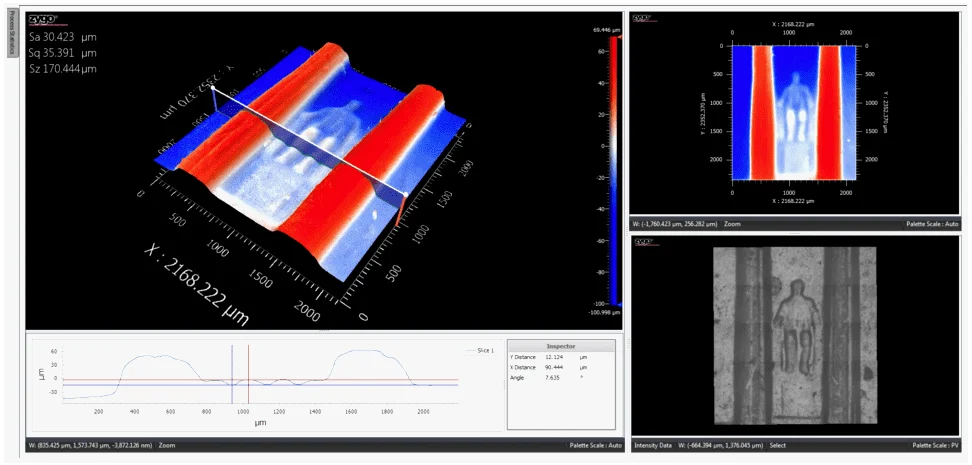
WLI can clearly visualize the figure of Lincoln sitting in his monument on the surface of a US 1-cent coin (barely visible with the naked eye).

WLI measurement of circuit board topography and features.
What we accept:
White Light Interferometry (WLI) works with samples in the solid phase with a maximum vertical height of 100 mm and a sample reflectivity of 0.05 – 100%.
Use Cases
Semiconductor
WLI is useful in many areas, including the semiconductor industry, for surface inspection of wafers and ICs. It measures step heights of features from deposition, photolithography, and etching, and surface roughness of polished wafers and deposited layers. It can also profile micro-defects and measure defect density.

Materials Science
White Light Interferometry is valuable in materials science for its versatile capabilities—offering precise 3D surface profiling, roughness analysis, and thickness measurements across diverse materials.
Complementary Techniques
- AFM: For zooming in on smaller features, we recommend using AFM.
- Chromatic Confocal Profilometry or Structure Light (VR) Profilometry: For zooming out to larger features or to map the distribution or density of features, use Chromatic Confocal Profilometry or Structured Light (VR) Profilometry.
- Laser Confocal Scanning Microscopy (LCSM): For a different view, depending on the surface finish and optical properties, use laser confocal scanning microscopy (LCSM).
- SAM or Micro-CT: For a look under the surface, SAM or micro-CT will be helpful.
- WLI and SEM: For an alternate look with improved lateral resolution, pair WLI with SEM.
Atomic Force Microscopy (AFM)
Maps nanoscale topography and material properties with a sharp probe. Explore
Chromatic Confocal Profilometry & 3D Surface Profiling
Fast, non-contact 3D surface measurements. Explore
Laser Scanning Confocal Microscopy (LSCM)
Non-destructive 3D imaging of sample surfaces. Explore
Scanning Acoustic Microscopy (SAM)
Locates internal flaws like cracks, voids, and delamination. Explore
Scanning Electron Microscopy (SEM)
Images surface topography and composition with electrons. Explore
X-ray Computed Tomography (Micro-CT)
Non-contact, non-destructive 2D/3D images at micron scale. Explore
Why Choose Covalent for Your White Light Interferometry Needs?
Frequently Asked Questions
Identifying the right test can be complex, but it doesn’t have to be complicated.
Here are some questions we are frequently asked.
What is the vertical resolution in Z?
The vertical resolution in Z is less than 1nm, and surface topography reproducibility is 0.15 nm. Covalent has AFM tools available for finer vertical resolution.
What is the largest sample area you can measure with WLI interferometry services?
With our low-NA objective, WLI interferometry services capture up to an 8 x 8 mm area within a single field of view, with roughly 10μm lateral (XY) resolution. Higher NA objectives can profile areas on the order of 1 mm^2 at 1µm lateral (XY) resolution. Sample sizes larger than 8 x 8 mm can be covered with multiple scans and stitched together for a seamless result. Covalent has other tools available for larger areas.
Is WLI surface profilometry a good fit for my needs?
Reach out to us and let’s discuss! Tell us a bit about your sample and what you are trying to learn, and we can provide a free consultation and prescribe the right mix of measurements to get you the answers you need.

Resources